

You now see 3d printing trends shaping 2026 with unprecedented momentum. Recent industry reports reveal that global awareness of additive manufacturing has soared to 71%. In China, you find awareness at 84%, while the U.K. stands at 73%. Adoption rates have climbed to 29%, reflecting a clear shift from novelty to parity with traditional manufacturing. You witness 3d printers powering transformation across healthcare, aerospace, and automotive sectors, driving innovation and redefining production standards.
Key Takeaways
-
3D printing is now a mainstream manufacturing method, enhancing flexibility and reducing costs across industries.
-
Sustainable materials and recycling are crucial for the future of 3D printing, helping to minimise environmental impact.
-
AI and automation are transforming 3D printing, optimising processes and improving product quality.
-
Multi-material printing allows for innovative designs, combining different materials in a single print for enhanced functionality.
-
Distributed manufacturing networks enable localised production, reducing lead times and supporting on-demand manufacturing.
3D Printing Trends in 2026
Industry Shift to Mainstream
You now see additive manufacturing moving beyond its early reputation as a niche technology. Today, you encounter 3d printing as a core part of industrial production, not just a tool for prototyping. This transition has reshaped how you approach manufacturing, especially in sectors where flexibility and speed matter most. The mainstreaming of 3d printing has transformed production volumes and product diversity. In defence, for example, you no longer rely solely on traditional supply chains. You can manufacture low-to-medium volumes and customise products without extra costs. This shift enables you to print parts on demand, reducing lead times and operational expenses. The agility and flexibility of additive manufacturing foster innovation and expand the range of products you can create.
Note: Industry analysts have identified the top five 3d printing trends for 2026. You should pay attention to these developments as they will shape your business strategies and technical decisions.
-
Industrial Scale AM Goes Mainstream
-
Materials Innovation and Sustainability in Focus
-
Automation, AI and the Digital Thread
-
Emerging Processes and Multi-Material Printing
-
Distributed Manufacturing and Supply Chain Reinvention
You notice the impact of these trends across several sectors. The following table highlights where you see the most significant changes:
|
Sector |
Impact Description |
|---|---|
|
Defence |
Recognised as critical infrastructure, affecting design, validation, production, and maintenance standards. |
|
Aerospace |
Integration of 3d printing in engines and components, with successful testing of 3d-printed rocket parts. |
|
Construction |
Focus on sustainable materials and large-scale applications, reflecting a shift towards a circular economy. |
Distributed Manufacturing Networks
You now operate in a landscape where distributed manufacturing networks are redefining how you produce and deliver goods. Automation Alley’s Project DIAMOnD has introduced a marketplace that lets you submit 3d printing jobs securely and collaborate with other manufacturers. This platform protects intellectual property and has already produced over 50,000 parts, proving the value of localised production.
Assembrix offers cloud-based software that connects you to a global network of 3d printers. You can submit jobs remotely and monitor progress in real time. This system allows you to scale production efficiently, without heavy investment in new equipment. You benefit from high security and compatibility, supporting your shift to on-demand manufacturing.
You see distributed networks facilitating high-mix, low-volume production, especially in aviation. The following points illustrate how this model supports your operations:
-
AM Craft holds EASA Part 21G Production Organisation Approval, enabling delivery of certified, airworthy parts.
-
The distributed model matches the needs of airlines, MROs, and OEMs, strengthening the supply chain for aviation components.
-
Partnerships between Stratasys and AM Craft use technical expertise to produce certified aviation parts, addressing the challenge of supplying low volumes and high variety.
-
You achieve cost-effective production and localisation, meeting specific customer requirements in maintenance hubs.
-
Additive manufacturing solves the problem of supplying minor parts in the aviation aftermarket, where low volume and high mix are common.
-
AM Craft’s certification process eases the burden on end customers, streamlining operations and ensuring compliance.
You now find yourself at the centre of a manufacturing revolution. Distributed networks and additive manufacturing empower you to respond quickly to market demands, reduce costs, and deliver customised solutions. These advances position you to lead in a world where agility and innovation define success.
Advances in 3D Printers and Technology
Laser Powder Bed Fusion (LPBF)
You now rely on Laser Powder Bed Fusion as a cornerstone of industrial 3d printers. This technology delivers exceptional mechanical properties and high accuracy, making it ideal for robust parts in aerospace and automotive sectors. LPBF achieves ultimate tensile strengths between 1110 and 1135 MPa, surpassing many traditional methods. You benefit from reduced build times—up to 76%—and see annual profit increases reaching 259%. The following table highlights key performance metrics and adoption aspects:
|
Metric |
Value/Impact |
|---|---|
|
Ultimate Tensile Strength |
1110 - 1135 MPa |
|
Reduction in Build Time |
Up to 76% |
|
Increase in Annual Profit |
Up to 259% |
|
Build Time Reduction |
31.2% to 34.6% |
|
Profit Increase |
One-third to 259% |
LPBF suits small to medium production runs, with costs ranging from $80K to $1M. You find high geometrical complexity and short lead times attractive, though you must manage bottlenecks such as build rate and process parameter interactions. Compared to other metal 3d printing technologies, LPBF offers a balance between cost and scalability.
Swarm Printing Collaboration
You now see swarm printing collaboration transforming how you deploy 3d printers in manufacturing. By coordinating multiple machines, you achieve rapid production and distributed sensing. Swarm printing supports applications such as search and rescue, environmental monitoring, and planetary exploration. The table below outlines key benefits:
|
Application |
Benefit |
|---|---|
|
Rapid deployment of robots for locating survivors |
|
|
Environmental monitoring |
Distributed sensing for monitoring large areas |
|
Explosive ordnance disposal |
Safe handling of dangerous materials |
|
Planetary exploration |
Swarms for exploration tasks on other planets |
Low-cost platforms and collaborative working approaches enhance efficiency and reduce operational costs. Proof-of-concept demonstrations validate the practicality of swarm technology, encouraging you to adopt these methods for large-scale operations.
Hybrid Manufacturing Integration
You now integrate hybrid manufacturing to optimise your workflows. This approach combines 3d printers with traditional methods, amplifying productivity and improving product quality. You experience a mature understanding of human-machine collaboration, with breakthroughs in material science and immersive technology changing how you design and manufacture products. The convergence of AI and robotics enhances operational efficiency and reduces human error. Autonomous machines and smart equipment optimise your supply chain processes. The following outcomes demonstrate the impact:
-
Reduction in conversion cost by 40%
-
Reduction in costs due to poor quality by 20%
-
Reduction in work-in-process inventory by 30%
-
Amplified productivity through automation of repetitive tasks
-
Enhanced quality control via real-time monitoring and defect identification
You now find additive manufacturing and 3d printing at the heart of these advances, driving innovation and efficiency across industries.
Multi-Material and Metal Printin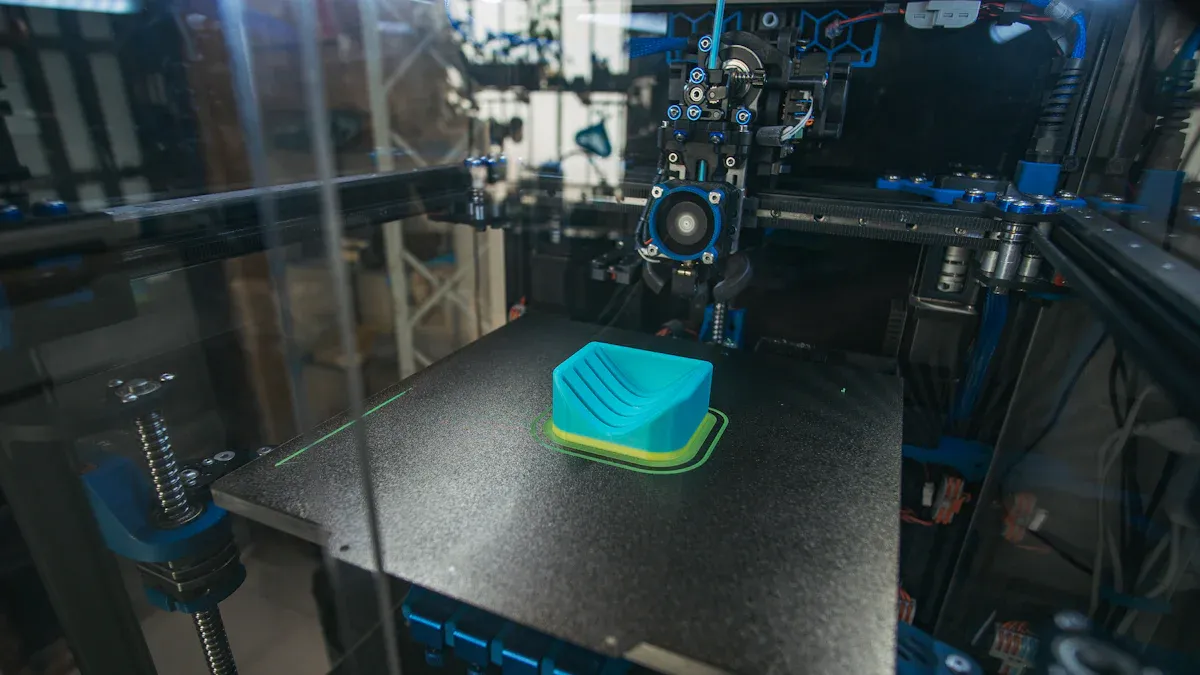
Mainstream Multi-Material Printing
You now harness multi-material 3d printing to unlock new design possibilities and product functionalities. Designers can produce components with a range of colours, textures, and finishes in a single print, which enhances visual appeal and reduces the need for post-processing. In healthcare, you create anatomical models with varied colours and textures, making them easier to interpret for medical professionals. You combine materials with different characteristics—rigid, flexible, transparent—within one print, optimising each material’s placement for its intended function. This approach leads to more efficient and functional designs, as you no longer need to manufacture separate components. You also minimise assembly by integrating multiple features into a single part, which reduces labour and production costs. Software tools now give you greater control over geometry and material distribution, allowing you to define material transition zones directly in your CAD models.
-
Create visually striking components with multiple colours and finishes.
-
Combine rigid and flexible materials for enhanced product performance.
-
Reduce assembly steps by printing integrated parts.
Metal 3D Printing Growth
You see metal printing expanding rapidly across key industries. Aerospace, healthcare, automotive, and energy sectors drive this growth, demanding high-performance parts with complex geometries. You produce lightweight aircraft components, custom medical implants, and intricate automotive parts with improved durability. The ability to print metals directly enables you to meet strict industry standards and accelerate innovation.
-
Aerospace: Manufacture lightweight, strong aircraft parts.
-
Healthcare: Produce custom implants and surgical tools.
-
Automotive: Create durable, complex components for vehicles.
-
Energy: Develop efficient parts for power generation.
Industrial 3D Printing Applications
You apply industrial 3d printing across a wide range of sectors. The following table highlights common applications in 2026:
|
Industry |
Applications |
|---|---|
|
Aerospace |
Manufacture of composite layup tooling, jigs, and moulds for aircraft components. Ideal for lightweight and large structures. |
|
Automotive |
Used for rapid prototyping, EV parts, battery casings, and custom tooling. Speeds up design cycles for electric mobility. |
|
Marine |
Supports large hull segments and moulds for boats and yachts, handling complex curves in design. |
|
Construction |
Utilised for custom panels, formworks, and architectural moulds, allowing high precision printing on-site or off-site. |
|
Defence |
Benefits from large tooling and rapid deployment components for various applications. |
|
Industrial Manufacturing |
Used for jigs, fixtures, and production aids to enhance manufacturing processes. |
You measure the return on investment by analysing time and labour savings, accuracy improvements, error reduction, and scalability. Automated systems reduce scanning time and improve efficiency. Advanced technology delivers higher precision, while robotic scanning minimises human error. You scale production to meet growing demand and reduce lead times from weeks to hours.
Sustainable 3D Printing Applications
Eco-Friendly Materials
You now see sustainability as a driving force in 3D printing. You choose sustainable and recyclable materials to reduce your environmental footprint and support a circular economy. Recent materials innovation has brought new options to your workflow. You can select recycled plastics, plant-based plastics, and even waste streams from food containers and drinks bottles. These choices help you address the challenge of sustainability in manufacturing.
|
Material Type |
Description |
|---|---|
|
Recycled Plastics |
Up to 100% recycled content in FDM plastics |
|
Waste Streams |
Utilises waste from plastic food containers and drinks bottles |
|
Plant-Based Plastics |
100% plant-based plastics that are biodegradable and compostable |
You also use eco-friendly calcium carbonate structures for coral reef restoration. Researchers at KAUST have developed 3D printed structures that mimic natural coral skeletons, supporting marine life and promoting sustainability. You can rely on Matrix PA12 CR, an eco-friendly material that maintains quality and reliability. When you compare eco-friendly materials to traditional options, you find that they offer high customisation for low volumes and lower environmental impact. You see that these materials are more cost-effective for small production runs and support your sustainability goals.
Recycling and Circular Production
You now embrace recycling and circular production as essential strategies for sustainability. You transform waste into valuable products, closing the loop in your manufacturing process. Projects such as The New Raw allow you to turn household plastic waste into urban furniture using robotic machines. EOOS demonstrates how you can create a 3D printed tricycle from supermarket waste, showing the potential of sustainable and recyclable materials in transport.
|
Project Name |
Description |
Key Strategy |
|---|---|---|
|
The New Raw |
Transforms plastic waste into everyday objects using robotic machines. |
Urban furniture from household waste. |
|
EOOS |
Created a 3D printed tricycle from supermarket waste. |
Utilises waste to create functional transport. |
|
Azur Printed Homes |
Produces homes from recycled plastic, aiming to reduce landfill waste. |
Sustainable construction using recycled materials. |
|
R3direct |
Creates 3D printed objects from 100% recycled post-consumer plastic. |
Focus on sustainability and longevity of products. |
|
Yuma Labs |
Produces sunglasses from recycled plastic collected at festivals. |
Recycling festival waste into consumer products. |
You see Azur Printed Homes using recycled plastic to build sustainable homes, reducing landfill waste and supporting community resilience. R3direct focuses on sustainability and product longevity by using 100% recycled post-consumer plastic. Yuma Labs turns festival waste into sunglasses, showing how you can create consumer products from recycled materials. You understand that these approaches not only support sustainability but also inspire new business models.
You recognise that sustainable and recyclable materials play a vital role in the future of 3D printing. You see the potential to print artificial tissues for medical applications, using eco-friendly materials that align with your sustainability objectives. You also explore how 3D printing can help regenerate coral tissues, supporting marine ecosystems. As you adopt these practices, you lead the way in sustainability and set new standards for responsible manufacturing.
Large-Scale 3D Printing Applications
Construction and Infrastructure
You now see 3d printing in construction transforming how you approach building projects. You can deliver homes and infrastructure faster, with less waste and greater design freedom. Large-scale printing allows you to create complex shapes and custom features that traditional methods cannot match. You reduce construction time by up to 70%, which means you can respond quickly to urgent housing needs or disaster recovery.
You also minimise labour dependency through automation and on-site printing. This shift lowers costs and reduces risks linked to workforce shortages. You use eco-friendly materials, supporting green initiatives and sustainable development.
Here are some recent examples of 3d printing in construction and infrastructure:
|
Project Name |
Location |
Description |
|---|---|---|
|
Wolf Ranch |
Georgetown, Texas, USA |
100 3D-printed houses completed from November 2022 to August 2024. |
|
Mehrfamilienhaus Wallenhausen |
Bavaria, Germany |
Three-storey building with five apartments, total area of 380 square metres. |
|
Zuri Gardens |
Houston, USA |
80 middle-class homes supported by the Affordable Home Development Program. |
|
TECLA |
Massa Lombarda, Italy |
House printed from local clay, focusing on biodegradability and a closed material cycle. |
-
Mvula Gardens in Kenya stands as Africa’s largest 3d printing in construction project, with 52 houses built to address housing shortages.
-
The Canal House project in Amsterdam explores the potential of 3d printing applications for classic architecture.
You gain design flexibility, enabling you to create unique architectural elements. You also drastically lower material wastage, making construction more sustainable and cost-effective.
End-Use Parts Production
You now use large-scale printing to produce end-use parts directly for infrastructure and industry. You print bridges, façade panels, and structural components that meet strict safety and durability standards. This approach lets you bypass traditional supply chains and manufacture parts on demand, reducing storage costs and lead times.
You see 3d printing applications expanding into public infrastructure, such as pedestrian bridges and bus shelters. You can customise each part for its location, climate, or function. You also support rapid urban development by printing components off-site and assembling them quickly on location.
Tip: You can use sustainable materials in end-use parts production, aligning your projects with environmental goals and regulatory requirements.
You now lead the way in construction by adopting 3d printing in construction for both buildings and infrastructure. You set new standards for speed, efficiency, and sustainability in the built environment.
3D Printing in Healthcare
Bioprinting Breakthroughs
You now see 3d printing in healthcare driving remarkable progress in bioprinting. You can create functional tissue structures using elastic hydrogel materials, which support the fabrication of soft living tissues such as blood vessels. Cellular matrices, including autologous mesenchymal stem cells, enable effective bone reconstruction and open new possibilities for regenerative medicine. Cellulose-based inks offer versatility for drug discovery and tissue engineering, allowing you to adapt to various clinical needs.
|
Breakthrough |
Description |
|---|---|
|
Elastic Hydrogel Materials |
Designed for 3D printing of soft living tissues, such as blood vessels. |
|
Cellular Matrices |
Incorporation of functional cells for bone reconstruction. |
|
Cellulose-based Inks |
Versatile materials for drug discovery and tissue engineering. |
You now use advanced bioprinting techniques to produce scaffolds with controlled pore sizes, ensuring nutrient diffusion and cell viability. Extrusion-based bioprinting lets you build these scaffolds efficiently. Inkjet-based bioprinting provides precise deposition of bioinks, forming complex tissue structures. Stereolithography-based bioprinting achieves high-resolution prints that mimic natural tissues. You also benefit from in vitro models that simulate drug safety and patient-specific responses, helping you select the most effective treatments and reduce side effects.
Personalised Medical Devices
You now rely on 3d printing in healthcare to deliver personalised medical solutions. You design custom implants and prosthetics tailored to individual anatomy, improving patient outcomes and comfort. You see rapid prototyping and production of devices that match each patient’s unique requirements. This approach reduces waiting times and enhances the quality of care.
Regulatory agencies now address the challenges of bioprinting and personalised medical devices by forming working groups of researchers, clinicians, and policymakers. You follow robust production methodologies and characterisation standards to ensure biomaterials meet safety criteria. You also see strengthened ethical frameworks and digital security for cell therapies, protecting patient information and supporting responsible innovation.
You must consider the future potential and ethical implications of bioprinting living tissues. As you adopt these technologies, you shape the next generation of healthcare, balancing innovation with patient safety and privacy.
Future of 3D Printing
AI and Automation
You now stand at the forefront of the future of manufacturing, where artificial intelligence and automation drive the evolution of 3d printing. You see AI-powered algorithms optimising print parameters, predicting failures, and enhancing quality control. You use machine learning to analyse vast datasets, which helps you refine designs and reduce waste. You rely on automated workflows to streamline production, allowing you to focus on innovation rather than repetitive tasks. Next-generation printers incorporate robotics, enabling you to scale operations and maintain consistency across distributed manufacturing networks. You benefit from predictive maintenance, which minimises downtime and extends equipment lifespan. You also witness AI-driven inspection systems that ensure every part meets strict standards. These advances position you to deliver groundbreaking applications in aerospace, healthcare, and automotive sectors.
Tip: You can leverage AI to automate design validation and accelerate prototyping, giving you a competitive edge in the future.
Software and Design Tools
You now use advanced software and design tools to unlock the full potential of 3d printing in the future. You access cloud-based platforms that support collaborative design, enabling you to work with global teams in real time. You employ generative design software, which creates optimised structures based on performance requirements. You manipulate complex geometries with intuitive interfaces, making it easier to realise ambitious concepts. You integrate simulation tools to predict how materials will behave under stress, ensuring reliability before production begins. You rely on digital twins to monitor and adjust manufacturing processes, improving efficiency and reducing errors. The table below highlights key features you find in modern design tools:
|
Feature |
Benefit |
|---|---|
|
Generative Design |
Optimises structures for strength |
|
Simulation |
Predicts material performance |
|
Cloud Collaboration |
Enables global teamwork |
|
Digital Twins |
Enhances process control |
You now prepare for the future by adopting these tools, which empower you to create innovative products and respond quickly to market demands. You see software and design platforms evolving rapidly, supporting the next wave of manufacturing transformation.
You have seen how 3D printing now drives change in manufacturing, healthcare, and construction. You use advanced materials, distributed networks, and AI-powered tools to create new solutions. You shape the future with sustainable practices and personalised products.
Stay informed and keep exploring new 3D printing innovations. You hold the power to lead your industry into a smarter, more agile era.
FAQ
What sectors benefit most from 3D printing in 2026?
You see aerospace, healthcare, automotive, and construction leading adoption. These sectors use 3D printing for rapid prototyping, custom parts, and sustainable solutions. You notice increased efficiency and innovation across these industries.
How does 3D printing support sustainability?
You choose eco-friendly materials and recycling methods. You reduce waste by printing only what you need. Projects in construction and consumer goods show how you can support a circular economy and lower your environmental impact.
What role does AI play in modern 3D printing?
You rely on AI to optimise print settings, predict failures, and automate quality checks. AI-driven systems help you improve accuracy, reduce downtime, and streamline production. You gain a competitive edge in the additive manufacturing market.
Can you print with multiple materials in one process?
You use advanced printers to combine rigid, flexible, and transparent materials in a single print. This capability lets you create complex products with varied properties, reducing assembly steps and enhancing design flexibility.
Are 3D-printed medical devices safe and regulated?
You follow strict standards and regulatory guidelines. Agencies work with clinicians and researchers to ensure safety and quality. You see robust frameworks for biomaterials and digital security, protecting patient data and supporting responsible innovation.
Share:
Sovol SV08 Max Review: Is This 500×500×500mm CoreXY 3D Printer Worth It?
Why 3D printers are perfect for families