
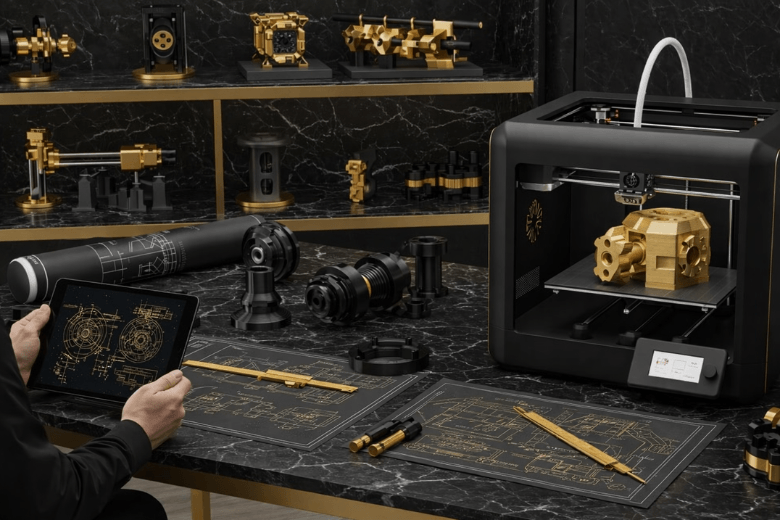
You experience immediate benefits when you adopt 3D printing in engineering. The technology enables you to save time by producing prototypes in hours rather than weeks. You no longer wait six weeks for machined fixtures, as FDM-printed templates are ready in two days.
Senior Design Engineer Tony notes, “Now we are able to print an item within a day or two, making the process less time consuming.”
You see time savings and cost reductions through rapid in-house prototyping. The following table highlights typical savings:
|
Method |
Cost Savings |
Time Savings |
|---|---|---|
|
3D Printing (Tooling) |
Upwards of $100,000 |
Less than a day |
|
3D Printing (Parts) |
$180 (from $200) |
2 days (from 2 weeks) |
|
Machining (Parts) |
Hundreds of dollars |
N/A |
You will find practical examples and scenarios throughout this blog to illustrate how 3D printing accelerates workflows and increases efficiency.
Key Takeaways
-
3D printing significantly reduces prototyping time, allowing you to create functional prototypes in hours instead of weeks.
-
Adopting 3D printing lowers production costs by minimising material waste and eliminating the need for expensive tooling.
-
You can quickly iterate designs without the delays of traditional methods, enabling faster feedback and improved decision-making.
-
Using 3D printing for jigs and fixtures streamlines manufacturing preparation, saving time and enhancing production efficiency.
-
Integrating 3D printing into your workflow can simplify logistics, reduce warehousing needs, and lower shipping costs.
Rapid Prototyping with 3D Printing
Speeding Up Design Cycles
You can transform your approach to product development by adopting 3d printing for rapid prototyping. This technology enables you to produce functional prototypes in hours, not weeks, which means you can reduce prototyping cycle time and accelerate your entire workflow. Mark Sanders, Senior Production Engineer, highlights that 3d printing allows you to create components rapidly, giving you the ability to test and refine designs without delay.
You will find 3d printing used across a wide range of engineering applications:
-
In civil engineering, you can create intricate scale models of buildings and infrastructure projects, supporting both visualisation and planning.
-
In aerospace, you can design and test complex components such as turbine blades and wing attachments, ensuring performance before committing to full-scale production.
-
In the automotive sector, you can develop and evaluate intricate parts, which helps you drive faster innovation and maintain a competitive edge.
MagCAD Designs demonstrates the power of 3d printing in their product development process. They use 3d printed prototypes to quickly develop, test, and validate components, which leads to shortened development cycles and reduced upfront investment. British Cycling’s partnership with Renishaw shows how additive manufacturing can enhance design efficiency and innovation in competitive sports, enabling you to quickly adapt to market demands.
You benefit from faster feedback at every stage. With 3d printing, you can move directly from a CAD file to a physical prototype, bypassing the delays and costs associated with traditional tooling. This approach supports material versatility for prototyping, allowing you to select the best material for each application and further enhancing design flexibility.
Tip: Use 3d printing to produce functional prototypes early in your process. You will identify design flaws and opportunities for improvement before investing in expensive tooling.
Multiple Iterations Without Tooling
You gain a significant advantage when you eliminate the need for new tools or moulds during the prototyping process. Traditional methods require you to wait for tooling, which slows down development and increases costs. With 3d printing, you can produce multiple iterations of your design rapidly, making frequent revisions based on testing and validation.
-
You can achieve quick iterations and immediate feedback, which is ideal for fast design cycles.
-
You avoid lengthy lead times and high costs, which are common with traditional prototyping.
-
You benefit from material versatility for prototyping, as you can switch materials easily to test different properties and functions.
CNC machining also supports rapid transitions from CAD models to prototypes, but 3d printing offers even greater flexibility. You can make adjustments without significant sunk costs, which is essential for efficient learning and adapting designs. This flexibility supports enhancing design flexibility and helps you drive faster innovation in your projects.
You will notice that 3d printing enables you to reduce prototyping cycle time and deliver functional prototypes that closely match final products. This capability ensures you receive faster feedback, which leads to better decision-making and more successful outcomes.
Note: By leveraging 3d printing for prototyping, you empower your team to innovate rapidly and respond to challenges with agility.
Save Time in Engineering Workflows
Faster Production of Jigs and Fixtures
You can streamline your manufacturing preparation by using 3d printing for jigs and fixtures. Traditional methods often require long lead times and expensive tooling. With 3d printing, you update your CAD design and produce a new fixture within hours. This approach allows you to save time at every stage of the process.
|
Benefit |
Explanation |
|---|---|
|
Quick updates and reprinting |
You can modify CAD files and print new jigs rapidly, reducing engineering time. |
|
Easy adjustment or reconfiguration |
You adjust fixtures without waiting for new tools, which helps you save time. |
|
Reduced setup times |
3d-printed fixtures enable fast changeovers, improving production efficiency. |
|
Shorter lead times |
You gain better control over production schedules and avoid unnecessary delays. |
You benefit from the flexibility to adapt your fixtures as your project evolves. This capability supports high-volume environments and ensures you maintain productivity without sacrificing quality.
Reduced Lead Times for Custom Parts
You can reduce lead times for custom parts by integrating 3d printing into your engineering workflows. This technology enables you to move from design to finished part in a single location, which helps you save time and accelerate product development. In the energy sector, for example, you can design and manufacture parts quickly, allowing you to explore new ideas and bring innovations to market faster.
3d printing supports on-demand production, so you avoid warehousing costs and produce only what you need. You can create a prototype in the morning and test it by the afternoon. This rapid turnaround means you spend less time waiting and more time optimising your designs.
-
You eliminate the need for expensive tooling.
-
You reduce upfront costs for prototyping.
-
You gain the ability to customise parts for specific requirements.
Matter’s use of 3d printing demonstrates how you can produce prototypes and make revisions on the same day. This process minimises post-processing and allows you to focus on product development rather than waiting for external suppliers. By adopting 3d printing, you empower your team to save time, improve efficiency, and deliver better results in every engineering project.
Efficient Logistics and Cost Reduction
Minimising Warehousing and Shipping
You can transform your logistics strategy by adopting additive manufacturing. This approach allows you to produce spare parts and components on demand, which reduces the need for large warehouses and complex inventory systems. You no longer need to store thousands of parts for years. Instead, you keep digital files and print what you need, when you need it. This shift leads to significant savings in storage and shipping costs.
-
Manufacturers now produce aftermarket components only as required, which lowers inventory expenses.
-
Automotive divisions use 3d printing for vintage model spare parts, making small-batch production economical and reducing warehousing needs.
-
You can store inventory digitally, which shortens lead times and minimises physical storage requirements.
-
On-demand production eliminates the need for large warehouses, as you print parts as needed.
Additive manufacturing also streamlines your supply chain. You can localise production, which reduces the time and cost associated with transporting goods. Engineering firms have reported logistics cost reductions by decreasing shipments and inventory levels. For example, General Electric reduced the number of jet fuel nozzle components from 18 to one, which lowered transportation needs and improved manufacturing savings. Studies suggest that 3d printing could reduce road freight by 25%, with a significant impact on air and ocean cargo.
Tip: Use additive manufacturing to simplify your logistics and save money on warehousing and shipping.
Lower Material Waste in Engineering
You achieve greater efficiency and sustainability in engineering projects by using additive manufacturing. The layer-by-layer process ensures that you deposit material only where necessary, which minimises waste and maximises versatility. Traditional manufacturing methods often waste resources, but 3d printing uses only the material required for each part.
Recent advancements, such as dynamically controlled surfaces, have reduced material usage by 35% by eliminating the need for wasteful supports. This reduction translates directly into cost savings and supports sustainable practices. Additive manufacturing consumes less energy and produces fewer emissions compared to conventional methods. You benefit from localised production, which further reduces shipping emissions and environmental impact.
-
Reduced material waste: Additive manufacturing minimises waste by using an additive process.
-
Energy efficiency: You consume less energy than with traditional manufacturing.
-
Localised production: You produce parts on demand, which cuts down on shipping emissions.
-
Customisation and optimisation: You create tailored parts, reducing the need for replacements.
-
Prototyping for sustainability: You test eco-friendly designs before full production.
You gain versatility in material selection and design, which supports both prototyping and final production. By adopting additive manufacturing, you not only achieve manufacturing savings but also contribute to a greener future. These practices help you save money, reduce waste, and enhance the versatility of your engineering workflows.
Challenges in 3D Printing for Engineering
Speed and Material Limitations
You encounter several challenges when you adopt additive manufacturing in engineering. One of the most significant issues is the speed of production. Printing large or complex parts can take hours or even days. This slow pace limits the scalability of additive manufacturing, especially when you need to meet tight deadlines or produce high volumes. In industries such as food production, slow printing speed remains a critical barrier to wider adoption.
Material limitations also affect your ability to use additive manufacturing for every application. The range of available materials is not as broad as with traditional manufacturing. Some high-performance materials come at a premium cost. You may find that certain 3d printing materials lack the mechanical strength, heat resistance, or durability required for demanding engineering tasks. Quality deficiencies, such as inadequate precision or surface finish, can require additional post-processing.
|
Challenge |
Description |
|---|---|
|
Fewer choices than traditional methods; high-performance materials can be expensive. |
|
|
Speed and Efficiency |
Printing large or complex parts can be slow, taking hours or days. |
|
Surface Finish and Accuracy |
Parts may need post-processing for smoothness and precision. |
|
Regulatory and Certification |
Meeting strict industry standards can be complex and time-consuming. |
|
Intellectual Property Concerns |
Digital files increase the risk of IP theft and unauthorised replication. |
-
Limited material options restrict your design freedom.
-
Some materials do not match the strength or durability of conventional parts.
-
Quality issues can impact the performance of your prototypes.
Note: You should always evaluate the material and speed requirements of your project before choosing additive manufacturing.
Workflow Integration Issues
Integrating 3d printing into your existing workflow presents its own set of challenges. Many simulation tools require specialised knowledge, which means you may need extra training for your team. Running simulations can take several hours, delaying your project timelines. You often find that simulation software does not integrate directly with additive manufacturing systems. This lack of integration forces you to export and import data between platforms, which slows down your process.
-
Software complexity increases the learning curve for your team.
-
Time-consuming simulations can delay prototyping and production.
-
Disconnected tools hinder workflow efficiency.
To address these issues, you can use a Business Process Map. This guide helps you identify potential barriers and assign tasks to the right team members. Some solutions include dedicated environments for model preparation, direct printer integration, and tools for validating printability. These features help you estimate build time and material usage, streamlining your additive manufacturing process.
Tip: Engage your team early and use process mapping to ensure smooth integration of additive manufacturing into your engineering projects.
You gain significant efficiency in engineering by adopting 3d printing. The technology accelerates prototyping, reduces waste, and enables innovative designs. Review the table below for key efficiency gains:
|
Efficiency Gain |
Description |
|---|---|
|
Faster Prototyping |
Rapid creation of prototypes speeds up development. |
|
Cost Savings |
Lower production costs through reduced waste and streamlined workflows. |
|
Unique parts and complex structures become achievable. |
-
You benefit from sustainable practices and on-demand production.
-
Explore educational resources to prepare future engineers for emerging technologies.
FAQ
What are the main advantages of using 3d printing in engineering?
3d printing accelerates prototyping, reduces costs, and allows for complex designs. It enables you to produce parts quickly, test ideas efficiently, and adapt designs with ease. This technology streamlines workflows and supports innovation across various engineering disciplines.
Can 3d printing replace traditional manufacturing methods?
While 3d printing offers flexibility and rapid prototyping, it does not fully replace traditional methods for mass production. Instead, it complements them by enabling quick iterations, customised parts, and on-demand manufacturing, especially for complex or low-volume components.
What materials are compatible with 3d printing?
A wide range of materials, including plastics, metals, and composites, are compatible with 3d printing. However, material choices depend on your application’s strength, heat resistance, and durability requirements. Advances continue to expand the options available for different engineering needs.
Are there limitations to using 3d printing in engineering?
Yes, speed and material restrictions can limit large-scale or high-performance applications. Some parts may require post-processing for finish and precision. Additionally, integrating 3d printing into existing workflows may need careful planning and specialised training.
How can I start integrating 3d printing into my engineering projects?
Begin by identifying suitable applications such as prototyping or custom parts. Invest in training and software tools that support your workflow. Collaborate with experienced providers to understand material options and optimise your process for efficient adoption.
Share:
Why CoreXY Matters and What It Means for Your 3D Prints
What Makes a 3D Printer Truly Fast? A 3D Printer Speed Explainer