

You encounter both remarkable benefits and notable challenges when you use 3d printers. The main pros and cons of 3d printing technology shape your decisions in manufacturing, healthcare, and design. For example, you gain flexible design, rapid prototyping, and reduced waste, yet you also face limits with materials and build size. The table below summarises the core advantages and disadvantages:
|
Advantages |
Disadvantages |
|---|---|
|
Flexible Design |
Limited Materials |
|
Rapid Prototyping |
Restricted Build Size |
|
Print on Demand |
Post Processing |
|
Strong, Lightweight Parts |
Large Volumes |
|
Minimising Waste |
Part Structure |
|
Cost Effective |
Reduction in Jobs |
|
Environmentally Friendly |
Design Inaccuracies |
3d printing improves efficiency and can lower costs, as seen with manufacturers redesigning processes for better output. You also help the environment by reducing energy use and emissions. Understanding the pros and cons of 3d printing allows you to make informed choices about adopting this innovative technology.
Key Takeaways
-
3D printing offers flexible design capabilities, allowing you to create complex shapes that traditional methods cannot achieve.
-
Rapid prototyping with 3D printing saves time and costs, enabling quick adjustments based on feedback.
-
Print on demand reduces inventory costs and supports customisation, making it ideal for urgent orders.
-
While 3D printing is cost-effective for small batches, it struggles with large-scale production due to slower speeds.
-
Understanding the limitations of 3D printing, such as material options and post-processing needs, helps you make informed decisions.
Pros and Cons of 3D Printing
Overview Table
You often weigh the pros and cons of 3d printing before adopting it for your projects. The following table gives you a quick reference to the main advantages and disadvantages:
|
Pros |
Cons |
|---|---|
|
Flexible design |
Limited material options |
|
Rapid prototyping |
Restricted build size |
|
Print on demand |
Post-processing required |
|
Strong, lightweight parts |
Slow for large batches |
|
Reduced waste |
Error vulnerability |
|
Less labour intensive |
High initial investment |
Tip: Use this table to quickly assess whether 3d printers fit your needs in terms of flexibility, speed, and cost.
3D Printing vs Traditional Methods
When you compare 3d printing with traditional manufacturing, you see clear differences in speed, cost, and material usage. 3d printing, also known as additive manufacturing, allows you to produce prototypes rapidly. You avoid the high tooling costs and long lead times that come with traditional methods. This makes 3d printing an agile and cost-effective solution, especially for small production runs.
|
FACTOR |
3D PRINTING |
TRADITIONAL |
|---|---|---|
|
VOLUME |
1-100 PARTS |
100+ PARTS |
|
SPEED TO MARKET |
FAST |
SLOW |
|
TOOLING COST |
NONE |
HIGH |
|
MATERIAL CHOICE |
LIMITED |
EXTENSIVE |
You eliminate upfront costs and minimise material waste with 3d printing. Traditional manufacturing offers a wider range of materials and suits large-scale production, but you face higher costs and slower turnaround. Many people believe 3d printing can replace all traditional methods, but the technology still has limits. For example, the construction industry remains in the early stages of adopting 3d printing. Some projects serve mainly as demonstrations, which can create unrealistic expectations about speed and feasibility.
Understanding the pros and cons of 3d printing helps you set realistic goals and choose the right approach for your needs.
Pros of 3D Printers
Flexible Design Capabilities
You gain remarkable design flexibility when you use 3d printing. This technology allows you to create complex geometries that traditional manufacturing cannot achieve. You can produce intricate lattice structures, internal channels, and organic shapes with ease. The accessibility of 3d printers makes them suitable for both large companies and those accessible to startups and hobbyists. You can quickly adjust designs without the need for expensive tooling, which enhances application versatility across industries. This flexibility supports innovation and enables you to respond rapidly to changing requirements.
Rapid Prototyping
You benefit from rapid prototyping, which transforms the way you develop products. 3d printing enables you to produce prototypes in hours, whereas traditional methods may take weeks. You save costs by eliminating the need for expensive moulds and tooling. The iterative nature of prototyping with 3d printing means you can make quick adjustments and reprint models based on feedback. This process improves part quality and reduces development time.
|
Aspect |
Description |
|---|---|
|
Speed |
Traditional methods can take weeks; 3D printing can produce models in hours. |
|
Cost-Effective |
Reduces costs by eliminating the need for expensive moulds and tooling. |
|
Iterative Improvements |
Allows for quick adjustments and reprints based on feedback. |
You see significant advantages in prototyping for industries such as automotive, aerospace, and consumer goods. The pros and cons of 3d printing often centre around how quickly you can move from concept to finished product. Rapid prototyping supports low-volume production and helps you test high-precision functional parts before committing to mass manufacturing.
Print on Demand
You experience greater accessibility and flexibility with print on demand. 3d printing allows you to produce parts only when needed, reducing inventory costs and storage requirements. This approach supports customisation and quick turnaround for urgent orders.
Badgemaster's collaboration with Photocentric to produce 30,000 customised badges quickly illustrates the effectiveness of 3D printing in meeting high-demand production needs without traditional tooling.
Food Ink showcases the potential of 3D printing in the culinary world by creating an immersive dining experience where all elements are produced through 3D printing, promoting a zero-waste approach.
Formlabs was able to mitigate supply chain issues during the pandemic by increasing print production at its facilities, demonstrating the effectiveness of 3D printing in maintaining production continuity.
New Balance utilised 3D printing to create custom soles for footwear, adapting to individual wearers' needs, which exemplifies the effectiveness of print on demand in the retail industry.
You see how print on demand supports application versatility, from manufacturing to food and retail. This capability helps you respond to market changes and customer preferences with speed and precision.
Strong and Lightweight Parts
You can produce strong and lightweight parts using advanced materials and technologies in 3d printing. Additive manufacturing offers you access to materials such as carbon fibre composites, titanium alloys, and aluminium alloys, which deliver high strength-to-weight ratios and resistance to environmental factors.
|
Material Type |
Properties |
Applications |
|---|---|---|
|
Carbon Fibre Composites |
Strong, lightweight, resistant to wear and heat, good electrical conductor |
Interior, structural, electrical parts |
|
Titanium Alloys |
High strength-to-weight ratio, temperature and corrosion resistant |
Structural and engine parts |
|
Aluminium Alloys |
Low weight, good conductivity, corrosion resistant |
Airframes, wings, structural parts |
|
Nickel Alloys |
High temperature and corrosion resistant |
Jet engines, exhaust systems |
|
Cobalt-Chrome Alloys |
Exceptional strength, durable, wear-resistant |
Landing gear in aircraft |
|
Stainless Steel |
Durable, corrosion-resistant |
Structural elements, engine components |
|
Advanced Ceramics |
Great wear and heat resistance, low outgassing properties |
Heat exchangers, turbine components |
-
Strength-to-weight ratios
-
Resistance to environmental factors
-
Durability and reliability in high-stress applications
You can select from several printing technologies to achieve high-precision functional parts:
-
Selective Laser Sintering (SLS)
-
Stereolithography (SLA)
-
Direct Metal Laser Sintering (DMLS)
These options allow you to tailor part quality to your specific needs, whether you require lightweight components for aerospace or durable parts for automotive applications.
Reduced Waste
You achieve significant waste reduction with 3d printing compared to traditional subtractive manufacturing. Additive manufacturing deposits material only where required, which leads to high material efficiency.
-
3d printers utilise only the material necessary for each part, leading to significant waste reduction compared to traditional methods.
-
Unlike subtractive manufacturing, which removes excess material, 3d printing deposits material precisely where needed, minimising waste.
You help conserve resources and reduce environmental impact by adopting 3d printing. This approach supports sustainability and aligns with modern manufacturing goals.
Less Labour Intensive
You find that 3d printing automates much of the production process, which significantly reduces the need for manual labour.
-
Automation leads to substantial cost savings, particularly in industries where precision and speed are critical, such as aerospace, medicine, and motorsport.
You can focus your workforce on design, innovation, and quality control rather than repetitive tasks. This shift increases efficiency and makes advanced manufacturing more accessible to startups and hobbyists.
Tip: When you consider the pros and cons of 3d printing, you see that the pros include flexibility, rapid prototyping, reduced waste, and less labour. These advantages make 3d printing a powerful tool for modern manufacturing.
Cons of 3D Printers
When you consider the cons of 3d printing, you encounter several limitations that can affect your decision to adopt this technology. Understanding these disadvantages of 3d printing helps you weigh the pros and cons and make informed choices for your business or personal projects.
Slow for Large Batches
You may find that 3d printing excels at producing prototypes and small batches, but it struggles with large-scale production. The process builds objects layer by layer, which means printing hundreds or thousands of identical parts takes much longer than traditional manufacturing. If you need high-volume output, additive manufacturing often cannot match the speed or efficiency of injection moulding or casting. This limitation makes 3d printers less suitable for mass production environments, where time-to-market and cost per unit are critical.
Note: For large batches, traditional methods remain more cost-effective and efficient due to their ability to produce many parts simultaneously.
Build Size Limitations
You face build size limitations with most 3d printers. While industrial machines have evolved, some can now print up to 2000mm in one axis. This increase in build size changes the physical dimensions of your printed parts and affects design, process control, and the strength of your final products. You must understand these differences if you plan to use additive manufacturing for industrial applications.
As parts become bulkier and heavier, structural stability becomes a major concern. With each layer added, internal stresses build up, which can cause distortion, delamination, or dimensional inaccuracies that make parts unfit for use.
-
Structural stability issues arise as parts increase in size.
-
Internal stresses during printing can lead to distortion and inaccuracies.
-
Machine design and process parameters must be carefully considered to achieve accuracy in large-scale production.
These limitations mean you must carefully assess your project requirements before choosing 3d printing for large or complex items.
Limited Material Options
You encounter limited material options when you use 3d printing compared to traditional manufacturing. Early machines only supported basic plastics like PLA and ABS, suitable for low-stress applications. Modern 3d printing materials now include high-temperature thermoplastics, reinforced composites, and metals, which enable high-performance parts for industries such as automotive, aerospace, and healthcare. Despite these advances, the range of compatible materials remains narrower than conventional methods.
|
Description |
Applications |
|
|---|---|---|
|
Ceramics |
High temperature and wear resistance materials used in various manufacturing processes. |
Foundry moulds, prototyping, mass production. |
|
Concrete |
A mixture of stone aggregates and water, economical for construction. |
Building walls, rapid construction. |
|
Stone |
Filament made from plaster and plastic, resembling natural stone. |
Decorative applications. |
|
Organic |
Includes bioprinting materials for creating biological tissues. |
Medical applications, skin, and organ printing. |
|
Wood |
Filament containing wood fibre and polymer, resembling wood. |
Sustainable parts, artwork, and jewellery making. |
-
Early 3d printing materials were limited to PLA and ABS for low-stress applications.
-
Modern materials include high-performance options like thermoplastics, metals, and bio-compatible resins.
-
These advancements allow for designs that were previously unachievable with traditional manufacturing methods.
You must evaluate your material options carefully, as some projects may require properties that additive manufacturing cannot deliver.
Post-Processing Needs
You should expect significant post-processing needs with 3d printing. After printing, objects typically need to be cured, cleaned, and polished to ensure usability and quality. Common post-processing steps include scrubbing sections and removing support or waste material. FDM parts often require extensive manual post-processing to enhance quality and eliminate layer lines.
-
Removal of support structures and finishing processes like sanding and painting can significantly influence overall production costs.
-
Thorough post-processing is crucial for achieving high-quality prints, especially for companies focused on product quality.
These requirements add time and cost to your workflow, which can offset some of the pros of 3d printing.
Initial Investment and Running Costs
You must consider the initial investment and ongoing running costs when adopting 3d printers. Entry-level machines for basic plastic printing range from £500 to £2,000, while high-end models can exceed £10,000. Industrial-grade printers require even greater investment. You also need to factor in software, training, and maintenance costs.
|
Type of 3D Printer |
|
|---|---|
|
Basic Plastic Printer |
£500 - £2,000 |
|
High-End Models |
£10,000+ |
|
Cost Category |
In-house 3D Printing |
Outsourced 3D Printing |
|---|---|---|
|
Upfront Costs (Hardware & Software) |
$5,995 |
$0 |
|
Training (Optional) |
$500 |
$0 |
|
Cost per Print (Estimate) |
$10 |
$200 |
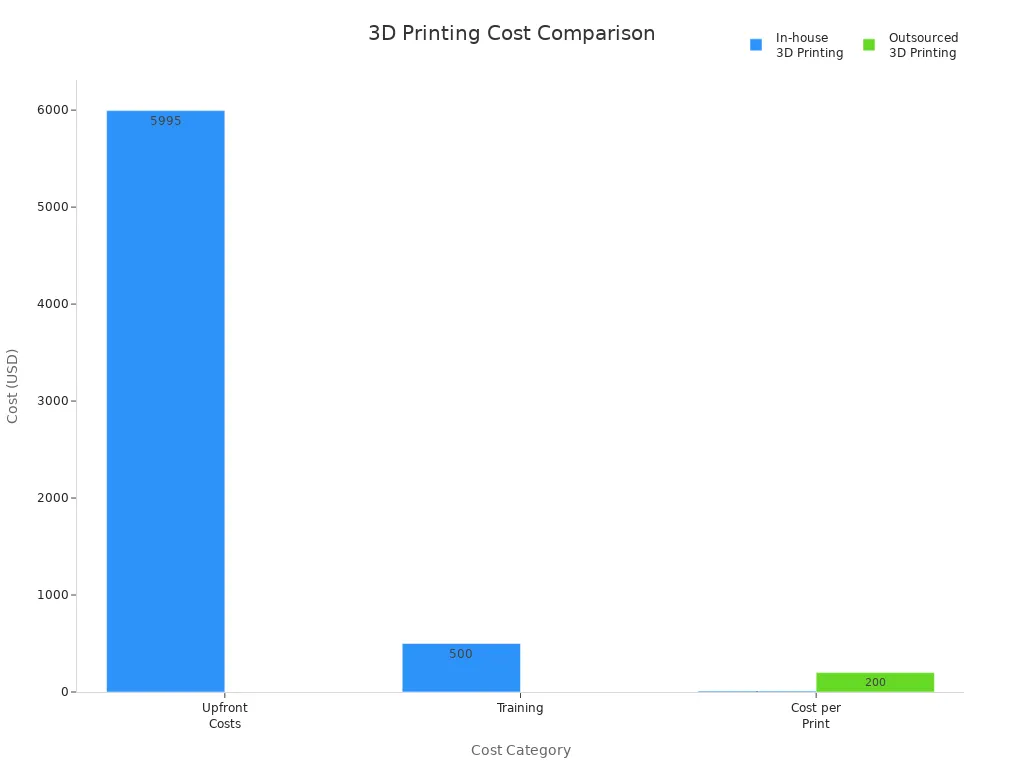
You may find that outsourcing 3d printing can reduce upfront costs, but the cost per print is higher. In-house additive manufacturing offers lower per-part costs but requires significant investment and ongoing expenses.
Error Vulnerability
You must address error vulnerability when using 3d printing. The technology has grown rapidly, but users still struggle with issues that affect print quality, such as over or under-extrusion, stringing, and layer splitting. These errors can result in wasted materials and failed prints.
-
Clogged extruder
-
System stops printing
-
Printing wrong size models
-
General maintenance
-
Warping (FDM)
-
Over or under-extrusion problems
-
Stringing
-
Layer splitting
-
Print surface imperfections
-
Gaps between the outline and print infill
You need to monitor your machines closely and perform regular maintenance to minimise these limitations. Error vulnerability remains one of the most significant cons of 3d printing, especially for users who require consistent, high-quality results.
Tip: When you evaluate the pros and cons of 3d printing, you must consider these limitations alongside the pros to make the best decision for your needs.
Practical Considerations for 3D Printing
Suitability for Different Users
You will find that 3d printing offers unique advantages for a wide range of users. If you work in healthcare, you can create customised dental prosthetics using materials like cobalt chrome, which meet strict mechanical and biocompatibility standards. The dental industry has embraced 3d printers for these reasons. In therapeutic settings, you see innovations such as the Blossom device, which supports stroke recovery and cognitive rehabilitation. This device, developed by Orlando Ely, uses 3d printing to deliver engaging therapy for fine motor skills. You also benefit from rapid prototyping, which makes 3d printing accessible to startups and hobbyists. The flexibility of additive manufacturing allows you to experiment with designs and produce functional prototypes quickly.
Cost and Efficiency Factors
You should consider both the costs and efficiency when choosing 3d printing. The technology is cost-effective for low-volume production and prototyping. You avoid the high upfront costs of traditional moulds, which can reach thousands of pounds. For low-volume production, 3d printing keeps costs steady regardless of batch size, while traditional methods only become economical at higher volumes. You gain flexibility and rapid prototyping capabilities, making it ideal for efficient manufacturing in dynamic industries. However, for large-scale runs, traditional manufacturing still offers better economies of scale.
-
3d printing is cost-effective for low-volume production and prototyping.
-
Traditional methods remain more economical for large batches.
-
You can change designs without expensive retooling.
Environmental Impact
You play a role in reducing environmental impact when you use 3d printing. The process can cut material waste by up to 90% compared to traditional methods. Many materials are reusable, and you can repurpose excess powder. Recycling initiatives, such as converting unused powder into road paint filler, further support sustainability. You also benefit from lower energy use over the product lifecycle, especially when you use energy-efficient materials and techniques. In aerospace, lighter parts lead to reduced fuel consumption and emissions.
Material waste remains a challenge, especially with support structures and powder-based technologies.
Selective Laser Melting machines can use much more electricity than CNC machines for some materials.
The distributed nature of additive manufacturing complicates recycling and reuse efforts.
Future Trends
You will see 3d printing continue to grow across manufacturing, healthcare, and construction. The technology enables customisation, such as personalised footwear and medical implants. In space exploration, you can use 3d printing to create tools and habitats. Companies now recognise the benefits of additive manufacturing, leading to more customised solutions and rapid prototyping. Sustainable housing projects and large-scale components for advanced industries highlight the expanding reach of 3d printing. Market forecasts predict strong growth, with the 3DFP market expected to rise from $201 million in 2022 to $1.9 billion by 2027, and the wider market reaching up to $12.9 billion by 2026. The consumer sector is also growing, driven by demand for custom products in fashion and home décor.
You see that 3D printing offers rapid prototyping, flexible design, and cost savings for low-volume production. However, you must weigh these against material limits, post-processing needs, and slower speeds for mass production.
|
Pros |
Cons |
|---|---|
|
Limited material options |
|
|
Fast turnaround and customisation |
Size and strength constraints |
|
Less material waste |
Post-processing required |
When choosing a 3D printer, consider strength, accuracy, cost, and sustainability. Small businesses benefit from local manufacturing and unique products, while large enterprises face integration challenges. You should match your goals and resources to the technology’s strengths for the best results.
FAQ
What industries benefit most from 3D printing?
You see the greatest impact in healthcare, automotive, aerospace, and manufacturing. These sectors use 3D printing for rapid prototyping, custom parts, and lightweight components. You also find applications in education and creative industries.
Can you recycle 3D printing materials?
You can recycle some 3D printing materials, such as certain plastics and metals. Many printers allow you to reuse excess powder or filament. However, not all materials are recyclable, so you should check compatibility before starting your project.
How accurate are 3D printed parts?
You achieve high accuracy with modern 3D printers, often within 0.1 mm. The final precision depends on the printer type, material, and settings. You should calibrate your machine regularly to maintain consistent results.
Is 3D printing safe for home use?
You can use 3D printers safely at home if you follow guidelines. Always operate your printer in a well-ventilated area. You should avoid touching hot surfaces and handle materials with care. Read the manufacturer’s instructions before starting.
Share:
Five Simple Ways to Optimise Your 3D Printer’s Performance
Beginner-Friendly Advice for Successful 3D Printing