
PLA is the default filament in a lot of makerspaces for one simple reason: it makes it easier to run reliable prints with a mixed-skill group.
But “easy to print” isn’t the same as “right for every job.” If you’re choosing between PLA vs PETG vs ABS for parts that need to work (not just look good), you need to understand where PLA shines—and where it fails.
The 30-second verdict
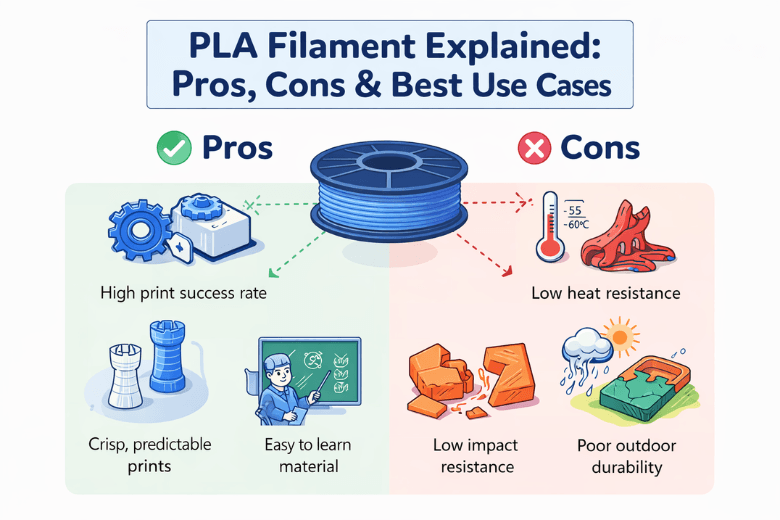
Choose PLA filament when you want:
-
High print success rates and low warping
-
Crisp detail and predictable dimensions
-
A material that’s easy to teach and standardize
Switch away from PLA when your part needs:
-
Heat resistance (PLA can soften around the ~55–60°C glass-transition range)
-
Toughness / impact resistance (PLA is stiff, but can fail suddenly)
-
Outdoor durability (UV and weather exposure degrade many plastics)
Key Takeaway: PLA is an excellent workshop baseline. Just don’t treat it like a heat-rated, impact-rated, outdoor plastic.
What PLA is (quickly)
PLA stands for polylactic acid, a common thermoplastic often made from fermented plant-based sugars/starches and polymerized into PLA.
In practical FFF/FDM terms, PLA prints so easily because it typically runs at lower temperatures and warps less than many alternatives.
Advantages of PLA filament (the real PLA filament pros and cons)
1) Easiest material to teach and standardize
For community workshops, the biggest win is consistency:
-
Lower warping risk than ABS
-
Usually no enclosure required
-
Friendly to “known-good” profiles you can reuse across printers
General comparisons often summarize it this way: PLA is easiest, PETG is the balanced middle, and ABS brings more heat resistance but more printing demands.
2) Great detail and surface finish
PLA is a strong choice for:
-
Calibration cubes and tolerance checks
-
Text, logos, and small features
-
Prototypes where you care about shape/fit first
3) Cost-effective for high-volume printing
If you’re trying to reduce “we ran out of filament mid-workshop” emergencies, PLA is usually the easiest material to buy in bulk and keep consistent.
A sensible internal starting point for stocking is the Sovol filaments collection.
Disadvantages of PLA filament
⚠️ Warning: If the part must keep its shape when it’s “hot to the touch,” PLA is the wrong default. Move to PETG, ABS, or ASA depending on the rest of your requirements.
2) Stiff, not tough (brittleness and sudden failure)
PLA can be plenty strong in a straight pull, but it’s not the best option for:
-
Clips and snap-fits that flex repeatedly
-
Parts that get dropped or knocked around
-
Thin sections under shock loads
PETG is commonly chosen here because it’s tougher and more impact resistant while remaining relatively easy to print.
3) Creep under sustained load
Even if PLA looks fine on day one, a constant load plus warmth can slowly deform parts over time.
If you’ve ever heard “it held for a week, then bent,” you’ve probably hit creep (or a too-thin design) and should consider PETG/ABS/ASA or redesign.
PLA vs PETG vs ABS: how to choose
Here’s a makerspace-friendly decision lens (and the two most common comparisons people search are PLA vs PETG and PLA vs ABS).
|
Criteria (what you care about) |
PLA |
PETG |
ABS (and often ASA) |
|---|---|---|---|
|
Print success rate (general) |
Excellent |
Very good |
Variable unless setup is dialed-in |
|
Warping risk |
Low |
Low–medium |
Medium–high (enclosure helps) |
|
Heat resistance |
Low |
Medium |
High |
|
Toughness/impact |
Medium–low |
High |
High |
|
Teaching / onboarding |
Easiest |
Easy |
Harder |
Decision rules you can actually use
-
Default to PLA for training, prototypes, and indoor tools.
-
Choose PETG when the part needs to survive knocks, flex, or light heat exposure.
-
Choose ABS/ASA when temperature and durability are non-negotiable—and you can support the print environment.
Best use cases for PLA 3D printing
1) Prototyping and design validation
Use PLA to:
-
Check fit and clearances
-
Iterate fast before committing to PETG/ABS/ASA
2) Teaching fundamentals
PLA is great for demonstrating:
-
First-layer setup
-
Retraction basics
-
Support strategies
3) Indoor workshop fixtures and organizers
PLA works well for:
-
Drawer organizers, bins, holders
-
Light-duty jigs and templates
Common PLA problems (and what usually fixes them)
Stringing
-
Often: too hot, retraction not tuned, or wet filament
-
Try: reduce nozzle temp slightly; tune retraction; dry the spool
Brittle filament snapping
-
Often: poor storage / moisture over time
-
Try: dry the spool; store sealed with desiccant
Weak parts / poor layer adhesion
-
Often: too cold, too much cooling, inconsistent extrusion from moisture
-
Try: raise temp within the filament’s range; reduce fan for thick sections; dry filament
Pro Tip: In shared spaces, a single documented “known-good PLA profile” (per printer model) reduces failures more than endlessly tweaking per-user settings.
PLA filament drying and storage: a simple SOP
Even though PLA isn’t the most moisture-sensitive filament, wet PLA can still cause brittle behavior, popping/bubbles, rough surfaces, and inconsistent extrusion.
Storage basics
-
Keep spools sealed with desiccant when not in use.
-
Use a dry box for spools that live on printers.
-
If you can, add a cheap hygrometer to the storage tote.
Drying PLA (safe temperature range)
Because PLA can soften around its Tg, drying too hot can deform the spool.
-
Wevolver notes a common PLA drying range of 40–50°C in its filament drying guide.
-
Bambu Lab lists 45°C for PLA drying in its filament drying recommendations.
If you want to support this in your workshop workflow, a dedicated dryer or dry-box setup can be sourced from Sovol 3D printer accessories & dryers.
FAQ
Is PLA safe to print indoors?
PLA generally prints at lower temperatures than ABS, but any melted plastic can emit particles and VOCs. Basic ventilation is still a good workshop default.
Can PLA be used for functional parts?
Yes—if the part is indoors and not exposed to sustained heat or repeated impacts. For “functional but abused” parts, PETG is often the better baseline.
Should a makerspace stock PLA, PETG, and ABS?
If you only stock one: PLA.
If you stock two: add PETG.
If you stock three: add ABS or (often better for outdoors) ASA—assuming you can support enclosure/ventilation and process control.
Next steps
If you’re standardizing materials, the simplest playbook is:
-
Choose one PLA brand/type and lock a known-good profile.
-
Add PETG for tougher parts.
-
Use ABS/ASA only when the job demands it.
Share:
Best PETG Filament for Strong Prints (UK Buyer’s Guide)
How Does FDM 3D Printing Work? PLA to Finished Print