
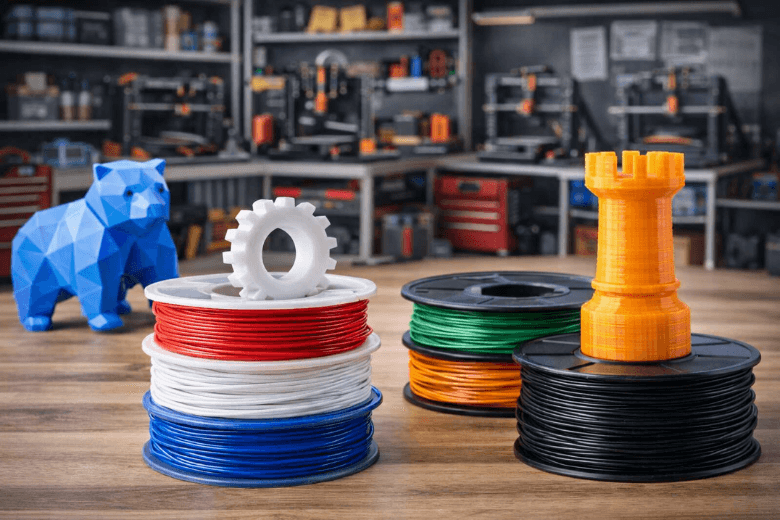
When you compare pla vs petg for 3d printing, you must decide what matters most for your project. You might value strength and flexibility, or you may prefer a filament that offers easy printing and a smooth finish. Pla works well for beginners and decorative pieces. Petg gives you more durability and impact resistance for functional parts. Assess your specific needs before you choose between pla and petg.
Key Takeaways
-
PLA is ideal for beginners due to its easy printing process and lower temperatures. Use it for decorative items and prototypes.
-
PETG offers greater durability and impact resistance, making it suitable for functional parts and outdoor applications.
-
Consider the heat resistance of each filament. PLA softens at lower temperatures, while PETG maintains its shape in higher heat.
-
Cost matters. PLA is more affordable, while PETG is a better investment for projects requiring strength and resilience.
-
Experiment with both filaments to find the best fit for your 3D printing needs. Each has unique benefits for different projects.
PLA and PETG Overview
PLA in 3D Printing
You will often encounter PLA as your first 3d printer filament. This thermoplastic comes from renewable resources, such as corn starch or sugarcane, making it one of the most eco-friendly 3d printing materials available. PLA offers you a smooth, glossy finish and prints at lower temperatures, usually between 200°C and 220°C. You do not need a heated bed, which simplifies the process for beginners.
PLA is rigid and provides good detail, but it is brittle and can fracture under stress. It softens at temperatures as low as 50–60°C, so you should avoid using it for parts exposed to heat or mechanical load. You will find PLA ideal for prototypes, decorative items, and educational models. However, it is not suitable for high-stress or outdoor applications due to its low heat resistance and tendency to degrade in sunlight or humidity.
Tip: If you want a filament that is easy to print and delivers a high-quality surface finish, PLA is a reliable choice for most non-functional 3d projects.
|
Property |
Value/Description |
|---|---|
|
Tensile Strength |
50–70 MPa (rigid, prone to fracture) |
|
Heat Resistance |
Softens at 50–60°C |
|
Durability |
Brittle, degrades with UV and moisture |
|
Applications |
Prototypes, decorative items, educational models |
PETG in 3D Printing
PETG stands out as a versatile thermoplastic for 3d printing. This 3d printer filament combines the strength of ABS with the printability of PLA. PETG is made from PET with added glycol, which improves its flexibility and impact resistance. You will need to print PETG at higher temperatures, typically between 220°C and 260°C, and use a heated bed to prevent warping.
PETG resists moisture, chemicals, and UV exposure, making it suitable for functional parts and outdoor use. It bends before breaking, so you can rely on it for clips, brackets, and enclosures that require durability. PETG is 100% recyclable, though it is not biodegradable like PLA. You will notice excellent layer adhesion and minimal shrinkage, which helps you achieve strong, reliable prints.
-
PETG is ideal for:
-
Workshop tools
-
Functional prototypes
-
Outdoor projects
|
Property |
Value/Description |
|---|---|
|
Tensile Strength |
45–55 MPa (high impact resistance) |
|
Heat Resistance |
Maintains shape up to 65–75°C |
|
Durability |
Resistant to water, chemicals, and UV |
|
Applications |
Functional parts, enclosures, outdoor components |
PLA vs PETG Comparison
Difference Between PLA and PETG Strength
You need to consider 3d printing strength when choosing between PLA and PETG. PLA offers a tensile strength between 50 and 70 MPa. This makes it rigid and suitable for detailed prints, but it is more prone to fracture. PETG has a tensile strength of 45 to 55 MPa, which is slightly lower. However, PETG stands out for its high impact strength and toughness. You will find PETG more durable for functional parts, especially those exposed to mechanical stress. The difference between PLA and PETG strength becomes clear when you require parts that must withstand repeated use or impact.
-
PLA is rigid and brittle, ideal for visual models.
-
PETG is tough and impact-resistant, suitable for mechanical components.
This comprehensive comparison shows that PETG is better for applications where durability and impact tolerance matter most.
Flexibility and Impact Resistance
You will notice a clear difference between PLA and PETG in flexibility and impact resistance. PLA is less flexible and prone to breaking under stress. PETG bends before breaking, offering more flexibility and resilience. This property makes PETG the preferred filament for functional parts and items that need to absorb shock.
|
Property |
PLA |
PETG |
|---|---|---|
|
Flexibility |
Less flexible |
|
|
Impact Resistance |
Prone to breaking |
More impact-resistant |
When you compare PLA vs PETG, PETG stands out for parts that require flexibility and impact resistance. You can use PETG for mechanical components, enclosures, and items exposed to harsh environments. PLA works best for educational models and low-stress components.
Printability and Ease of Use
Printability is a crucial factor in your 3d printing projects. PLA is considered one of the simplest materials for 3d printing. You can print PLA at lower temperatures, usually between 190°C and 240°C, and you do not need a heated bed. This makes PLA highly accessible for beginners and those with basic 3d printers.
PETG requires higher printing temperatures, from 220°C to 270°C, and a heated bed set between 60°C and 80°C. You may find PETG more challenging if you are new to 3d printing. PETG can be prone to stringing and requires careful tuning of settings.
|
Filament |
Printing Temperature |
Heated Bed Requirement |
User-Friendliness |
|---|---|---|---|
|
PLA |
190–240°C |
No |
High |
|
PETG |
220–270°C |
Yes |
Moderate |
If you are starting with 3d printing, PLA is the best choice for ease of use. PETG is suitable for users who want to advance their skills and produce more durable parts.
Heat Resistance and Outdoor Suitability
Heat resistance is another key difference between PLA and PETG. PLA softens at temperatures as low as 50–60°C. This limits its use in environments where heat exposure is possible. PETG maintains its shape up to 65–75°C, making it more suitable for parts exposed to higher temperatures.
|
Filament |
Maximum Heat Resistance |
|---|---|
|
PLA |
50–60°C |
|
PETG |
65–75°C |
For outdoor applications, PETG is the superior choice. PETG resists UV light and water, maintaining its integrity even in extreme summer conditions. You can use PETG for garden tools, outdoor enclosures, and parts that must withstand sunlight and rain. PLA is sensitive to heat and UV, so it is not recommended for outdoor projects.
Tip: Choose PETG for any 3d printing project that requires weather resistance and durability outdoors.
Surface Finish and Quality
You will see a difference between PLA and PETG in surface finish and print quality. PLA provides a smooth, semi-gloss finish, making it ideal for prototypes and decorative items. PLA is easier to post-process, allowing you to sand and paint prints with minimal effort.
PETG offers a high-gloss finish, but layer transitions can be more noticeable. You must handle PETG carefully during sanding and smoothing to avoid deformation. Painting PETG can be challenging due to its properties, but you can use epoxy resins to achieve a glossy finish.
|
Filament |
Surface Finish |
Post-Processing Ease |
|---|---|---|
|
PLA |
Smooth, semi-gloss |
Easier |
|
PETG |
High-gloss |
Requires care |
Mechanical methods such as sanding and filing work well for both materials. Start with coarse grit and move to finer grits for best results. Painting is simpler on PLA, while PETG benefits from epoxy resins for enhanced detail.
Cost Comparison
Cost is an important factor in your 3d printing budget. PLA is generally more affordable, with an average cost per kilogram ranging from £20 to £30. PETG costs more, averaging £25 to £50 per kilogram. For a 100g print, PLA costs about £1.28, while PETG costs £1.60. The difference between PLA and PETG in cost is £0.32 per 100g print.
|
Material |
Average Cost per Kilogram |
Cost per Gram |
Cost for 100g Print |
|---|---|---|---|
|
PLA |
£20–£30 |
£0.0128 |
£1.28 |
|
PETG |
£25–£50 |
£0.016 |
£1.60 |
If you are working on prototypes or decorative items, PLA helps you keep costs low. PETG is worth the extra investment for functional parts and projects requiring durability.
Note: PLA is the best option for budget-conscious users, while PETG offers greater value for demanding applications.
PETG vs PLA Applications
PLA for Prototypes and Decorative Items
You will find PLA the most accessible choice for rapid prototyping and decorative 3d printing projects. This filament allows you to iterate designs quickly, making it ideal for visual models and concept validation. You can use PLA for educational projects, as it is safe and easy for students to handle. Home decor items such as vases, ornaments, and sculptures benefit from PLA’s smooth finish and vibrant colours.
If you want to create intricate designs, support structures with PLA are easy to remove, enabling detailed ornamental elements and cosplay props.
The cost-effectiveness of PLA makes it suitable for low-wear parts and hobby projects. You can paint PLA prints with ease, achieving artistic results that PETG cannot match. The following table highlights common uses for PLA:
|
Application Type |
Description |
|---|---|
|
Prototyping |
Rapid design iterations and visual models |
|
Hobby and decorative items |
Vases, ornaments, sculptures |
|
Educational models |
Safe for student projects |
|
Low-wear parts |
Effective for minimal-stress components |
You should select PLA when your project prioritises aesthetics, ease of printing, and budget.
PETG for Functional and Outdoor Parts
PETG stands out in strength-critical applications and outdoor use. You can rely on PETG for replacement gears in kitchen appliances, brackets for garden machinery, and signage mounts. This filament maintains structural integrity in sunlight and does not become brittle or discoloured like PLA. PETG’s flexibility and impact resistance make it suitable for functional parts requiring resilience.
PETG offers better UV and weather resistance, water and moisture stability, and superior layer adhesion. You can use PETG for marine hardware and outdoor enclosures, as it remains stable in humid environments.
PETG bridges the gap between prototypes and end-use products, allowing real-world testing. You should choose PETG when your project demands durability, environmental resistance, and suitability for outdoor applications.
-
PETG uses include:
-
Outdoor enclosures
-
Replacement parts for garden machinery
-
Signage mounts
-
Marine hardware
-
The comparison between PLA and PETG shows that you must assess your project’s requirements. PLA excels in artistic and educational uses, while PETG is the best option for functional and outdoor parts.
Printing Tips and Challenges
PLA Printing Tips
You can achieve excellent results with pla by following a few practical steps. Begin your 3d printing session with a calibration cube. This helps you verify nozzle temperature, flow rate, and layer adhesion before you start larger projects. Adjust temperature settings as needed: lower the nozzle temperature if you notice stringing, or increase it if layers fail to bond. Clean your print bed using isopropanol to improve adhesion and prevent common printing issues. Store pla in airtight boxes with silica gel. This prevents moisture absorption, which can affect print quality and cause brittle filament.
-
Start with a calibration cube for optimal settings.
-
Fine-tune nozzle temperature to reduce stringing or improve adhesion.
-
Clean the print bed with isopropanol for better grip.
-
Store filament dry to avoid moisture-related problems.
Tip: Pla offers a low warping tendency, making it ideal for beginners and reliable for most 3d projects.
PETG Printing Tips
You must pay attention to temperature and speed when printing with petg. This filament requires higher nozzle and bed temperatures. Use the following recommended parameters for best results:
|
Parameter |
Recommended Range |
|---|---|
|
Nozzle Temperature |
230–250°C |
|
Bed Temperature |
70–90°C |
|
Print Speed |
30–60 mm/s |
Avoid using supports unless necessary, as petg adheres strongly and can make removal difficult. Set extrusion temperature between 220° and 260°C. Keep the heated bed at 75–90°C. Print at speeds from 40–60 mm/s for optimal layer bonding.
-
Adjust temperature and speed for strong prints.
-
Minimise supports to simplify post-processing.
Note: Petg resists moisture and UV, making it suitable for outdoor and functional parts.
Common Issues and Troubleshooting
You may encounter several challenges during 3d printing with pla or petg. The following table outlines frequent issues, symptoms, causes, and solutions:
|
Issue |
Symptoms |
Causes |
Fixes |
|---|---|---|---|
|
Warping |
Corners peel off the bed |
Uneven cooling, poor adhesion |
Use correct bed temp, clean surface, add a brim |
|
Layer Shifting |
Layers misaligned |
Loose belts, axis obstruction |
Check belts, ensure smooth movement, reduce print speed |
|
Stringing |
Thin strands between parts |
Retraction, high temp |
Increase retraction, lower temp, enable combing |
|
Poor First Layer Adhesion |
First layer does not stick |
Bed not level, nozzle height |
Relevel bed, clean with isopropanol, add skirt or brim |
|
Under-Extrusion |
Gaps, weak walls |
Clogged nozzle, extrusion |
Clean nozzle, verify diameter, calibrate extruder |
|
Over-Extrusion |
Bulging, excess filament |
High extrusion multiplier |
Lower flow rate, check filament diameter |
|
Brittle Filament |
Filament breaks before extruder |
Moisture, old filament |
Store dry, dry before printing |
Callout: You can resolve most printing issues by calibrating your printer, maintaining clean surfaces, and storing filament properly.
When you compare pla vs petg for 3d printing, you see clear differences in cost, strength, and application. You should choose pla if you want eco-friendliness and lower cost. Select petg for strength, durability, and outdoor use. Consider these recommendations:
-
Use pla for prototypes, decorative models, and educational projects.
-
Choose petg for functional parts, outdoor components, and items needing heat resistance. You gain valuable experience by experimenting with both filaments. This approach helps you match the right material to your 3d printing goals.
FAQ
What is the main difference between PLA and PETG?
You will notice that PLA offers easier printing and a smoother finish. PETG provides more durability and flexibility. You should choose based on your project’s requirements for strength, finish, and application.
Can you use PLA and PETG on the same 3d printer?
You can use both materials on most 3d printers. You must adjust the temperature settings and ensure your printer has a heated bed for PETG. Always check your printer’s specifications before switching filaments.
Is PETG safe for food contact items?
You should avoid using PETG for food contact items unless the manufacturer certifies it as food-safe. Even then, bacteria can grow in the tiny gaps between layers. For safety, do not use 3d printed items for food storage.
Which filament is better for outdoor use?
You will find PETG more suitable for outdoor use. It resists UV light and moisture better than PLA. If you need parts that last outside, PETG is the preferred choice.
How do you prevent stringing when printing with PETG?
You can reduce stringing by lowering the nozzle temperature and increasing retraction settings. Clean the nozzle regularly and keep the print speed moderate. These adjustments help you achieve cleaner results with PETG.
Share:
Why Sovol SV08 Printer wins hearts over other printers
PLA vs PETG vs ABS Which Filament Is Best?