
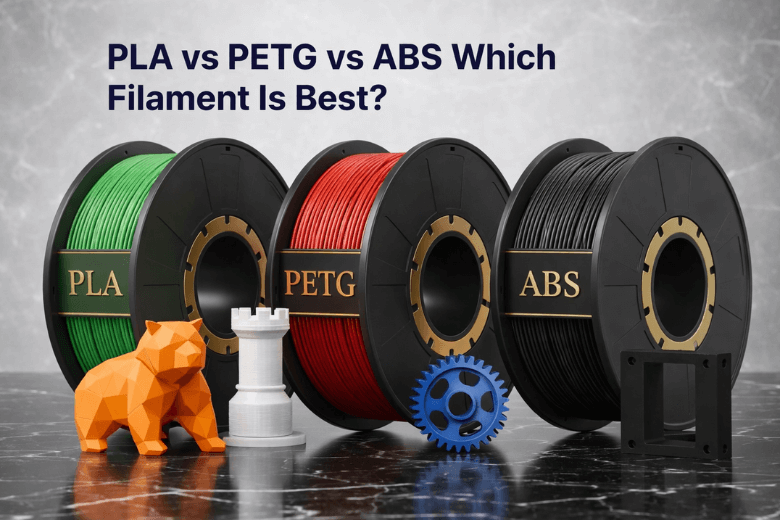
You want the best 3d printer filament for your needs. For most users, PLA wins as the best 3d printer filament for easy print and great finish. PETG suits you if you require strength and need to print outdoor parts. ABS gives you the edge for heat resistance and tough prints. You can print with PLA smoothly, print prototypes with PETG, and print functional parts with ABS. The PLA vs PETG VS ABS debate comes down to your project. Print with confidence by matching the right filament to your print goals.
Key Takeaways
-
PLA is the easiest filament to print, making it ideal for beginners and decorative items.
-
PETG offers a strong balance of strength and flexibility, perfect for outdoor and functional parts.
-
ABS excels in heat resistance and durability, suitable for mechanical applications and parts exposed to stress.
-
Always match your filament choice to your project needs to achieve the best results.
-
Consider your printer's specifications and environment to ensure compatibility with the filament.
PLA vs PETG vs ABS Comparison
Quick Table Overview
You need a clear comparison to choose the right filament types for your project. The table below summarises the main characteristics and properties of PLA, PETG, and ABS. You can quickly see how each material performs in key areas.
|
Material |
Ease of Use |
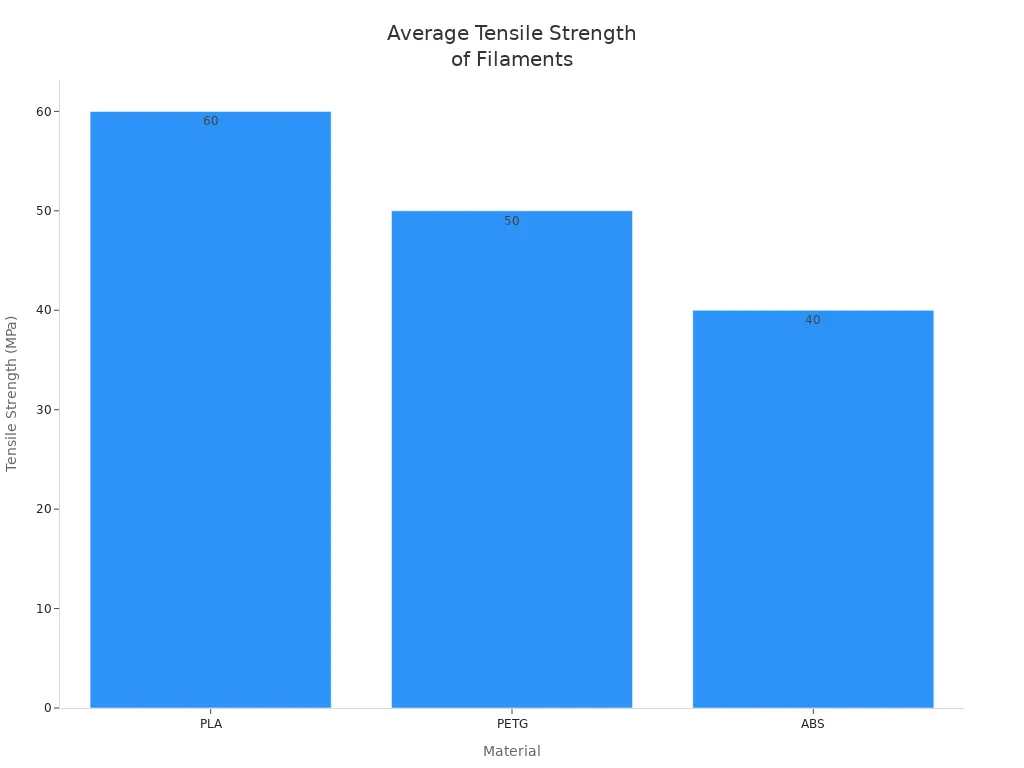
Tensile Strength (MPa) |
Durability |
Print Quality |
Cost |
Best Applications |
|---|---|---|---|---|---|---|
|
PLA |
Very Easy |
Moderate |
High |
Low |
Prototypes, models, decorative items |
|
|
PETG |
Moderate |
~50 |
High |
High |
Medium |
Functional parts, outdoor use, food containers |
|
ABS |
Challenging |
~40 |
Very High |
Good |
Low |
Mechanical parts, toys, enclosures |
You can also compare the tensile strength visually:
For print temperatures, you should consider the following:
|
Material |
Nozzle Temperature (°C) |
Bed Temperature (°C) |
|---|---|---|
|
PLA |
60 |
|
|
PETG |
220-250 |
70-90 |
|
ABS |
210-250 |
80-110 |
When you compare filament types, you see that PLA prints at the lowest temperature and offers the easiest experience. PETG requires a higher temperature but gives you a balance of strength and printability. ABS needs the highest temperature and an enclosed printer for best results.
Key Strengths and Weaknesses
You want to understand the main differences between these filament types. Each material has unique characteristics that suit specific needs.
-
PLA
You find PLA the easiest to print. It works well for beginners and delivers excellent detail. PLA is biodegradable under the right conditions, so you make a more sustainable choice. However, PLA has moderate durability and can become brittle. It does not withstand high temperatures, which limits its use for functional or outdoor parts. -
PETG
PETG gives you a strong balance between strength and flexibility. You can use it for functional parts that need to handle stress. PETG resists chemicals and UV light, making it ideal for outdoor use or food-safe applications. You may find PETG a bit sticky during printing, so you need careful calibration. PETG is fully recyclable, but it is not biodegradable. -
ABS
ABS stands out for its durability and heat resistance. You choose ABS for mechanical parts, toys, and enclosures that must endure impact and higher temperatures. Printing with ABS can be challenging. You need an enclosed printer to prevent warping and to manage fumes. ABS is less environmentally friendly due to the emission of potentially toxic fumes during printing.
Tip: If you want the best print quality with minimal hassle, PLA is your top choice. For outdoor or functional parts, PETG offers the best compromise. If you need maximum durability and heat resistance, ABS is the right filament.
You can see the most common applications for each material in the table below:
|
Material |
Common Applications |
Notes |
|---|---|---|
|
PLA |
Suitable for implants that degrade over time |
|
|
PETG |
Food industry, medical device packaging |
Can withstand sterilisation for medical use |
|
ABS |
General-purpose applications, toys |
Known for its strength and durability |
When you compare the characteristics and properties of PLA vs PETG vs ABS, you notice that PLA is best for ease of use and fine detail. PETG gives you a balance of strength and printability. ABS excels in heat resistance and durability. You should match the filament types to your project requirements for the best results.
You also need to consider the environmental impact of each material:
-
PLA is biodegradable under the right conditions.
-
PETG is 100% recyclable but not biodegradable.
-
ABS is less environmentally friendly due to potential toxic fumes.
When to Use PLA
Ease of Printing
You will find that pla filament offers unmatched simplicity when you start 3D printing. You can print at lower temperatures, which reduces the risk of warping and makes the process straightforward. Most printers support pla filament, so you avoid compatibility issues. You achieve optimal results by setting your print speed between 50 and 100 mm/s, nozzle temperature from 190 to 220 °C, and bed temperature up to 60 °C. You should also use 100% cooling fan for best surface finish. The table below shows how pla filament compares to other materials in terms of print difficulty:
|
Material |
Print Difficulty |
|---|---|
|
PLA |
Very Easy |
|
PETG |
Easy |
|
ABS |
Moderate |
You gain confidence as a beginner because pla filament rarely causes problems during printing.
Best Uses for PLA
You select pla filament for decorative prints, prototypes, and educational models. The material excels at capturing fine details, so you produce intricate designs and smooth surfaces. You benefit from minimal warping, which ensures reliable results for architectural mockups and toys. The following table highlights the main features and common uses:
|
Feature |
Details |
|---|---|
|
Pros |
|
|
Cons |
Brittle, low heat resistance |
|
Best For |
Prototypes, educational models, toys, mockups |
|
Industries |
Education, Architecture, Consumer Goods |
You should avoid using pla filament for parts exposed to high temperatures or mechanical stress. The material becomes brittle and loses strength when heated, so it suits non-functional or display items.
Tip: Choose pla filament for projects where appearance and detail matter more than durability.
Cost and Availability
You enjoy excellent affordability when you buy pla filament. Most online stores offer 1kg rolls starting at approximately $18, with average prices around $20. Specialty or premium pla filament costs more, but basic options remain accessible. You find pla filament widely available, so you never struggle to source it for your projects.
You make a smart choice by selecting pla filament for easy printing, fine detail, and cost-effective results.
When to Use PETG
Strength and Flexibility
You choose petg filament when you need a balance between strength and flexibility. PETG stands out as stronger than PLA but not as robust as ABS. You notice that PETG's flexibility exceeds ABS, yet falls short of PLA. This intermediate position allows petg filament to flex before failing, unlike PLA which fractures under stress. You benefit from PETG's molecular toughness, which makes it ideal for parts that require some give without breaking. You rely on petg filament for functional prints that must withstand repeated use and moderate mechanical stress.
PETG offers a unique combination of strength and flexibility, making it suitable for parts that need to bend slightly without snapping.
Outdoor and Functional Parts
You select petg filament for outdoor applications and functional parts. PETG resists UV exposure, moisture, and temperature cycling, so you trust it to maintain strength and appearance over time. You find that petg filament retains its shape in extreme weather conditions and does not splinter. You can use it for garden tools, outdoor fixtures, and food containers. PETG's chemical resistance enhances its versatility. It withstands alkalis, acids, oils, greases, mild acids, cleaning chemicals, and saltwater. You rely on petg filament for medical packaging and food containers, as it handles sterilisation and post-processing well.
-
PETG is strong and flexible, suitable for outdoor use.
-
It resists UV exposure, moisture, and temperature cycling.
-
Maintains strength and appearance over time.
-
PETG is UV and water-resistant, ideal for outdoor applications.
-
Retains shape in extreme weather conditions.
-
Does not splinter and handles post-processing well.
Printing Challenges
You encounter moderate difficulty when printing with petg filament. PETG is more prone to oozing than PLA or ABS, so you must adjust bridging and retraction settings. You may face challenges with bed adhesion, but you can mitigate these by applying a layer on the build plate. If you do not store petg filament correctly, it absorbs moisture and becomes brittle. You need careful calibration to achieve optimal results. You should monitor print settings and storage conditions to avoid common issues.
Tip: Store petg filament in a dry environment and fine-tune your printer settings to minimise oozing and improve bed adhesion.
When to Use ABS
Heat and Impact Resistance
You select abs filament when your project demands durability and resilience. This material withstands temperatures up to 100°C, making it ideal for parts exposed to heat. You benefit from its high impact resistance, which ensures your prints survive drops and mechanical stress. You can easily post-process abs filament by drilling, sanding, or smoothing with acetone. The table below summarises these features:
|
Feature |
Description |
|---|---|
|
Maximum Heat Resistance |
Up to 100°C |
|
Impact Resistance |
Highly resistant to impacts and stress |
|
Post-Processing Capability |
Handles drilling, sanding, acetone smoothing |
Note: You achieve robust results with abs filament for parts that must endure heat and physical force.
Industrial and Mechanical Parts
You rely on abs filament for demanding industrial and mechanical applications. This material suits projects where strength and longevity matter most. You find abs filament used in a wide range of products:
-
Phone cases
-
High-wear toys
-
Tool handles
-
Automotive trim components
-
Electrical enclosures
-
Functional prototypes
-
Electronic enclosures and cases
-
Large models
-
End user products
-
Batch manufacturing
-
Jigs and fixtures
-
Architectural models
-
Engineering parts
You see abs filament in industries such as:
-
Automotive
-
Consumer Electronics
-
Industrial Design
Tip: You choose abs filament for engineering parts and products that require repeated use and mechanical reliability.
Printing Considerations
You face unique challenges when printing with abs filament. Warping often occurs, especially on larger prints. You must use a heated bed to improve adhesion and reduce deformation. You achieve the best results by printing in a fully enclosed printer or enclosure. This setup maintains a stable temperature and minimises fumes, which can be unpleasant and potentially harmful. You should always ensure proper ventilation in your workspace.
-
Heated bed required for abs filament
-
Fully enclosed printer or enclosure recommended
You compare abs filament to PLA and PETG. ABS offers greater flexibility and robustness, especially for parts exposed to heat and impact. PLA prints easily but lacks durability. PETG balances strength and printability, yet does not match ABS for heat resistance.
Alert: You protect your health and improve print quality by using an enclosure and ventilating your workspace when printing with abs filament.
Filament Selection Guide
Match to Project Needs
You must select the right filament by considering your project’s requirements. Each 3d printing material offers unique properties. You should assess mechanical demands, heat resistance, and chemical resistance. For prototypes and decorative items, PLA suits you best. PETG works well for functional parts exposed to moisture or moderate heat. ABS excels in mechanical parts that require high impact resistance and durability. You must also consider the applications for pla vs abs, as both materials serve different purposes. Avoid common mistakes by matching the filament to your project’s needs and not just following popular trends.
Tip: Always check if your filament choice aligns with the physical demands and environmental exposures of your project.
Printer and Environment
Your printer’s specifications play a crucial role in filament selection. You must verify the maximum extrusion temperature and heated bed requirements. Some filaments, such as ABS, need an enclosed chamber to prevent warping. PETG requires moisture control for optimal results. The table below helps you compare printer compatibility for PLA, PETG, and ABS:
|
Filament |
Melting Point |
Shrinkage |
Special Requirements |
|---|---|---|---|
|
PLA |
Low |
Minimal |
None |
|
PETG |
Moderate |
Moderate |
Moisture control |
|
ABS |
High |
Significant |
Enclosed chamber |
You must also consider environmental factors. PLA offers smooth detail but low UV and moisture resistance. PETG provides better durability and moderate resistance to UV and moisture. ABS delivers high impact resistance and moderate UV resistance. You should avoid ignoring these factors, as they affect the longevity and performance of your prints.
Skill Level
Your experience level influences your filament choice. Beginners benefit from PLA due to its ease of printing and minimal requirements. PETG offers a balance between printability and strength, suitable for users with some experience. ABS demands advanced skills and a controlled environment. You must check your printer’s compatibility before purchasing new 3d printing materials. Not all filaments work with every printer, so you should always confirm specifications.
Note: Choose PLA if you are new to 3d printing materials. Select PETG for outdoor or functional parts. Opt for ABS when you need mechanical strength and heat resistance.
You should match your filament choice to your project’s demands. For prototypes and models, PLA offers easy printing and fine detail. PETG suits outdoor and functional parts due to its strength and flexibility. ABS excels in mechanical and heat-resistant applications. Review the table below for a quick summary:
|
Filament |
Best For |
Key Benefit |
|---|---|---|
|
PLA |
Prototypes, models |
Easy to print |
|
PETG |
Outdoor, functional parts |
Strength, flexibility |
|
ABS |
Mechanical, heat-resistant |
Durability, resilience |
Consider your printer’s capabilities and workspace safety. If you want to explore advanced options, look into nylon or TPU for specialised needs.
FAQ
What filament should you use for food-safe prints?
You should choose PETG for food-safe prints. PETG resists chemicals and does not release harmful substances. Always check that your filament is certified as food-safe by the manufacturer.
Can you print ABS without an enclosure?
You can print ABS without an enclosure, but you risk warping and poor adhesion. For best results, use an enclosed printer and ensure proper ventilation.
Does PLA degrade outdoors?
PLA degrades quickly outdoors. Sunlight, moisture, and heat cause PLA to lose strength and shape. For outdoor applications, you should select PETG or ABS.
Which filament is best for beginners?
You should start with PLA. PLA prints easily, requires low temperatures, and rarely warps. You will achieve reliable results with minimal adjustments.
Share:
PLA vs PETG – Choosing the Best Filament for Your 3D Printing Needs
Essential tips for flawless prints with Sovol SV08 Max