

You encounter large-format printing daily, whether you notice bold outdoor signage or bespoke retail displays. This type of printing produces oversized graphics that command attention and deliver messages with impact. In 2026, you see it transform spaces with immersive event graphics, exhibition panels, window vinyls, and even interior office décor. Large-format printing helps you achieve high-visibility communication where standard sizes fall short.
Key Takeaways
-
Large-format printing produces oversized graphics that capture attention and enhance visibility in various settings.
-
This printing method supports high-resolution images and custom designs, making it ideal for banners, billboards, and promotional displays.
-
Sustainability is a key trend in 2026, with eco-friendly materials and practices becoming essential for brand credibility.
-
Investing in large-format printing can lead to measurable benefits, such as increased sales and reduced marketing costs.
-
The printing process involves careful planning, material selection, and finishing touches to ensure high-quality results.
Large-Format Printing Explained
What is Large-Format Printing?
You encounter large-format printing when you need graphics that go beyond the limits of standard print sizes. This process produces visuals that exceed the dimensions of A3 and A2, using specialised equipment designed for wider materials. You rely on large-format printing for banners, billboards, and other oversized displays that demand attention in public spaces. Unlike conventional printing, which uses standard printers for smaller formats such as A4 posters, large-format printing employs advanced technology to deliver high-resolution images up to 2400dpi. You benefit from vibrant colours and sharp details, even at large scales.
-
Large-format printing typically exceeds the dimensions of standard A3 (297 x 420 mm).
-
You use specialised printers capable of handling wider materials.
-
The technology supports higher resolutions, ensuring crisp and vivid graphics.
-
Large format digital printing and digital large format printing allow you to customise designs for unique applications.
-
You can print on a variety of materials, including paper, vinyl, and fabric, making the process versatile for different environments.
You choose wide format printing when you need to make an impact with graphics that cannot be achieved with standard printing methods. This approach enables you to create custom signage, promotional displays, and event backdrops that stand out in any setting.
Key Features and Benefits
Large-format printing offers you several distinct advantages over traditional printing methods. You gain the ability to produce prints that are larger than standard sizes, using equipment that accommodates a wide range of materials. This flexibility allows you to tailor your graphics to specific needs, whether you require durable outdoor signage or eye-catching indoor displays.
-
Prints typically exceed A2 dimensions.
-
You utilise large-sized printing equipment for greater output.
-
You can select from various materials, including paper, vinyl, and fabric.
-
Large format digital printing supports custom designs and large-scale graphics.
-
Digital large format printing ensures consistent quality across all applications.
Tip: You achieve maximum visibility and brand recognition by choosing large-format printing for your marketing campaigns.
You see measurable benefits across different industries when you adopt large-format printing solutions. The following table highlights how businesses have improved performance and reduced costs:
|
Industry |
Measurable Benefit |
|---|---|
|
Retail Clothing Chain |
Sales of featured products rose 28% within 6 weeks. |
|
Quick-Service Restaurant |
Increased throughput by 12% due to improved order speed. |
|
University Campus |
Reduced lost-student incidents by 34% during orientation week. |
|
Real Estate Firm |
Reduced annual reprint costs by 18% with longer-lasting signs. |
|
Construction Company |
22% more inbound project inquiries due to improved visibility. |
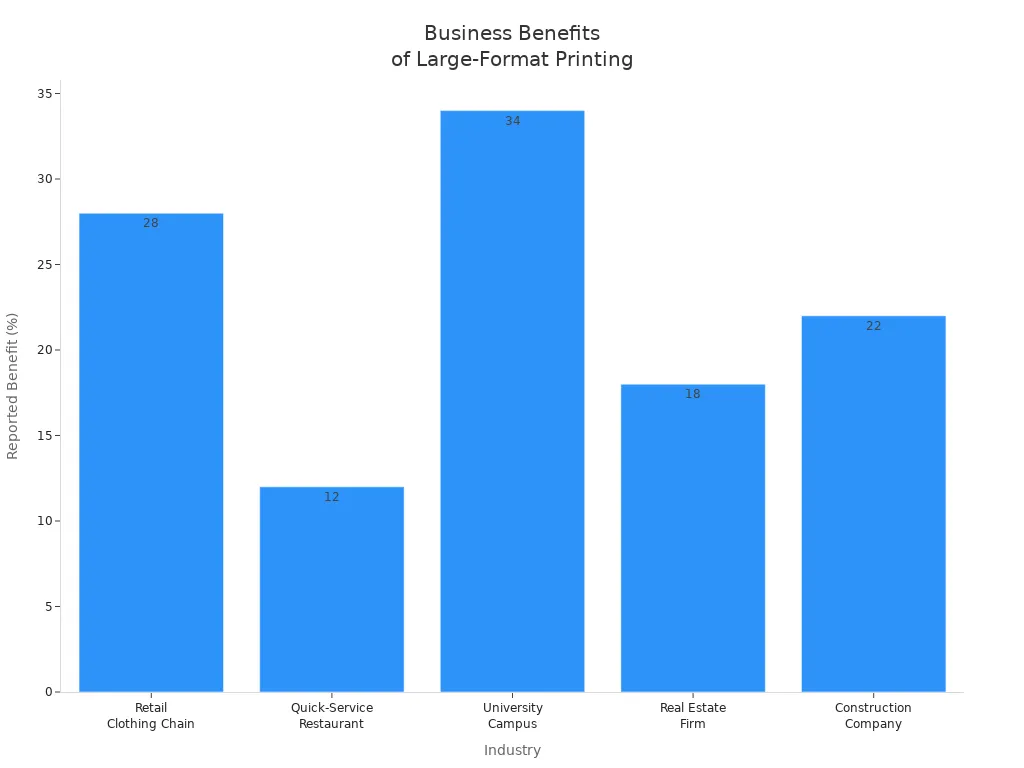
You notice that large-format printing not only enhances the visual appeal of your graphics but also delivers tangible results for your business. You improve sales, increase efficiency, and reduce costs by investing in high-quality, durable prints. You also create a more engaging environment for your customers and visitors, making your brand memorable and accessible.
Large Format Printing Process
How the Process Works
You begin the large format printing process by clarifying your objectives and developing a design that matches your vision. You select materials that suit the intended environment, whether you need weather-resistant vinyl for outdoor banners or premium fabric for indoor displays. You operate advanced printers and use high-quality inks to produce vibrant graphics. You apply finishing touches such as lamination or mounting to improve durability and appearance. You complete the process by installing the print in its final location, ensuring maximum impact.
Here is a step-by-step overview of the large format printing process:
-
Conceptualisation and Design: You define the purpose of your print and create a design that aligns with your goals.
-
Selecting the Right Materials: You choose materials based on the print’s application, such as paper, vinyl, or fabric.
-
Printing Process: You use specialised printers and premium inks to achieve vivid colours and sharp details.
-
Finishing Touches: You enhance the print with lamination, mounting, or cutting for added durability and visual appeal.
-
Installation and Display: You install the finished product to ensure it captures attention and communicates your message effectively.
Note: You improve the longevity and quality of your prints by following strict quality control measures. You define specific requirements for each job, complete a thorough pre-flight check, review proofs for colour and alignment, maintain your equipment regularly, and select superior materials.
Main Technologies Used
You rely on advanced technologies to achieve outstanding results in large-format printing. You choose printers that match your project’s requirements and environmental standards. You benefit from innovations that optimise workflow and expand your creative options.
-
HP’s Latex printers help you adopt eco-friendly practices and reduce environmental impact.
-
PageWide technology enables you to streamline production and improve efficiency.
-
DesignJet printers allow you to diversify your applications, from architectural plans to retail graphics.
You compare digital and analogue printing methods to select the best solution for your needs. Digital printing offers higher resolution and faster turnaround, while analogue methods may suit specific traditional applications.
|
Feature |
Digital Printing |
Analog Printing |
|---|---|---|
|
Output Quality |
Superior, higher resolutions, sharper images |
Generally lower quality, less detail |
|
Speed |
Faster, ideal for high-volume printing |
Slower, less efficient for large jobs |
You achieve superior results by choosing the right technology and maintaining rigorous quality standards throughout the production process. You ensure that every print meets your expectations for clarity, durability, and visual impact.
Uses of Large-Format Printing in 2026
Business and Marketing Applications
You use large-format printing to elevate your brand and capture attention in crowded markets. Large-scale graphics such as banners, billboards, posters, and window wraps help you communicate messages quickly and effectively. You rely on large-scale prints for trade show booths, retail displays, and promotional campaigns. The physical presence of print materials like direct mail, brochures, and flyers increases engagement compared to digital messages. Premium finishes, including soft-touch laminates and foiling, make your brand memorable and enhance the quality of your marketing materials. You integrate technology such as QR codes and NFC chips into your print products to create interactive experiences for customers. Eco-friendly options, including recycled paper and bio-based inks, are now essential for brand credibility.
-
Banners and billboards deliver high-impact visuals.
-
Window and vehicle wraps extend your brand beyond the storefront.
-
Direct mail and flyers provide tangible touchpoints for your audience.
-
Soft-touch laminates and foiling add a premium feel to your print.
-
QR codes and NFC chips connect print to digital experiences.
Tip: You strengthen your brand by choosing sustainable printing practices and innovative finishes.
Events and Public Spaces
You transform events and public spaces with large-format printing. You select eye-catching vinyl backdrops, contour cut vinyl prints, and LED acrylic signage to create immersive environments. Foam boards and flex face graphics offer versatile solutions for both indoor and outdoor displays. Bespoke fabricated signage and wooden options allow you to tailor your brand presence to any setting. Neon and LED neon signage attract attention at exhibitions and public gatherings. Pop-up and pull-up banners provide portable branding for events, while modular stands offer flexibility for different layouts.
|
Service Type |
Description |
|---|---|
|
High-quality backdrops for events and exhibitions. |
|
|
Contour cut vinyl prints |
Custom-shaped vinyl prints for unique signage. |
|
LED acrylic signage |
Illuminated signage for maximum visibility. |
|
Foam boards |
Lightweight boards for versatile displays. |
|
Flex face graphics |
Durable graphics for indoor and outdoor use. |
|
Bespoke fabricated signage |
Custom signage tailored to your brand. |
|
Wooden signage |
Eco-friendly options for a rustic look. |
|
Neon and LED neon signage |
Bright signage for attracting attention. |
|
Pop-up and pull-up banners |
Portable banners for events. |
|
Modular stands |
Flexible designs for various event needs. |
You see large-format printing at major events such as PRINTING United Expo 2026 and Sign & Digital UK 2026, where brands showcase creativity and innovation through large-scale graphics and vehicle wraps.
Trends in 2026
You notice several trends shaping large-format printing in 2026. Sustainability drives the industry, with greener substrates like PVC-free materials and recycled boards gaining popularity. You adopt water-based and UV-curable inks to reduce environmental impact. Personalisation and customisation grow rapidly, allowing you to tailor large-scale graphics to specific audiences. You combine digital and print strategies for cohesive brand messaging. AI and automation streamline print workflows, making production faster and more accurate. Print-on-demand services enable agile marketing, reducing waste and inventory costs.
-
Sustainability leads the market, projected to reach $420 billion by 2026.
-
Personalised printing grows at 7.5% annually, reaching $31.6 billion.
-
79% of consumers act on direct mail immediately, compared to 45% for email.
-
AI and automation improve efficiency and personalisation.
-
Print-on-demand supports flexible, targeted campaigns.
You stay ahead by embracing these trends, ensuring your brand remains visible and relevant in a competitive landscape.
Wide Format Printing Materials & Printers
Types of Materials
You select from a wide range of printing materials when planning a large-format printing project. The types you choose directly affect durability, appearance, and suitability for different environments. You often use thermoplastics such as ABS, PETG, PP, and PLA for their resistance and ease of processing. Composites, including carbon fibre-reinforced polymers, offer lightweight strength for tooling and structural applications. Recycled pellets help you reduce waste and maintain performance. High-performance polymers like PEI and PPS provide heat resistance and chemical resilience.
|
Material Type |
Examples |
Key Characteristics |
|---|---|---|
|
Thermoplastics |
ABS, PETG, PP, PLA |
Good resistance, easy to process |
|
Composites |
Carbon fibre-reinforced polymers, glass-filled materials |
Lightweight, strong, ideal for tooling |
|
Recycled Pellets |
N/A |
Reduces waste, maintains performance |
|
High-Performance Polymers |
PEI, PPS, PA-based composites |
Heat resistance, strength, chemical resilience |
You also use self-adhesive vinyl for temporary wall graphics, foam PVC for indoor displays, acrylic for illuminated feature walls, aluminium composite for permanent signage, and fabric graphics for exhibitions. Paper-based and cardboard options suit short-term campaigns. Printing on a range of materials allows you to match the types to your project’s needs, balancing cost, sustainability, and visual impact.
Large Format Printer Innovations
You rely on large format printer technology to achieve high resolution and efficient output. The latest models, such as the Canon imagePROGRAF PRO-1100, offer 12 ink cartridges and Wi-Fi connectivity for seamless workflow. The HP DesignJet Z9+ PS 44" features a 500GB hard drive and integrated vertical trimmer, supporting prints up to 44 inches wide. Epson’s SureColour SC-F9300 delivers rapid print speeds with advanced printheads, while the SC-T3405 produces A1 posters in just 24 seconds.
|
Printer Model |
Key Features |
|---|---|
|
Canon imagePROGRAF PRO-1100 |
12 LUCIA PRO ll inkjet cartridges, prints up to A2, 2400 x 1200 DPI, Wi-Fi and ethernet connectivity |
|
HP DesignJet Z9+ PS 44" |
500GB hard drive, vertical trimmer, 9-colour ink set, prints up to 44" wide |
|
Epson SureColour SC-F9300 |
Print speeds up to 108.6m²/hr, PrecisionCore MicroTFP printhead, UltraChrome 12 cartridge ink set |
|
Epson SureColour SC-T3405 |
Prints A1 posters in 24 seconds, supports various ink cartridge sizes |
You see eco-friendly options becoming standard. PVC-free banner materials and recyclable boards help you meet environmental targets. Water-based and latex inks support cleaner production, while some suppliers offer carbon-neutral printing. Wide-format printer advances enable you to print on a range of materials with high resolution and minimal waste.
Printing Techniques and Finishes
You enhance your prints using a variety of techniques and finishes. Specialty finishes such as lamination, textured effects, and multi-layer prints add depth and visual appeal. Specialty inks, including white and gloss, create unique results. Printing on a range of materials like metallic, holographic, and clear substrates expands your creative options. White ink techniques, such as underflooding and overflooding, improve visibility and impact.
-
Specialty finishes: lamination, textured effects, multi-layer prints
-
Specialty inks: white, gloss, sustainable latex inks
-
Printing on a range of materials: metallic, holographic, clear substrates
-
White ink techniques: underflooding, overflooding
You choose finishing options based on the types of prints you require. Matt finishes enhance colour depth and reduce glare, improving readability. Satin offers balanced depth and moderate reflections. Gloss provides a striking appearance but can hinder legibility. Textured effects and spot varnishes highlight specific areas, drawing attention where needed. Large-sized printing equipment ensures consistent quality across all types of projects.
Tip: You maximise the longevity and impact of your large-format printing by selecting the right combination of printing materials, printer technology, and finishing techniques.
Benefits and Considerations
Impact and Versatility
You harness large-format printing to elevate your brand presence in physical spaces. High-impact visuals capture attention and help your business stand out from competitors. You tailor print campaigns to specific audiences, using direct mail and local leaflet distribution to reach targeted demographics. Wide format printing transforms vehicles into mobile advertisements and brings architectural renderings to life with high-resolution prints. You revamp retail environments, create bold displays for events, and launch advertising campaigns with banners and posters. You also use wall graphics, window films, floor decals, signage, and vehicle wraps to cost-effectively create large-scale graphics across diverse industries.
-
Large-format printing creates high-impact visuals.
-
Wide format printing supports vehicle wraps, architectural renderings, and retail displays.
-
You use UV printing for durable outdoor signage and eco-solvent printing for sustainability.
-
Dye sublimation delivers vibrant prints on fabrics for trade shows.
-
Screen printing produces bold designs for textiles.
Tip: You maximise brand visibility by choosing wide format printing for your marketing and event needs.
Cost and ROI
You achieve excellent return on investment with large-format printing. Strategically placed billboards and vehicle wraps attract thousands of impressions over their lifespan, making them a cost-effective marketing strategy. Once installed, large format print advertising incurs no recurring expenses, unlike pay-per-click or social media campaigns. Quality prints endure for months or years, providing ongoing exposure without additional costs. You invest in wide format printing to reach large audiences and maintain brand awareness efficiently.
|
Advertising Method |
Ongoing Costs |
Lifespan |
Impressions Generated |
|---|---|---|---|
|
Large-format billboard |
None |
Months to years |
Thousands to millions |
|
Vehicle wrap |
None |
Years |
Thousands |
|
Social media advertising |
Recurring |
Immediate |
Variable |
Note: You reduce long-term marketing expenses by choosing durable print solutions.
Practical Considerations
You plan your wide format printing projects carefully to ensure optimal results. You balance negative space and avoid clutter in your designs. You discuss substrate options with your printing provider, as material choice affects both design and durability. You select fonts compatible across systems and present them in vector format for clarity. You use high contrast and consider the display context to enhance visibility. You print test copies to assess readability and make adjustments before final production.
|
Challenge |
Description |
Solutions |
|---|---|---|
|
Thermal Control |
Maintaining uniform temperature during printing. |
Controlled airflow and insulated enclosures. |
|
Structural Stability |
Preventing distortion in large prints. |
Robust machine design and careful tool path planning. |
|
Material Flow Consistency |
Ensuring stable material flow over long durations. |
Engineered extrusion systems for consistent pressure and temperature. |
|
Machine Accuracy |
Achieving precise positioning despite thermal expansion. |
Precision motion systems and advanced calibration routines. |
|
Production Efficiency |
Reducing risks of failures and quality issues during long production runs. |
High-throughput extrusion and predictive maintenance. |
Tip: You improve print quality and efficiency by addressing common challenges and collaborating closely with your printing partner.
You see large-format printing redefine visual communication in 2026. Sustainability drives innovation, automation streamlines production, and flexible processes help you adapt to market changes.
-
Eco-friendly materials meet regulatory standards.
-
Automated workflows manage complex projects.
-
Flexible production supports business growth.
|
Benefit |
Description |
|---|---|
|
You capture attention in busy environments. |
|
|
Durability |
Premium materials ensure your prints last longer. |
|
Versatility |
You apply printing across diverse settings for greater engagement. |
You enhance your brand presence and project impact by choosing large-format printing for your next campaign.
FAQ
What types of businesses benefit most from large-format printing?
You see retail stores, event organisers, construction firms, and educational institutions gain the most from large-format printing. These sectors use banners, signage, and displays to attract attention and communicate messages quickly.
How do you choose the right material for your project?
You assess the environment and purpose of your print. For outdoor use, select weather-resistant vinyl or aluminium composite. For indoor displays, choose fabric or foam board. Consult your provider for expert recommendations.
Can you print custom designs and graphics?
You can print any custom design or graphic. Large-format printers support high-resolution images and unique layouts. You upload your artwork, specify dimensions, and select finishes to achieve your desired result.
What is the typical turnaround time for large-format printing?
You usually receive your prints within three to five working days. Complex projects or bulk orders may require extra time. Always confirm deadlines with your printing partner.
Are eco-friendly options available for large-format printing?
You choose eco-friendly materials such as PVC-free vinyl, recycled boards, and water-based inks. Many providers offer sustainable solutions to help you meet environmental targets.
Share:
What Sets the SV08 Max Printer Apart from Competitors
What Is CoreXY 3D Printer Technology and How Does It Work