
Sometimes, 3D printing is not just about making parts.
Sometimes, it becomes something much more meaningful — a tool for independence, movement, and hope.
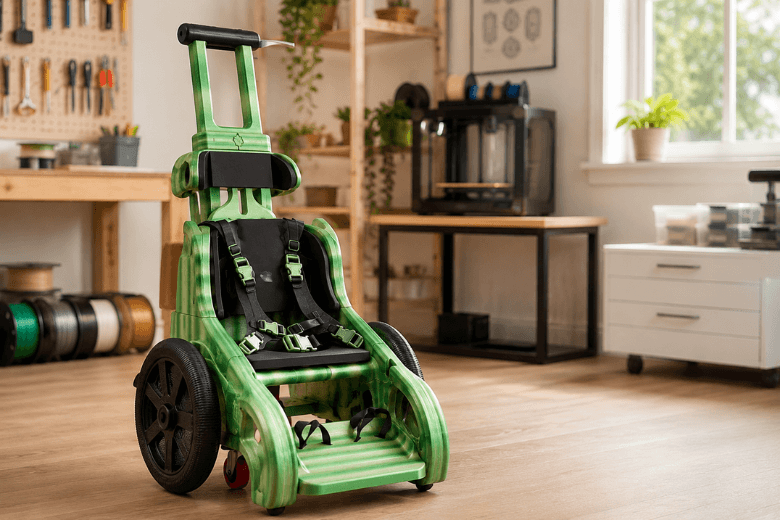
Recently, we received a message from Joshua, a UK-based maker who used Sovol Gradient Green PETG filament to print a toddler mobility trainer for a young boy. The finished project immediately caught our attention: a beautifully printed green mobility trainer with a sturdy frame, smooth gradient colour transitions, supportive seating, footrest sections, and carefully assembled straps.
It was not just a print.
It was a real project made for a real child.
Joshua shared that the trainer used just under 10kg of filament, and that the final result turned out “fantastic”. For us, seeing Sovol filament used in this kind of project is incredibly special. It shows what 3D printing can do when reliable materials meet generous makers and meaningful design.
A Community-Built Mobility Project
The printed trainer is part of a wider maker movement around toddler mobility trainers, often referred to as TMT projects. These designs are created to help young children gain more movement, confidence, and independence through accessible, 3D printed structures.
Projects like these are especially powerful because they bring together open-source design, local makers, families, and practical 3D printing. Instead of waiting for expensive or difficult-to-access equipment, communities can use 3D printers and filament to create useful mobility solutions closer to home.
According to MakeGood / 3D Mobility, their mission is to share free mobility trainer designs so families and makers can help children build mobility and independence. The project also notes that the TMT is a prototype device, so builders and families should carefully review the relevant safety guidance before use.
That is exactly why material choice matters.
When a print becomes part of a large functional project, filament quality is not just about appearance. It affects consistency, strength, print reliability, and the amount of rework a maker may need to deal with during a long build.
Why Gradient Green PETG Worked So Well for This Build
For this mobility trainer, Joshua used Sovol Gradient Green PETG filament.
The result is easy to see from the finished photos. The green gradient creates a layered, almost woodgrain-like visual effect across the frame. On large printed parts, this colour transition gives the whole trainer a more personal, crafted look rather than a plain plastic appearance.
That matters for projects like this. A mobility trainer for a child should feel practical, but it can also feel joyful. The green gradient makes the finished build look bright, friendly, and full of character. It turns the material itself into part of the design.
For large-format or multi-part prints, PETG is also a popular choice among makers because it offers a good balance between usability and durability. It is commonly chosen for functional parts, outdoor-friendly prints, brackets, accessories, organisers, and projects that need more toughness than decorative PLA prints.
In this case, the filament had to support a long print process and a large amount of material usage. Joshua mentioned that the trainer used slightly less than 10kg of filament. That is a serious test for any material, especially when the parts need to match visually and assemble cleanly.
The final result shows exactly why consistent filament matters.
A Real Maker Review, Not Just a Product Claim
What makes this story valuable is that it did not come from a lab test or a marketing photoshoot.
It came from a maker who bought the filament, printed a meaningful project, and shared the result with us afterwards.
Joshua told us that the print quality was excellent and that he was glad he ordered enough filament for the full build. He also mentioned that other makers in his community may be interested in bulk filament purchases for similar mobility trainer projects.
That kind of feedback means a lot to us.
Many makers do not just print small decorative items. They print real-world objects: jigs, tools, replacement parts, workshop fixtures, storage systems, mobility projects, educational models, and custom solutions for families. These prints can take many hours, many spools, and a great deal of patience.
For those makers, reliable filament is not optional. It is the foundation of the project.
Printed on a Bambu A1 — and Looking Toward Faster Production
Joshua printed this trainer using a Bambu A1. The result was already impressive, but he also told us that he is considering adding a faster machine to help produce more mobility trainers for children in need.
This is where printers such as the Sovol SV08 may become useful for makers working on larger community projects.
When a project requires repeated production, large parts, or multiple sets of components, speed and build reliability can make a real difference. A faster printer can help reduce waiting time, increase output, and make it easier for volunteers to support more families.
For makers building large assistive projects, the combination of a capable 3D printer and dependable PETG filament can become a powerful production setup.
Why This Story Matters to Sovol
At Sovol, we often talk about 3D printers, filaments, accessories, and print performance.
But stories like this remind us why those things matter.
A roll of filament may look simple when it sits on a shelf. But in the hands of a dedicated maker, it can become a chair, a support frame, a learning tool, a repair part, or something that brings more confidence to someone’s daily life.
Joshua’s project shows the practical and human side of 3D printing.
It also shows the strength of the maker community. One person prints a trainer. Another shares a design. Someone else recommends a material. A forum helps answer questions. A family receives something that may improve a child’s daily experience.
That is the kind of 3D printing story we are proud to be part of.
Choosing Filament for Large Functional Prints
If you are planning a large functional project, especially one that uses several kilograms of material, here are a few things to consider before you start:
Choose the right material for the job.
PETG is often preferred for functional prints because it offers a practical balance of strength, flexibility, and printability.
Plan your filament quantity carefully.
Large projects can use far more material than expected. Joshua’s mobility trainer used just under 10kg of filament, so having enough spools from the same colour range helps maintain a consistent look.
Test before committing to the full print.
Before printing large parts, it is always worth testing temperature, bed adhesion, wall thickness, and infill settings.
Keep your filament dry.
PETG can absorb moisture over time. For cleaner prints, smoother extrusion, and fewer surface issues, store filament properly and use a filament dryer when needed.
Think about colour as part of the design.
Gradient filament can make large printed objects look more finished and more personal, especially when the project will be seen and used by families or children.
About Sovol Gradient Green PETG
Sovol Gradient Green PETG is available from Sovol UK with UK shipping options. The product page currently lists 1KG, 2KG, 5KG, and 10KG options, making it suitable for both smaller prints and larger multi-spool projects.
Whether you are printing functional parts, workshop tools, large creative builds, or community projects like this mobility trainer, Gradient Green PETG offers a distinctive look and practical material performance for makers who want their prints to stand out.
A Thank You to Joshua and the Maker Community
We want to say a sincere thank you to Joshua for sharing this project with us.
His work is a reminder that 3D printing is not only about machines and materials. It is about people who use those tools to solve real problems, support families, and create something meaningful.
We are honoured that Sovol filament was part of this build, and we look forward to supporting more makers, volunteers, educators, and families across the UK.
If you are working on a large PETG project, a community build, or a functional print that requires multiple spools, Sovol UK is here to help.
Ready to Start Your Own Large-Scale Print?
Joshua’s project was printed with Sovol Gradient Green PETG, but every build has its own material needs. On Sovol UK, you can explore a wider range of 3D printing filaments, including PETG, PLA, gradient colours, silk finishes, glow-in-the-dark options, and larger multi-spool bundles for bigger projects.
Whether you are making functional parts, creative models, workshop tools, educational prints, or community builds, choosing the right filament can help improve print reliability, appearance, and overall project results.
For larger builds, community projects, or repeated production, feel free to contact the Sovol UK team for support, stock planning, and filament recommendations.
Choose the right filament. Print with confidence. Make something that matters.
Share:
Why large 3D prints fail more often than small prints
Is a Filament Dryer Worth It for PLA and PETG?