
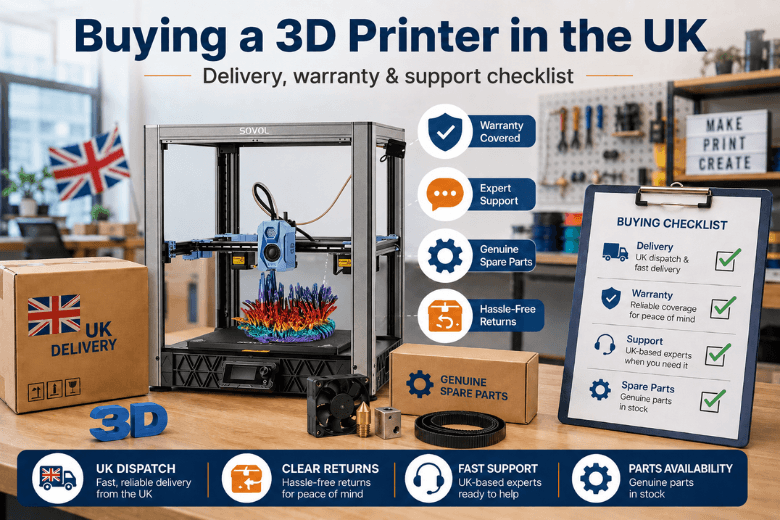
If you’re recommending a 3D printer to a UK makerspace or a large online community, “good specs for the money” isn’t the hard part. The hard part is what happens after someone clicks buy.
-
Will it arrive when you need it for a workshop?
-
If it’s damaged in transit, is there a clear process?
-
If a fan dies in month eight, can you get the right part quickly?
This guide breaks down delivery, warranty, and support in plain English—so you can compare brands like an adult, not like an unboxing channel.
Key takeaways
-
The smoothest UK buying experience comes from UK-stock dispatch, clear returns, and parts availability—not from the headline speed number.
-
Separate change-of-mind returns from faulty-goods fixes. They’re different problems with different processes.
-
Don’t treat “1-year warranty” as a yes/no checkbox. Look for what’s excluded, who pays shipping, and how claims actually work.
-
If a seller ships from overseas, plan for customs/VAT/duty friction and potential delivery delays. Which? explains why surprise charges can appear as import VAT, duty and courier handling fees in their guide to online shopping VAT, import and handling costs.
The quick comparison: what “good” looks like (and what’s a red flag)
|
What you’re checking |
Good (low risk) |
OK (manageable) |
Red flag (expect pain) |
|---|---|---|---|
|
Dispatch location |
UK warehouse with clear stock status |
EU/overseas dispatch but clearly stated |
“Ships in 24h” but no dispatch origin anywhere |
|
Delivery promise |
Specific range (e.g., 2–5 business days) + tracking process |
Broad estimate |
No estimate, or vague “fast shipping” |
|
Split shipments |
Explicitly explained |
Mentioned only in FAQs |
You find out when parts arrive separately |
|
Returns |
14-day window + clear “how to start a return” |
Returns exist but unclear shipping costs |
Returns are hard to locate / “contact us” only |
|
Warranty |
Length + what’s covered + exclusions |
Length stated, details buried |
“Lifetime warranty/support” with no terms |
|
Support channels |
Email + ticketing/chat + hours expectations |
Email only but responsive |
No real contact path; only social DMs |
|
Spare parts |
Common parts listed and in local stock |
Parts exist but long lead times |
“Out of stock” everywhere / no parts catalog |
|
Import charges |
UK-stock (no import) or taxes clearly explained |
Overseas but transparent about customs |
“No extra fees” with no explanation |
Buying a 3D printer in the UK: the logistics checklist
Most buyer regret starts with a simple mismatch: you thought you were buying a printer, but you were really buying a delivery chain, a returns process, and a support queue.
If you only take one thing from this post, take this: read the policy pages like a checklist, not like a promise.
1) 3D printer UK delivery: what to check before you recommend
UK warehouse vs overseas dispatch
If a seller has UK stock, you usually get:
-
faster arrival
-
fewer “tracking not updating” days
-
fewer customs surprises
If the seller ships from overseas (often from China), you may still get a good deal—but you’re accepting more variables: customs clearance, courier handoffs, and longer “unknown” periods.
As a baseline, GOV.UK’s overview of online and distance selling highlights that businesses must provide key information to customers and that delivery expectations should be clear unless you agree otherwise.
Split shipments (printers vs accessories)
It’s extremely common for brands to ship printers and accessories separately. That’s not automatically bad—but it matters if you’re trying to run a workshop next weekend.
What to look for:
-
a clear note that orders may be split
-
which items typically ship together
-
whether tracking numbers are provided per package
Damage in transit: who owns the problem?
For community leaders, the practical question is: If it arrives damaged, can you get a replacement quickly without an argument?
The best policies are blunt and procedural:
-
“Contact us within X days”
-
“Provide photos of packaging + damage”
-
“We ship replacement parts first”
If you can’t find anything like that, assume you’ll be negotiating in an email thread.
2) 3D printer returns policy UK: change-of-mind vs fault
Returns get messy because people use “return” to mean two different things:
-
“I changed my mind.”
-
“This is faulty / misdescribed / arrived damaged.”
They are not the same workflow.
Change-of-mind returns (the “cooling-off” reality)
Many UK buyers expect a short cooling-off window for online purchases. The exact rules depend on what you bought and from whom, but a sensible way to evaluate a seller is: do they clearly explain the timeframe and the process?
Even in a straightforward policy, pay attention to the friction points:
-
Do you need approval before sending it back?
-
Is original packaging required?
-
Who pays return shipping on non-fault returns?
Bulky items matter here. A 3D printer isn’t a USB cable; return shipping cost can wipe out the “saving” that made the deal look good.
Faulty printer: why warranty isn’t your only lever
When something is faulty, a manufacturer warranty is helpful—but it’s not the only thing that matters. Citizens Advice is clear that warranties and guarantees add to your legal rights. In other words: your warranty may be one route, but it shouldn’t be the only route.
If you’re unsure how a seller frames this, check whether they explain the difference between warranty claims and statutory rights (a lot don’t).
3) 3D printer warranty UK: treat it like a contract, not a badge
A good warranty page reads like a repair plan. A weak one reads like marketing.
Here’s what to check.
Coverage: what’s included (and what’s conveniently excluded)
Typical exclusions you should expect to see spelled out:
-
consumables (nozzles, beds/plates)
-
wear and tear
-
damage caused by misuse or poor packaging on return
Those exclusions aren’t automatically unreasonable. The red flag is when exclusions are broad enough that everything becomes “misuse.”
Shipping responsibility for warranty issues
This is one of the biggest hidden costs.
Ask:
-
If a part fails, do they ship you the part, or do you ship the whole printer back?
-
If you do ship something back, who pays shipping?
-
If it’s going overseas, who deals with customs paperwork?
Claim workflow: what they’ll actually ask you for
A mature support process usually requests:
-
order number/proof of purchase
-
photos/video of the issue
-
your shipping address
-
a clear description of what troubleshooting steps you tried
If the policy doesn’t say what evidence is needed, expect back-and-forth.
Pro Tip: If you’re buying for a makerspace, keep a shared “support packet” template: purchase proof, serial number, a short video of the fault, and a list of what you already tested. It cuts ticket time dramatically.
4) Support: measure response time, not promises
“Lifetime support” sounds nice. What you need to know is: How quickly will a human help you get printing again?
The minimum viable support checklist
-
A real support email (not just a form)
-
Clear expectations on response time (even if it’s “within 1 business day”)
-
Troubleshooting docs you can follow without guesswork
-
An escalation path for unresolved issues
For your ICP (maker community leaders), the best support is a mix:
-
responsive official support for warranty cases
-
a strong user community for “weird edge cases” and tuning
Documentation: the quiet support multiplier
If your community is going to teach on these machines, docs matter as much as spare parts.
Look for:
-
setup guides
-
maintenance schedule
-
known-issue troubleshooting
-
firmware/update guidance
A decent example of the kind of internal resource that reduces downtime is a maintenance checklist like Sovol’s blog post, The Ultimate Checklist for 3D Printer Maintenance.
5) 3D printer spare parts UK: avoid the slow-motion failure
If you’re responsible for uptime, spare parts are not “nice to have.” They are the difference between a printer that’s a community asset and a printer that becomes an expensive shelf ornament.
What “parts availability” should mean
At a minimum:
-
parts are listed per model (and per revision if revisions exist)
-
common failure parts are purchasable without emailing support
-
stock status and delivery estimates are visible
Minimum spares list for shared-use printers
For a makerspace or classroom environment, consider having at least:
-
a couple of nozzles (appropriate sizes)
-
one spare fan (hotend/part cooling, depending on model)
-
one spare thermistor or heater cartridge (if the model uses common types)
-
a spare belt or at least known belt spec
-
one spare build surface (PEI sheet/plate, depending on the machine)
You don’t need to overstock. You need to avoid “two-week downtime because a £6 sensor is stuck in customs.”
6) Overseas shipping: avoid the surprise-cost trap
If a printer ships from outside the UK, the checkout price may not be the final price.
GOV.UK’s overview of tax and duty on goods sent from abroad is the canonical starting point. In practical terms, buyers may run into:
-
import VAT
-
customs duty (depending on value/category)
-
courier handling/clearance fees
⚠️ Warning: If taxes/fees are collected on delivery, your parcel can sit in a depot waiting for payment—turning “5–10 days shipping” into “5–10 days plus delays.” Ask whether taxes are included at checkout.
7) A neutral example: how to read a real UK policy page (Sovol UK)
To make this concrete, here’s what it looks like when you read policy pages like a checklist.
Delivery expectations and dispatch model
Sovol UK states in its Shipping Policy that orders may dispatch from a UK warehouse or a China warehouse depending on stock, with UK dispatch typically estimated at 2–5 business days and China dispatch around 5–10 business days. It also notes that overseas dispatch can involve customs clearance.
The corresponding Help Center calls out that orders can be split into multiple packages and that tracking may be limited during customs clearance.
Takeaway: this is the sort of transparency you want—because it lets you plan for workshop timelines.
Returns friction and who pays shipping
On Sovol’s Refund Policy, the headline is a 14-day return window (subject to conditions and approval), and it also states how return shipping is handled depending on whether the issue is quality-related.
Even if you don’t buy from Sovol, use the same lens on any seller:
-
Does the policy explain approval, condition, timelines, and shipping responsibility?
-
Does it explain what happens with missing parts or transit damage?
FAQ
Is “UK shipping” the same as “ships from the UK”?
Not always. Some sites mean “we ship to the UK.” What you want to know is where it dispatches from, because that drives delivery time and customs risk.
If a seller only offers email support, is that a deal-breaker?
Not automatically. If response time is clear and fast, and documentation is strong, email can work. It becomes a problem when email is the only channel and responses take days.
What’s the single best way to reduce downtime?
Two things: (1) choose a printer with easy-to-buy consumables and common replacement parts, and (2) keep a tiny spares kit for the parts that stop printing entirely.
Should we avoid overseas shipping entirely?
Not necessarily. But if your community relies on predictable delivery and quick repairs, UK-stock dispatch and local parts availability typically reduce risk.
Where can I learn more about UK consumer rights online purchases?
Start with GOV.UK’s distance selling guidance (linked above) and treat it as the baseline for what sellers should explain up front.
Next steps
If you’re buying a 3D printer in the UK for a community (or recommending one), do this before you compare specs:
-
Take the table near the top and score each seller as Good / OK / Red flag.
-
Screenshot the delivery estimate and save the policy links you relied on.
-
Make a shortlist of the first parts you’d need if something fails—and check you can actually buy them.
If you want an example of a UK-focused store setup to compare against, you can start with the policy pages on Sovol and see how they handle shipping and refunds in plain language.
Share:
Do You Really Need a Filament Dryer in the UK?
Why large 3D prints fail more often than small prints