
Key takeaways
-
In the UK, humidity isn’t “extreme” — it’s just persistent. That means open spools slowly drift into problem territory, especially in garages, sheds, and shared workshops.
-
You don’t buy a filament dryer to make prints magically better. You buy it to reduce troubleshooting time and make results more consistent, particularly for moisture-sensitive materials.
-
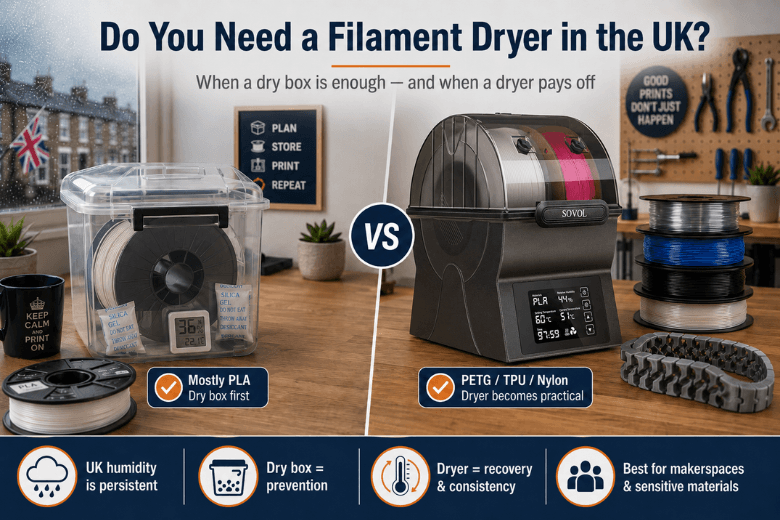
If you mostly print PLA and your storage is decent, a dryer is often optional. If you print PETG frequently (or any TPU/nylon), a dryer starts to pay for itself faster.
-
The cheapest reliable setup for most people is: airtight storage + desiccant + a basic hygrometer, then use a dryer only as a recovery tool when a spool acts up.
A quick decision table (UK-focused)
|
Your reality |
How often filament gets left out |
What you print |
Recommendation |
Why |
|---|---|---|---|---|
|
Heated room, spools bagged/boxed after use |
Rarely |
Mostly PLA |
Dry box first |
Prevention solves most problems at near-zero running cost |
|
Spare room / workshop, spools occasionally left on printer |
Sometimes |
PLA + PETG |
Dry box + “rescue drying” plan |
PETG shows moisture as stringing and surface mess |
|
Garage/shed, or lots of door opening, or shared makerspace |
Often |
PETG + TPU, occasional nylon |
Filament dryer becomes practical |
Cuts down “mystery failures” and saves mentor time |
|
You print TPU/nylon regularly (or teach beginners on them) |
Any |
TPU/nylon/PA |
Treat a dryer as standard kit |
These materials are far less forgiving when wet |
Key Takeaway: A filament dryer is rarely about peak quality. In UK community environments, it’s mainly about predictability.
What actually changes the answer (it’s not just “UK weather”)
There are four variables that matter more than the postcode:
-
Material (PLA vs PETG vs TPU vs nylon)
-
Storage discipline (sealed right away vs “left on the printer for a week”)
-
Failure cost (one failed print is annoying; ten failed workshop prints is a problem)
-
Who’s using the printer (you alone vs a rotating cast of members)
That’s why a filament dryer can be “unnecessary” for a careful home PLA user and borderline essential for a makerspace running PETG through multiple machines.
Sovol’s own calibration guide puts it bluntly: Improve 3D print quality with a better 3D printer setup notes that “the UK is not kind to open spools,” and it lists the classic wet-filament signs.
The 60-second diagnosis: is it moisture or something else?
Moisture problems tend to show up as noisy extrusion and messy surfaces, not subtle tolerance issues.
Signs that strongly point to wet filament
-
Popping / hissing / sizzling at the nozzle
-
Bubbles in extrusion, or a slightly “foamy” line
-
Sudden stringing that wasn’t there on the same profile
-
Rough surfaces that look inconsistent layer-to-layer
-
Brittle parts (or brittle filament that snaps easily)
These symptoms are consistent across multiple troubleshooting resources, including Siraya Tech’s overview of wet filament symptoms and solutions and BCN3D’s support note on print issues related to humid filament.
Signs that are often not moisture
-
Elephant’s foot, poor first layer, warped corners → usually first-layer / bed / airflow issues
-
Dimensional accuracy problems → usually temperature, flow, cooling, or mechanics
-
Intermittent under-extrusion on one printer only → often a partial clog, worn drive gear, or tension issue
Pro Tip: If a spool printed fine for weeks and then “randomly” starts stringing, treat moisture as the first suspect — especially with PETG.
A UK reality check: where your spools live matters more than the forecast
UK homes aren’t tropical — but many of us store printing kit in places that behave like it:
-
garages with temperature swings
-
sheds with condensation cycles
-
spare rooms that get aired out (and humid) frequently
-
shared makerspaces where spools sit out because nobody “owns” them
That’s why the baseline win is boring: seal the spool.
Prusa makes the same point in its guidance on drying filament: the best drying plan is filament storage that avoids having to dry constantly.
When a filament dryer is worth it (UK makerspace scenarios)
1) You run PETG as a default material
PETG is where moisture stops being theoretical and starts becoming operational.
In Sovol’s own PETG printing guide, the troubleshooting logic is basically: dry first, then tune temperature/retraction — because stringing and blobs often appear when PETG has picked up moisture.
If your members print PETG on multiple machines, a dryer reduces the “is it the printer or the filament?” debate.
2) You print TPU or nylon (or you want to teach them reliably)
TPU and nylon are much less forgiving. If you’re mentoring beginners, you want fewer variables — and “this spool has been out for two weeks” is a variable you can eliminate.
A dryer that can maintain a controlled environment during long prints is especially helpful here.
3) You’re trying to reduce downtime, not chase perfect surfaces
A dryer makes sense when your goal is:
-
fewer failed workshop prints
-
fewer mid-print surprises
-
less time spent tuning around symptoms that were never a slicer problem
In other words: it’s a tool for fleet reliability, not just individual print quality.
When a filament dryer is overkill (and what to do instead)
If you mostly print PLA
PLA is usually the most forgiving. For many home users, “don’t leave spools out” plus airtight storage gets you 80–90% of the benefit without a powered device.
If your biggest problem is storage discipline
A dryer won’t fix the real issue if spools live out in the open again immediately after drying.
A pragmatic alternative workflow (and one that maps well to shared spaces) is to focus on sealed containers with desiccant and a hygrometer, and treat active drying as occasional recovery. That’s the core argument of XDA’s piece on using a filament dryer as a recovery tool.
The “cheap, reliable baseline” setup
-
Airtight boxes or vacuum bags
-
Desiccant you can recharge
-
A small hygrometer inside the box
This gives you a clear rule: if the box humidity is creeping up, your desiccant needs attention.
A simple “makerspace filament policy” you can actually enforce
If you lead a community space, your goal isn’t to make every member an expert — it’s to make success the default.
Storage rules
-
Every open spool lives in a sealed container (or a labelled dry box).
-
Desiccant is mandatory in that container.
-
Label the container with date opened (even a bit of tape works).
Drying rules (when to require it)
-
Require drying if you hear popping/hissing, see bubbles, or PETG suddenly strings heavily.
-
Require drying for TPU/nylon spools that have been out overnight in a shared space.
-
Don’t require drying for PLA that’s been properly sealed between sessions, unless symptoms show up.
Workflow rule that saves the most time
When someone reports a print issue, ask one question before touching the printer:
“Did you try a known-dry spool?”
If the answer is no, you haven’t diagnosed anything yet.
⚠️ Warning: Avoid using a domestic oven unless you can verify temperature stability. Overheating can deform filament on the spool and create a bigger mess than the original problem.
If you decide to buy a dryer: what to look for (without getting upsold)
A filament dryer is only useful if it matches how you actually run prints.
Minimum features that matter
-
Stable temperature control appropriate for your materials
-
A path to print while the spool stays protected (especially for long jobs)
-
Capacity that matches your environment (one spool is fine at home; shared spaces often need more)
-
A way to keep filament dry after drying (or a clear handoff to sealed storage)
If you want to browse UK-dispatched options as a reference point, Sovol’s UK store keeps them together in the Filament Dryer collection.
FAQ
Do I need a filament dryer for PLA in the UK?
Not usually — if you reseal PLA after use and store it with desiccant, you can often skip a dryer. If PLA starts popping, stringing unusually, or producing rough surfaces, then a drying cycle can help.
Is a dryer better than a dry box?
They solve different problems. A dry box prevents moisture uptake cheaply. A dryer removes moisture from a spool that’s already picked it up. Many people end up using both: dry box as the default, dryer as the recovery tool.
How do I know it’s wet filament and not bad settings?
Listen for popping/hissing and look for bubbles or steam-like behaviour at the nozzle. If PETG suddenly strings when it didn’t before, moisture is a prime suspect.
What’s the fastest way to reduce stringing in PETG?
Start with moisture. Sovol’s PETG filament guide treats drying and storage as the first move, then you fine-tune temperature and retraction.
If I buy one dryer for a shared space, what’s the best use?
Use it as a triage tool: dry the spools that are causing failures (or any TPU/nylon about to be used), then move those spools straight into sealed storage so you don’t repeat the cycle.
Next steps
If you want to make this operational for your space, start with one small change: pick one sealed storage standard and enforce it for every opened spool. Then add a dryer only if you’re still losing time to moisture-related troubleshooting.
If you’re comparing options, you can use Sovol’s Filament Dryer collection as a simple reference list for UK-dispatched units.
Share:
Wet Filament in the UK: Why Weather Ruins 3D Printer Filament
Buying a 3D Printer in the UK: Delivery, Warranty and Support Explained