
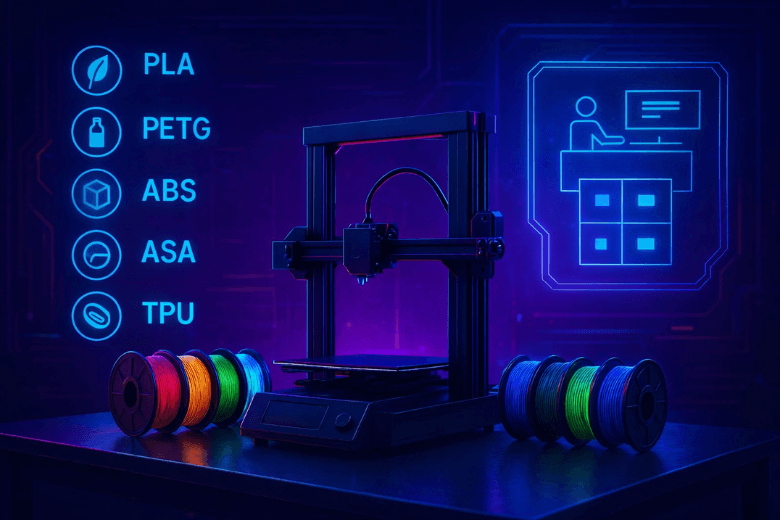
If you’ve ever picked a filament because it was “popular” and then watched corners lift, layers split, or details turn into stringy fuzz… you already know the truth:
Choosing filament isn’t about finding the best material. It’s about matching your part to your environment, your printer setup, and your tolerance for hassle.
This guide is written for UK makers (especially makerspaces, mentors, and community leads) who want something teachable: a simple decision framework, a comparison table you can share, and the real-world gotchas that cause failed prints. If you’re wondering how to choose 3D printer filament without wasting weeks on trial-and-error, start here.
Key takeaways
-
PLA is the easiest default for indoor parts and prototypes, but it’s the wrong choice for heat.
-
PETG is the “tough everyday” option for functional parts when you don’t want enclosure drama.
-
ASA is the outdoor workhorse (UV/weather resistant) if you can control warping.
-
ABS can be strong and heat tolerant, but it’s more demanding and needs ventilation.
-
TPU is for flexible parts (feet, gaskets, bumpers) and prints best with slower speeds and good filament control.
-
In the UK, moisture is a bigger deal than people expect—dry filament prints better, wastes less time, and fails less.
Pick a filament in 60 seconds (quick decision)
Answer these in order:
-
Will the part see heat above ~60°C? (near a motor, in a car, next to a hotend, in direct sun behind glass)
-
Yes → skip PLA. Consider PETG, ABS, ASA, nylon (PA), or PC.
-
-
Will it live outdoors or see lots of UV?
-
Yes → lean ASA (or PETG for “not structural” outdoor bits).
-
-
Does it need to flex like rubber?
-
Yes → TPU.
-
-
Do you have an enclosure (or can you reliably avoid drafts)?
-
No → avoid ABS/ASA/PA/PC for large parts; use PLA or PETG.
-
-
Can you keep filament dry (dry box / dryer / sealed storage)?
-
No → avoid PA and PC for anything you care about.
-
Pro tip: If you’re teaching beginners, standardise on PLA for visuals and PETG for functional parts. You’ll cut failures dramatically.
3D printing filament types: the decision matrix (what actually matters)
When people say a filament is “good”, they usually mean one of these things:
-
it prints reliably on their machine,
-
it survives heat,
-
it resists UV/weather,
-
it doesn’t snap under impact,
-
it isn’t ruined by moisture.
A solid way to evaluate materials is to look at the same criteria used by reputable material comparisons: ease of printing, mechanical behaviour (impact/elongation), heat resistance, and humidity/chemical resistance. Hubs lays out this kind of framework in its 2026 update to “FDM 3D printing materials compared”.
|
Material |
Ease of printing |
Heat resistance |
UV/weather |
Impact/toughness |
Flexibility |
Moisture sensitivity |
Typical best use |
|---|---|---|---|---|---|---|---|
|
PLA |
High |
Low |
Medium |
Low–Medium (can be brittle) |
Low |
Low–Medium |
Clean prints, models, jigs, light-duty parts |
|
PETG |
Medium–High |
Medium |
Medium |
Medium |
Low–Medium |
Medium |
Durable functional parts, indoor fixtures |
|
ABS |
Medium–Low |
High |
Low |
Medium–High |
Low |
Low |
Heat-resistant indoor parts (needs control) |
|
ASA |
Medium–Low |
High |
High |
Medium–High |
Low |
Low |
Outdoor functional parts (needs control) |
|
TPU |
Medium–Low |
Low–Medium |
Medium |
High |
High |
Medium |
Flexible parts, dampers, grips |
|
Nylon (PA) |
Low |
Medium |
Medium |
High |
Medium |
High |
Tough functional parts (drying discipline) |
|
PC |
Low |
High |
Medium |
High |
Low |
Medium |
High strength + heat (advanced setups) |
Treat the table as a starting point. Exact performance depends on brand, additives, and your printer setup.
PLA vs PETG vs ABS: the practical difference
If you only remember one thing, make it this:
-
PLA = easiest, cleanest, best for learning.
-
PETG = tougher, more durable general-purpose functional material.
-
ABS = more heat tolerant and tough if you can manage drafts and ventilation.
Sovol’s beginner-focused progression (PLA first, then PETG/TPU, then ABS) is a sensible learning path, along with typical temperature ranges and setup notes in Sovol’s “FDM 3D printing filament guide for beginners” (updated 2026).
What each filament is best for (with real-world notes)
PLA: the clean, reliable default (until heat shows up)
Use PLA when:
-
you want high success rates, sharp detail, and minimal warping
-
the part stays indoors and won’t get hot
Avoid PLA when:
-
the part sees sustained heat (car interiors, near heaters, enclosed electronics)
-
you need impact resistance (PLA can snap rather than bend)
If you want a straightforward UK-available starter spool, Sovol PLA filament is a simple, low-risk place to begin.
PETG: functional parts without enclosure drama
Use PETG when:
-
you need tougher parts than PLA (clips, mounts, brackets)
-
you want decent moisture/chemical tolerance without jumping to advanced materials
Watch for:
-
stringing that needs a little retraction/temperature tuning
-
first layers that can stick too well if you over-squish
A UK option to point people at (without overthinking it) is Sovol PETG filament.
ABS: heat resistance and toughness, but safety and drafts matter
ABS can be a great material for heat-tolerant indoor parts, but it’s less forgiving.
Plan for:
-
a warm, draft-free environment (often an enclosure)
-
ventilation (especially in shared spaces)
⚠️ Warning: If you’re running ABS (or similar materials) in a makerspace, treat ventilation and user exposure as first-class requirements—not “nice to haves”.
ASA: the outdoor-friendly cousin of ABS
ASA is often chosen for outdoor parts because it’s known for weather and UV resistance compared to ABS.
Choose ASA when:
-
the part will live outside (signage, garden fixtures, outdoor enclosures)
-
you can control warping (draft protection, stable temperatures)
TPU: when you need flex, grip, and impact absorption
Use TPU when:
-
the part needs to flex repeatedly (feet, bumpers, phone cases, gaskets)
Practical note:
-
TPU likes slower speeds and consistent filament path control.
Nylon (PA): tough, wear-resistant… and thirsty
Nylon is famous for toughness and wear resistance—and for absorbing moisture.
If you can’t keep it dry, nylon will waste your time.
Polycarbonate (PC): advanced mode
PC can deliver high heat resistance and strength, but it usually demands high temperatures and a stable printing environment. It’s not a “first spool” material.
Filament storage (especially in the UK): symptoms, routine, and when to dry
Wet filament can look totally normal… until you print it.
Common signs of moisture:
-
popping/crackling at the nozzle
-
extra stringing and blobs
-
rough, foamy surfaces
-
weak layers and brittle parts
For a practical humidity-first storage setup, Ruuvi’s 2026 update to “Managing temperature and humidity in 3D printing and filament storage” is a helpful reference.
For drying methods across materials, Wevolver’s 2026 update to “How to Dry Filament: PA, TPU, PLA, PVA & PET” is a solid overview.
And for a checklist-style “what to dry and when”, Bambu Lab’s “Filament Drying Recommendations” is useful.
If you want to make drying part of a repeatable workflow, Sovol’s UK store has a dedicated Filament Dryers collection you can browse based on how many spools you need to keep ready.
Common mistakes (and how to avoid them)
1) Swapping materials before your basics are stable
If you’re still chasing first-layer consistency, don’t add “mystery filament” as another variable. Standardise one PLA profile first.
2) Treating PETG like PLA
PETG often needs different retraction and cooling habits. If you get stringing, change one variable at a time (temperature, retraction, then speed).
3) Printing ABS/ASA in a cold draft
If the room is cold or there’s airflow across the printer, warping and cracking become much more likely.
4) Assuming filament is dry because it’s new
New doesn’t mean dry. If a spool has been in shipping or storage, a short drying cycle can save an entire job.
FAQ
What filament should I start with?
PLA. It’s forgiving, consistent, and lets you learn your printer without fighting warping and fumes.
Do I need a filament dryer in the UK?
Not always—but if you print regularly, store spools in a garage/shed, or use moisture-sensitive materials (nylon, TPU, PVA), a dryer can turn intermittent problems into predictable results.
What’s the biggest reason prints suddenly start failing?
Moisture, bed contamination, and changed ambient conditions are common culprits. If you hear popping or see sudden stringing, suspect wet filament first.
Next steps
If you want a low-drama setup for a UK makerspace:
-
Standardise on one PLA.
-
Add PETG for tougher parts.
-
Add an outdoor option (ASA) only when your setup supports it.
-
Build a simple “keep it dry” routine.
If you’re printing a lot (classes, workshop batches, community projects), bulk spools can reduce cost per print and reduce “we ran out mid-job” chaos. A UK example is a 10kg PLA filament bundle.
Share:
How Does FDM 3D Printing Work? PLA to Finished Print
PLA vs PETG vs ABS: Which Filament Should You Choose?