
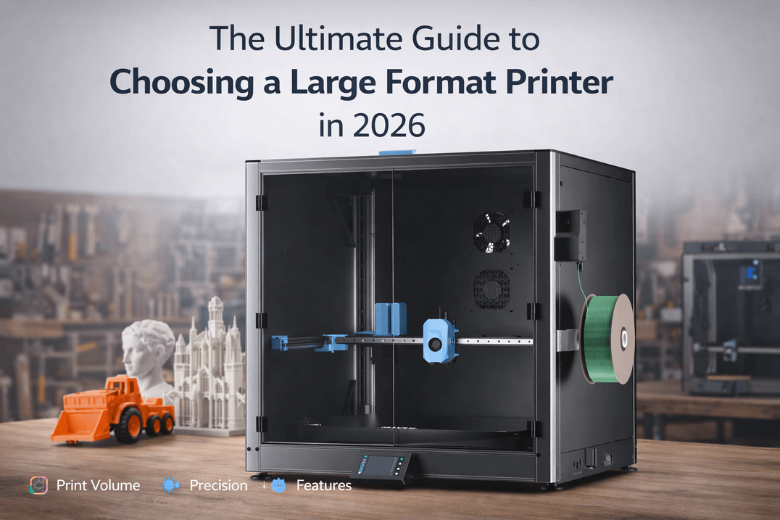
I always recommend choosing a large format printer by matching it to your main application. If you produce technical drawings, vibrant graphics, or durable signage, your needs will differ. The market for large format printers continues to expand, driven by high-quality print quality and new applications. I see signage taking the lead, making up over 40% of usage. When I evaluate options, I check print volume, media compatibility, and reliability. I compare top brands, read reviews, and use a buying guide. I suggest focusing on your priorities, whether you want the best large format printer for photographers, canvas, graphic designers, posters, or even the best large format sublimation printer. The Sovol SV08 Max 3D Printer stands out for large format photo printers.
-
Large format printing now supports sustainability, advanced colour management, and durability.
Key Takeaways
-
Match your large format printer to your specific application, whether for technical drawings, vibrant graphics, or durable signage.
-
Always evaluate print resolution and quality; high dpi ensures sharp details and accurate colour reproduction for professional results.
-
Consider print volume and speed; choose high-volume printers for busy environments and reliable models for occasional use.
-
Check ink systems; dye-based inks offer vibrant colours for indoor use, while pigment-based inks provide fade resistance for outdoor applications.
-
Assess connectivity options; modern printers should support wireless features for flexibility and ease of integration into your workflow.
Key Features of Large Format Printers
Print Resolution and Quality
I always start my evaluation of a large format printer by looking at print resolution and quality. High resolution matters when I want to achieve sharp detail, especially for technical drawings or photographic work. Printers with very high dpi keep images crisp, even at large sizes. I have noticed that colour accuracy plays a vital role in matching what I see on my screen to the final output. This becomes essential for branding, graphic design, and professional photography. When I compare models, I check sample prints and look for consistent colour reproduction. I also consider the printer’s ability to handle gradients and fine lines, as these often reveal the true capabilities of the device.
Tip: Always request sample prints from suppliers before making a decision. This helps me judge real-world print quality, not just specifications.
Print Volume and Speed
Print volume and speed influence my workflow and productivity. I assess how many square metres a large format printer can produce per hour. For high-volume environments, speed becomes a priority. I look for printers that maintain quality at higher speeds, as some models sacrifice detail for output rate. I also consider the duty cycle, which tells me how much printing the machine can handle each month without issues. If I run a busy print shop, I need a printer that can keep up with demand. For occasional use, I focus more on reliability and ease of use.
-
High-volume printers suit busy offices and print shops.
-
Lower-volume models work well for studios or small businesses.
-
Consistent speed without quality loss is a key differentiator.
Ink Systems and Colour Accuracy
Ink technology has advanced rapidly in recent years. I see two main types of large format printers: dye-based and pigment-based ink systems. Dye-based inks give me vibrant colours and smooth finishes, which I prefer for indoor graphics and posters. Pigment-based inks offer better fade resistance, making them ideal for outdoor signage and long-lasting displays. The compatibility of ink with media and protective coatings affects print longevity. I always check if the printer supports water-based or UV-curable inks, as these options are safer and more energy-efficient. Many manufacturers now use greener substrates and recyclable materials, which aligns with sustainability goals.
-
Dye-based inks: Vibrant colours, best for indoor use.
-
Pigment-based inks: Fade-resistant, suitable for outdoor applications.
-
Water-based and UV-curable inks: Lower environmental impact.
-
Recyclable and PVC-free materials: Support sustainable large format printing.
Connectivity Options
Connectivity options determine how easily I can integrate a large format printer into my workflow. In 2026, most large format printers offer a range of modern and legacy connections. I always check for wireless features, as these allow flexible placement and remote printing. Wired connections provide stability, which I value in high-demand environments. I rarely use older ports, but they may still appear on some models for compatibility.
|
Connectivity Option |
Description |
|---|---|
|
WiFi |
Allows wireless printing, ideal for remote placement of printers. |
|
USB |
Direct connection to a computer for printing. |
|
Bluetooth |
Wireless connection for mobile printing. |
|
Ethernet |
Wired connection for stable network access. |
|
Parallel/Serial |
Older connection types, now largely phased out. |
When I compare types of large format printers, I always match connectivity to my existing systems. This ensures seamless integration and reduces setup time.
Note: I recommend checking for certification and transparency in sustainability claims. Many brands now provide detailed reporting on materials and processes, which helps me make informed choices.
I use this buying guide to compare features directly. I focus on print resolution, speed, ink system, and connectivity. This approach helps me identify the best large format printer for my needs and ensures I invest in a model that supports my workflow and sustainability goals.
Types of Large Format Printers
When I evaluate the types of large format printers, I always consider how each technology matches my workflow and output requirements. The main categories include inkjet, laser, and specialist or hybrid models. Each offers distinct advantages for different applications.
Inkjet Large Format Printers
I find inkjet large format printers ideal for producing vibrant images and high-quality colour documents. These printers use liquid ink sprayed onto media, which allows for exceptional detail and colour accuracy. I often recommend them for photography, graphic design, and art reproduction. Their versatility stands out, as they can print on a wide range of materials, including canvas, vinyl, and textiles.
Advantages of inkjet large format printers:
-
High print quality with rich colours and fine detail
-
Versatile media compatibility
-
Lower initial cost and compact size
-
Energy efficient operation
Disadvantages:
-
Slower print speeds compared to other types of large format printers
-
Higher running costs due to frequent ink cartridge replacements
-
Prints may smudge or fade if not handled properly
Tip: I always perform regular maintenance to keep printheads in top condition and ensure consistent results.
Laser Large Format Printers
Laser large format printers excel in speed and efficiency. I choose these models for high-volume environments, such as architectural firms or busy offices. They use powdered toner fused with heat, which produces water and smudge-resistant prints. Although the initial investment is higher, the lower cost per page makes them economical for bulk printing.
|
Feature |
Inkjet Printer |
Laser Printer |
|---|---|---|
|
Printing Technology |
Liquid ink sprayed onto paper |
Powdered toner fused with heat |
|
Best For |
Photos, colour documents |
Black-and-white text, bulk printing |
|
Print Speed |
Slower |
Faster |
|
Cost per Page |
Higher |
Lower |
|
Initial Cost |
Lower |
Higher |
|
Durability |
Can smudge |
Water and smudge-resistant |
I notice that laser printers are less common for colour-critical work but dominate where speed and durability matter most.
Specialist and Hybrid Models
In 2026, I see specialist and hybrid large format printers offering advanced features for unique production needs. Some models focus on eco-friendly printing, using sustainable inks and minimal waste. Others combine digital and screen printing, delivering high-speed output and soft hand feel for textiles.
|
Feature |
Description |
|---|---|
|
Eco-Friendly Printing |
Uses sustainable inks, over 360 units per hour (A3 format) |
|
High-Speed Digital Station |
Complements automatic screen printing, up to 360 prints per hour |
|
UVgel 860 Ink Set |
Instant-dry prints for rigid and flexible applications |
|
Printhead Technology |
Automated nozzle monitoring for consistent quality |
|
Media Handling |
Vacuum belt system reduces wrinkling and skewing |
I recommend these specialist models for industrial production, textile printing, and businesses seeking sustainable solutions. The right choice depends on your specific application and production goals.
Matching Large Format Printer to Use Case
Selecting the right large format printer always starts with understanding the intended application. I match my choice to the type of work I produce, whether that involves technical drawings, vibrant posters, textiles, or outdoor signage. Not all large format printers can handle every media type or output requirement. I always check both the printer’s capabilities and the specific paper or material I plan to use.
It is really important to select the correct paper not only for your project, but also paper that is suitable for your printer. Not all large format printers can handle every type of media. Large format printers are often made with a specific job in mind, so whether that is for printing CAD plans and technical drawings or whether you are printing Fine Art and Photography you no doubt will have selected a printer for the intended end use you had in mind.
Technical and CAD Printing
When I print technical drawings or CAD plans, I focus on precision and reliability. I look for a large format printer with high print resolution and excellent line accuracy. These features help me reproduce intricate vectors and fine text without distortion. I also value robust media handling, especially if I need to print continuous rolls. Pigment inks provide longevity and resistance to fading, which is essential for archival work. Fast printing speeds and wireless connectivity improve my workflow.
-
Print resolution and line accuracy for detailed drawings
-
Reliable media handling for continuous output
-
Pigment inks for durability
-
Fast speeds and wireless integration
Graphics and Posters
For graphics and poster production, print quality takes priority. I always define the purpose of my print before starting the design. High-resolution images prevent pixelation when enlarged, and I use bold, clear typography for visibility. I check that my images have a resolution of at least 150 dpi, and I review artwork at 50% scale to confirm clarity. Large, legible fonts and ample white space keep the design clean.
Higher dpi means more detail. For example, 300 dpi provides high-quality, detailed images, while 72 dpi results in pixelation.
-
Use high-quality design tools for clarity
-
Ensure images are 100-300 ppi for sharpness
-
Choose large fonts and avoid clutter
Canvas and Textile Printing
When I print on canvas or textiles, I select materials and inks based on the final application. I use special fabrics like SoTex for displays and backlit uses. For retail and interior design, lightweight and transportable materials work best. I rely on direct dye-sublimation or transfer printing for fabrics, especially those with high polyester content. For outdoor advertising, I choose vinyl-coated polyesters for UV resistance and moisture protection. I always ensure compliance with fire safety standards for commercial displays.
-
Use appropriate materials for indoor or outdoor use
-
Employ dye-sublimation for polyester fabrics
-
Ensure fire safety compliance for public venues
Outdoor Signage and Banners
Outdoor signage demands durability and weather resistance. I choose vinyl options like solvent-based PVC or eco-solvent for long-term use. Mesh vinyl allows wind to pass through, making it ideal for large banners. Correx boards offer a lightweight, weather-resistant solution for signs. I also consider ink types, selecting eco-solvent or mild solvent inks that bind to the substrate for toughness and flexibility.
|
Feature |
Description |
|---|---|
|
Ink Type |
Eco-solvent or mild solvent for outdoor durability |
|
Durability |
Inks bind to substrate, tough even without lamination |
|
Flexibility |
Materials stretch without cracking, ideal for windy conditions |
|
Material Choice |
PVC banners, mesh vinyl, and Correx boards for different outdoor needs |
By aligning my large format printer choice with my primary use case, I ensure the best results and avoid costly mistakes.
Media Compatibility in Large Format Printing
Supported Media Types
When I select a large format printer, I always check the range of media it supports. The right media compatibility ensures I can deliver the results my clients expect. In 2026, leading large format printers handle a wide variety of materials. I see this versatility as essential for businesses that serve multiple markets or want to expand their services.
-
A1 Multi-Function Printers allow me to print technical drawings and posters with precision.
-
A0 Multi-Function Printers give me the flexibility to produce larger architectural plans and banners.
-
Signage Printers work well for banners, posters, retail graphics, and even vehicle wraps.
-
Sublimation Printers open up opportunities for printing on T-shirts, mugs, sportswear, and home décor.
I always match the printer’s capabilities to my main applications. This approach helps me avoid costly mistakes and ensures consistent results across different projects.
Roll vs Sheet Feeding
I often compare roll feeding and sheet feeding when I assess large format printers. Each method offers distinct advantages, and the choice depends on my workflow and production needs. I have summarised the main differences in the table below:
|
Aspect |
Roll Feeding |
Sheet Feeding |
|---|---|---|
|
Efficiency |
Higher efficiency due to full-speed operation |
Reduced efficiency due to manual reloading |
|
Media Handling |
Handles output from multiple printers seamlessly |
Requires manual handling and is prone to mis-feeding |
|
Production Time |
No delays in production, immediate conversion |
Stopping to reload reduces production time |
|
Operator Skill Requirement |
Fewer operators needed, less skill required |
Additional skill and training needed for operation |
|
Cost |
Lower hardware costs with no additional feeders |
Higher costs due to additional equipment needed |
Roll feeding gives me uninterrupted production and reduces the need for manual intervention. I find this method ideal for high-volume environments. Sheet feeding, on the other hand, suits smaller runs or specialised jobs where I need to use unique media sizes. I always consider my typical job types before making a final decision.
Budget and Cost of Ownership
Upfront Costs vs Long-Term Value
When I choose a large format printer, I always weigh the initial price against the long-term value. The cost of large format printers can seem high at first, but I know that ongoing expenses often have a bigger impact on my budget. I look beyond the purchase price and consider factors like ink usage, maintenance, and energy consumption. These ongoing costs can add up quickly and sometimes exceed my expectations. I also check if the printer supports upgrades or uses sustainable materials, as this can save money and reduce environmental impact over time.
Tip: I always evaluate the total cost of ownership, not just the upfront cost. This approach helps me make a sound investment and avoid hidden expenses.
Ink and Consumable Expenses
Ink and consumables represent a significant part of my running costs. I compare ink consumption rates and cartridge prices before I commit to a model. Over five years, these expenses can become substantial. For example, ownership might involve a large initial payment and variable running costs, while rental options provide predictable monthly fees and include maintenance. I have summarised typical costs in the table below:
|
Cost Type |
Ownership Cost |
Rental Cost |
|---|---|---|
|
Initial Payment |
£2,000 |
N/A |
|
Annual Supplies & Maintenance |
£600/year |
Included |
|
Repair Costs (over 5 years) |
£500 |
N/A |
|
Total Cost Over 5 Years |
£5,500 |
£7,200 |
I always factor in these numbers when I plan my budget for large format printers.
Maintenance and Reliability
Maintenance and reliability play a crucial role in my decision. I prefer printers with robust support and easy access to replacement parts. Regular servicing keeps my machine running smoothly and prevents costly breakdowns. I also look for models with transparent warranty terms and responsive customer service. Hidden costs, such as unexpected repairs or downtime, can disrupt my workflow and increase my expenses. I always ask suppliers about maintenance schedules and typical repair costs before I buy.
Note: Reliable printers with good support reduce stress and help me focus on delivering quality work to my clients.
Buying, Leasing, and Top Brands
Buying vs Leasing Options
When I consider investing in a large format printer, I always weigh the benefits of buying against leasing. Each option suits different business needs. I use a buying guide to compare the financial impact and flexibility of both approaches. Leasing appeals to me when I want to keep my upfront costs low and prefer predictable monthly payments. Maintenance often comes included, which reduces unexpected expenses. Buying gives me full ownership and the freedom to customise my equipment. I avoid ongoing payments and can achieve long-term savings if I plan to use the printer for many years.
Here is a summary I use in my buying guide:
|
Aspect |
Leasing Benefits |
Buying Benefits |
|---|---|---|
|
Initial Costs |
Lower upfront capital required |
Full ownership of the equipment |
|
Monthly Payments |
Fixed monthly payments for budgeting |
No ongoing payments after purchase |
|
Upgrades |
Regular upgrades to latest models included |
Freedom to choose and customise the copier |
|
Maintenance |
Maintenance often included in lease agreements |
No lease restrictions on maintenance |
|
Tax Implications |
Lease payments may be tax-deductible |
Potential long-term cost savings |
I always match my choice to my cash flow, business growth plans, and how often I expect to upgrade my large format printers.
Leading Brands in 2026
I rely on my buying guide to compare the top brands before I make a decision. In 2026, several manufacturers stand out for their innovation and reliability. I look for features that match my workflow, such as print speed, ink technology, and media handling. The table below highlights the leading brands and their distinguishing features:
|
Brand |
Model |
Distinguishing Features |
|---|---|---|
|
Canon |
imagePROGRAF PRO-1100 |
12 LUCIA PRO ll inkjet cartridges, high resolution (2400 x 1200 DPI), ideal for photography. |
|
HP |
DesignJet Z9+ PS 44" |
500GB hard drive, 9-colour ink set, high-speed printing, integrated vertical trimmer. |
|
Epson |
SureColour SC-F9300 |
Print speeds up to 108.6m²/hr, PrecisionCore MicroTFP printhead, UltraChrome 12 cartridge ink set. |
|
Epson |
SureColour SC-T3405 |
Prints A1 posters in 24 seconds, UltraChrome XD2 inks, supports various ink cartridge sizes. |
|
Canon |
imagePROGRAF PRO-6600 |
60 inches printing space, dual roll functionality, Chroma Optimiser for enhanced image quality. |
I always check which models offer the best fit for my main applications and which brands provide reliable support.
Reading Reviews and Comparisons
I use a buying guide to help me interpret reviews and comparisons of large format printers. I focus on ink pricing and cartridge value, as some printers offer high-capacity units or multi-packs that lower the cost per millilitre. I do not rely on headline prices alone. I also look for printers that support different ink cartridge sizes, as this flexibility helps me manage ink usage and reduce replacement frequency. The ability to mix and match ink tanks allows me to optimise my printing environment and control running costs. I always read user feedback on reliability and service, as these factors influence my long-term satisfaction.
Tip: I recommend reading reviews that discuss real-world performance, not just technical specifications. This approach gives me a clearer picture of how a large format printer will perform in my business.
I always follow a clear process when selecting the best large format printer. I assess support, servicing, sustainability, and performance. I create a checklist with usability, financial, and practical questions to compare options. Balancing print quality, consumable costs, and future requirements helps me make a sound investment.
|
Cost Factors |
Description |
|---|---|
|
Ink, media, print heads, cleaning accessories |
|
|
Service Costs |
Service contracts or charges |
I consult suppliers and involve operators and IT teams to ensure my final choice meets all technical and production needs.
FAQ
What is the main difference between types of large format printers?
I notice that inkjet models deliver high print quality for photos and graphics. Laser options suit technical drawings and high-volume work. Specialist models handle unique tasks like textile or eco-friendly large format printing. I always match the printer type to my main application.
How do I choose the best large format printer for photographers or graphic designers?
I look for large format photo printers with high resolution and accurate colour reproduction. The best large format printer for photographers or graphic designers offers advanced ink systems and supports a wide range of media. I always check sample prints before making a decision.
What should I consider when comparing the cost of large format printers?
I compare the upfront price, ink and consumable expenses, and maintenance. The cost of large format printers includes more than just the purchase. I use a buying guide to estimate long-term value and avoid hidden fees.
Which features matter most for the best large format printer for posters or canvas?
I focus on print quality, media compatibility, and ink durability. The best large format printer for posters or canvas supports vibrant colours and handles heavy materials. I always check if the printer can manage both roll and sheet feeding.
Is there a best large format sublimation printer for textiles?
I recommend looking for a model designed for dye-sublimation. The best large format sublimation printer offers consistent results on polyester fabrics and supports high-volume production. I always check for reliable support and easy maintenance.
Share:
Is the Sovol SV08 Max Worth It for Big Projects? Our In-depth Analysis
Why CoreXY Kinematics Lead to Faster and Higher Quality 3D Printing