
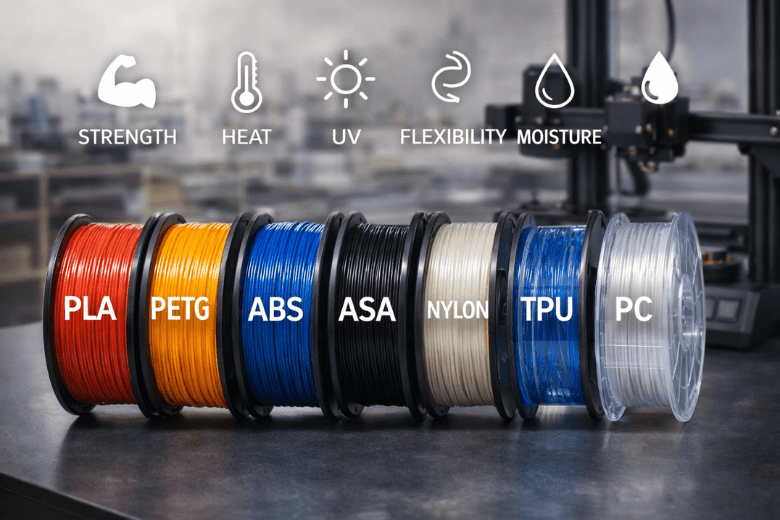
Choosing the right filament isn’t about finding the best material. It’s about matching your project (load, heat, outdoors, looks) to your printer setup (enclosure, ventilation, storage) and your tolerance for hassle.
This UK-focused guide gives you a repeatable framework you can teach to beginners, use in a makerspace, or apply to your own builds.
Key takeaways
-
For most indoor prints, PLA is the easiest starting point.
-
For functional parts without enclosure drama, PETG is the usual next step.
-
For outdoor parts, ASA is often the better choice than ABS because of UV/weather resistance.
-
If you need flexibility, TPU filament is the go-to.
-
If you need wear resistance, nylon filament (PA) can be excellent—but only if you can keep it dry.
-
Polycarbonate (PC) filament is powerful but unforgiving: high temps, stable environment, dry filament.
How to choose 3D printing filament: a 60-second decision
Answer these in order:
-
Will the part see heat above ~60°C? (near a motor, in a car, in a warm enclosure)
-
Yes → skip PLA. Consider PETG, ABS, ASA, nylon (PA), or PC.
-
-
Will it live outdoors or in UV?
-
Yes → lean ASA (or PETG for light-duty outdoor parts).
-
-
Does it need to flex like rubber?
-
Yes → TPU.
-
-
Do you have an enclosure (or can you reliably avoid drafts)?
-
No → avoid ABS/ASA/PA/PC for larger parts; use PLA or PETG.
-
-
Can you keep filament dry (sealed storage / dryer)?
-
No → avoid PA and PC for anything you care about.
-
Pro tip: If you’re teaching newcomers, standardise on PLA for visual prints and PETG for functional parts. You’ll reduce failures and arguments.
The 5 questions that decide the right filament (use this in any project)
1) What’s the job: display, fit-check, or real load?
-
Display / models / cosplay → PLA.
-
Fit-checks and light-duty brackets → PLA or PETG.
-
Functional parts that get knocked, dropped, or tightened with screws → PETG or ASA/ABS.
2) What kind of stress: bending stiffness, impact, or wear?
-
Stiffness (rigid feel) → PLA can be stiff, but it’s more brittle.
-
Impact (drops/knocks) → PETG and ASA/ABS tend to survive better.
-
Wear and sliding (hinges, gears) → nylon (PA) is often a strong fit.
3) What’s the environment: heat, UV, water, chemicals?
If you’re unsure what “counts” as heat- or UV-sensitive, skim the material-by-material use-case notes in UltiMaker’s guide once (we’ll refer back to it without re-linking): 3D printer filament types and uses (UltiMaker).
4) What can your printer realistically handle?
Some materials need stable temperatures to avoid warping and layer cracking. Prusa’s overview is a good sanity check for which materials commonly benefit from an enclosure and higher bed temps: Filament material guide (Prusa Knowledge Base).
5) How much hassle can you tolerate?
The “best” filament is the one you can print consistently with your reality:
-
If you don’t want to babysit prints: stay in PLA/PETG.
-
If you want outdoor and heat resistance: accept that ASA/ABS want control (enclosure, tuning).
-
If you want wear resistance: accept that PA wants dryness.
Filament comparison table (PLA vs PETG vs ABS vs ASA vs TPU vs nylon vs PC)
Use this to shortlist, then validate with a small test print.
|
Filament |
Best for |
Avoid if… |
Enclosure usually needed? |
Moisture sensitivity |
|---|---|---|---|---|
|
PLA |
Easy indoor prints, prototypes, teaching |
Heat exposure or repeated impact |
No |
Low |
|
PETG |
Tough everyday functional parts |
You refuse to tune stringing |
No |
Medium |
|
ABS |
Heat-tolerant indoor functional parts |
Poor ventilation / drafty setup |
Recommended |
Low |
|
ASA |
Outdoor parts, UV exposure |
You can’t manage warping/drafts |
Recommended |
Low |
|
TPU |
Flexible parts: feet, gaskets, bumpers |
Your extruder can’t feed soft filament |
No |
Medium |
|
PA (Nylon) |
Wear parts, hinges, gears, tough brackets |
You can’t store/dry filament |
Recommended |
High |
|
PC |
High heat + strength (advanced) |
Your printer can’t run high temps reliably |
Recommended |
High |
If you want to compare materials by specific mechanical/thermal properties (rather than vibes), you can use the checkbox comparison view in Simplify3D’s filament properties table.
What each filament is best for (and what usually goes wrong)
PLA: clean, reliable, and great for learning
Use PLA when:
-
You want high success rates and clean surfaces.
-
You’re printing indoors and the part won’t get hot.
Avoid PLA when:
-
The part might soften in warm conditions (car interiors, near motors, in a warm enclosure).
PETG: the functional default for many makerspaces
Use PETG when:
-
You want a tougher part than PLA without moving to enclosure materials.
-
You need decent water/chemical resistance for everyday use.
Common failure mode: stringing.
-
Fixes that usually matter more than “magic settings”: dry the filament, reduce temperature slightly, and tune retraction.
ABS vs ASA: if you need heat (and especially outdoors)
ABS is a common step up for heat-tolerant parts, but it’s more sensitive to drafts and benefits from ventilation.
ASA is often the better choice for outdoor use because it’s designed to handle UV/weather exposure.
Common failure modes: warping and layer cracking.
-
Fixes that actually move the needle: enclosure, stable ambient temperature, and not overcooling the part.
TPU filament: flexible parts that survive drops
Use TPU when:
-
You need grip, flex, or vibration damping (feet, bumpers, seals).
Common failure mode: feeding issues.
-
Fix: slow the print down and keep the filament path constrained.
Nylon filament (PA): wear resistance, toughness, and real-world durability
Use nylon when:
-
You need tough parts that handle repeated movement or wear.
Common failure mode: moisture.
⚠️ Warning: If nylon has been out for a while, it may print rough/bubbly and lose strength. Drying and sealed storage are part of the material.
Polycarbonate (PC) filament: advanced mode
Use PC when:
-
You have a printer that can hold high temps steadily and you genuinely need the performance.
Common failure mode: instability (temps + moisture).
-
Fix: dry filament, reduce drafts, and treat the printer environment as part of the process.
Printer and space constraints (what decides success in the real world)
Enclosure: not a luxury for ABS/ASA/PA/PC
If you’re printing ABS, ASA, nylon (PA), or PC at any meaningful size, an enclosure is often the difference between “it works” and “it’s a warping simulator.”
If you’re choosing a printer or upgrading your setup for more materials, this Sovol UK piece is a useful reference point for enclosed printing capability and material notes: SV08 Max 3D printer review.
Ventilation: plan for it early
In shared rooms (classrooms, makerspaces), treat ventilation as a requirement—especially if you plan to run ABS regularly. Even if you’re technically able to print it, the space might not be.
Bed adhesion is the highest-impact fix for workshop success rate
If you’re trying to increase printer uptime, don’t start with exotic filaments. Start with first-layer repeatability.
Sovol’s practical checklist is worth sharing with new members: Top 7 3D printing bed adhesion solutions (Sovol).
Filament storage & drying (UK reality)
In the UK, humidity swings can quietly wreck repeatability—especially with PA and PC.
Rules that work in busy spaces:
-
Keep spools in sealed boxes or bags with desiccant.
-
Label spools with “opened date” and “last dried date.”
-
If a spool suddenly strings more, prints rough, or pops/hisses, treat it as “needs drying” before you chase slicer settings.
If you want a simple, safe default for family-friendly projects, PLA remains the easiest material to manage. This Sovol UK blog post uses PLA as the suggested choice for casual projects: Fun Easter 3D printing projects for the family.
Quick troubleshooting: symptom → likely cause → what to try
|
Symptom |
Likely cause |
What to try |
|---|---|---|
|
Corners lifting / warped base |
Shrink + drafts (ABS/ASA/PA/PC) or weak first layer |
Enclosure, brim, hotter bed, slower first layer, better bed prep |
|
Stringing everywhere |
Moisture (PETG/TPU) or retraction mismatch |
Dry filament, reduce temp slightly, tune retraction |
|
Cracks between layers |
Part cooling too fast (ABS/ASA/PC) |
Enclosure, reduce fan, stabilise ambient temps |
|
Bubbly surface / popping |
Moisture (often PA/PC; sometimes PETG/TPU) |
Dry spool, sealed storage |
|
Part snaps instead of bends |
PLA brittleness / wrong material |
Switch to PETG/ASA/TPU depending on need |
FAQ
What’s the most beginner-friendly filament?
PLA. If you need tougher functional parts, PETG is the usual next step.
Is PETG stronger than PLA?
It depends what you mean by “strong.” PLA can be stiff, but PETG often handles impact and abuse better. Use the decision framework above: environment + load type decides.
ABS vs ASA: which should I pick?
If it’s outdoors or UV-exposed, ASA is usually the more sensible choice. If it’s indoors and you’re set up for it, ABS can work well—but it raises the bar on environment control and ventilation.
Do I really need to dry nylon?
If you care about repeatability: yes. Treat drying and sealed storage as part of printing nylon.
Next steps (and a light Sovol mention)
If you’re standardising materials for a classroom or makerspace:
-
Choose PLA as the default teaching filament.
-
Add PETG as the “functional parts” option.
-
Introduce ASA after you have enclosure + process discipline.
If you’re in the UK and you value local support plus open-source-friendly hardware and accessories, Sovol is worth keeping on your shortlist.
Share:
PLA vs PETG vs ABS: Which Filament Should You Choose?
How PLA Filament Works: From Digital Design to 3D Printed Model