
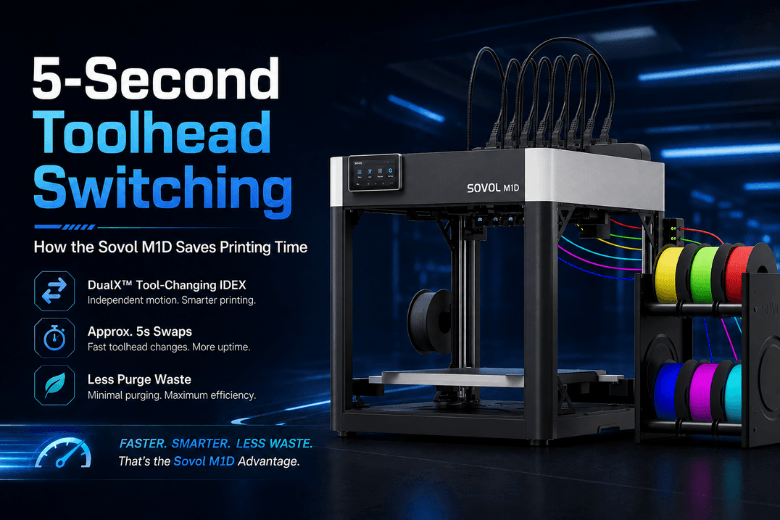
Key Takeaway: The Sovol M1D combines an Independent Dual Extruder (IDEX) setup with a 6-slot automated tool changer, enabling toolhead swaps in approximately 5 seconds. By eliminating the lengthy retract-cut-purge cycles required by single-nozzle multi-material systems, the M1D reduces total multi-color print times by 60% to 80% and cuts filament waste by up to 95%.
Multi-color and multi-material 3D printing has long suffered from a major bottleneck: wasted time. Traditional multi-material systems that feed several filaments through a single hotend spend more time purging plastic, cooling nozzles, and cutting filament than actually laying down layers. For complex models with hundreds of color changes, a print that should take 8 hours can easily stretch past 30 hours.
The Sovol M1D 5-second toolhead switching system addresses this delay at the hardware level. Built on Sovol's DualX™ architecture, the machine pairs a fixed primary extruder with an active tool-changing carriage capable of swapping between six independently heated toolheads in roughly 5 seconds.
For UK makerspaces, university fabrication labs, and prototyping hubs evaluating high-throughput desktop FDM 3D printers, understanding how this 5-second swap works—and the exact math behind the time savings—is essential for optimizing workshop efficiency.
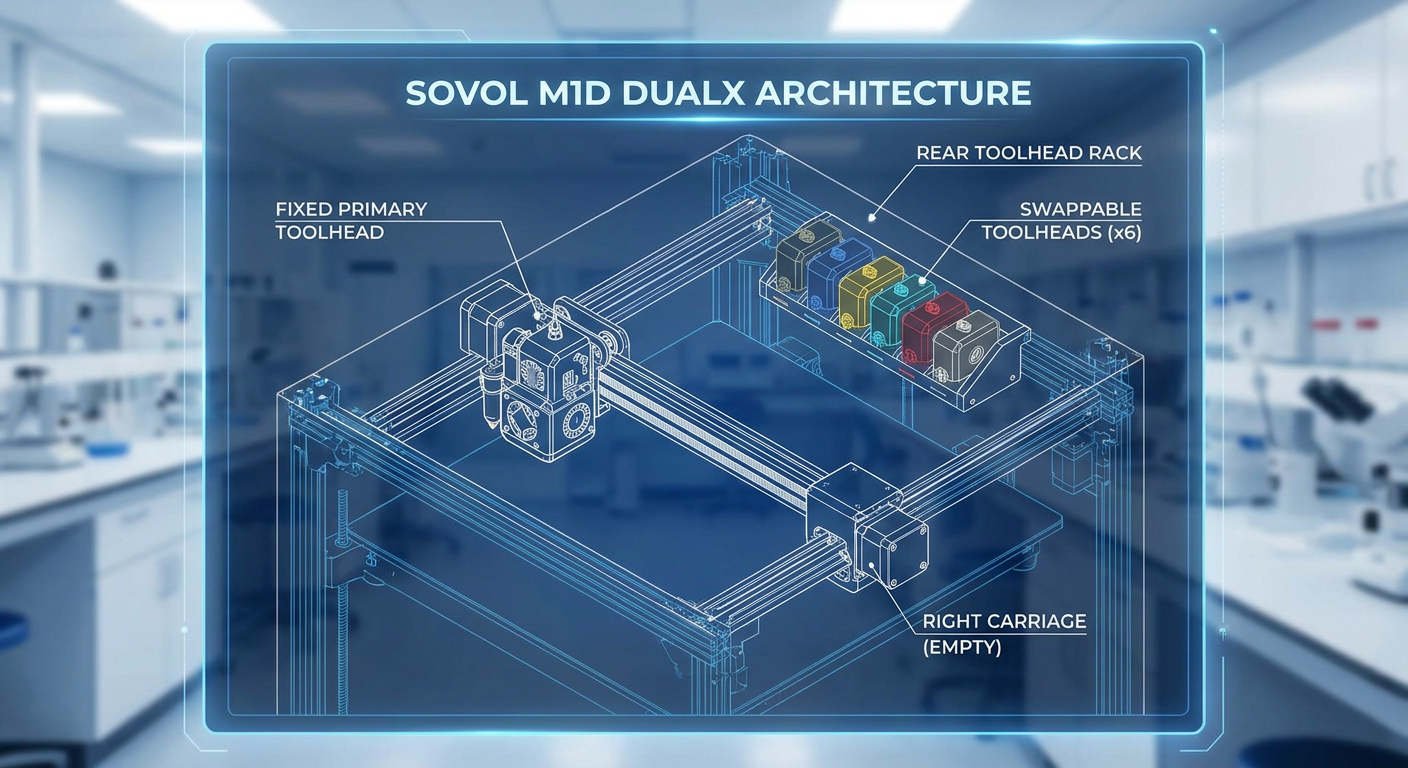
Understanding the M1D DualX Architecture: 1 Fixed + 6 Swappable Toolheads
To grasp how the M1D achieves rapid tool changes, it helps to look at its carriage design. Most desktop multi-toolhead printers fall into two traditional categories:
-
Standard IDEX (Independent Dual Extruder): Uses two separate toolheads on independent carriages, but is limited strictly to 2 materials or colors.
-
Single-Carriage Toolchangers: Uses a single gantry toolhead that parks and retrieves tools from a rack, requiring complete movement stops for every tool pick-up and drop-off.
The Sovol M1D introduces a hybrid approach called DualX™:
-
Carriage 1 (Fixed Tool 0): Mounted permanently on the left carriage for continuous high-speed output.
-
Carriage 2 (Tool-Changing Carriage): Operates independently on the right side, automatically docking into a 6-slot rear rack to pick up and swap Tools 1 through 6.
Together, this gives the M1D support for up to 7 distinct materials or colors in a single setup (1 fixed + 6 swappable). Because Carriage 1 remains dedicated, single-material jobs or dual-material jobs can run without touching the tool changer rack at all.
The Mechanics of a 5-Second Toolhead Swap
How does the M1D complete a mechanical swap in five seconds? The system relies on three synchronized mechanical and electrical design choices:
1. Auto-Grip Docking Mechanism
Carriage 2 features an automated mechanical coupling mechanism. When a tool change is called by Klipper firmware, Carriage 2 moves to the rear docking rack, releases its current toolhead into its dedicated docking slot, slides over to the target toolhead, and engages its high-precision locking grip in under 2 seconds.
2. Smart Docking Preheating
In traditional single-nozzle systems, the nozzle must reach temperature, purge the old filament, wipe, adjust temperature for the next filament, and then resume. The M1D eliminates thermal wait times by preheating standby toolheads in the dock. Before Carriage 2 docks to collect Tool 3, the heating element for Tool 3 is already active and sitting at printing temperature. The moment the toolhead locks into place, it is ready to extrude instantly.
3. Zero-Retraction Filament Paths
Unlike single-nozzle automated material systems (AMS or MMU) that pull filament back through meters of PTFE tubing before pushing the new spool forward, each M1D toolhead maintains its own dedicated direct-drive extruder and hotend assembly. Filament stays fully loaded in the drive gears right up to the melt zone. There is zero feeding overhead during a swap.
The Print Time Math: Single-Nozzle AMS vs. Sovol M1D Tool Swapping
To understand how 5-second swaps translate into hours saved on the build plate, let's examine a concrete print scenario.
Scenario Benchmark
-
Model: A 4-color anatomical model or multi-part enclosure prototype.
-
Total Layers: 600 layers.
-
Swaps Per Layer: 2 tool switches per layer (1,200 total tool changes across the entire job).
|
System Feature |
Single-Nozzle AMS / MMU System |
Sovol M1D Tool Changer |
|---|---|---|
|
Swap Sequence |
Retract → Cut → Feed → Heat → Purge → Wipe |
Dock → Lock → Print |
|
Time Per Tool Swap |
75 seconds (average flush/wipe cycle) |
5 seconds (mechanical dock & lock) |
|
Nozzle Thermal Lag |
10–20 seconds per temp adjustment |
0 seconds (preheated in docking rack) |
|
Total Overhead Time |
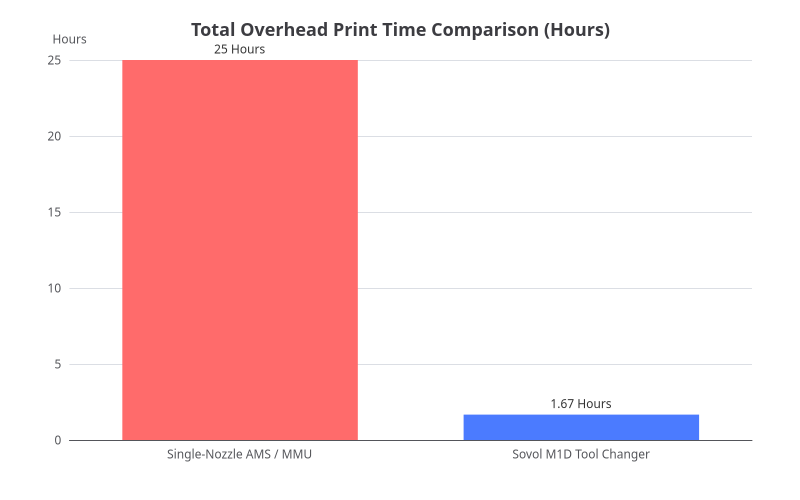
1,200 × 75 sec = 90,000 sec (25 Hours) |
1,200 × 5 sec = 6,000 sec (1.67 Hours) |
|
Time Saved On Swaps |
Baseline |
23.33 Hours Saved |
On this single project, the M1D eliminates over 23 hours of unproductive overhead time. On large multi-color prints spanning 1,500+ layers, the time differential grows even wider, turning 3-day prints into overnight runs.
Eliminating the "Poop Tower": Up to 95% Material Savings
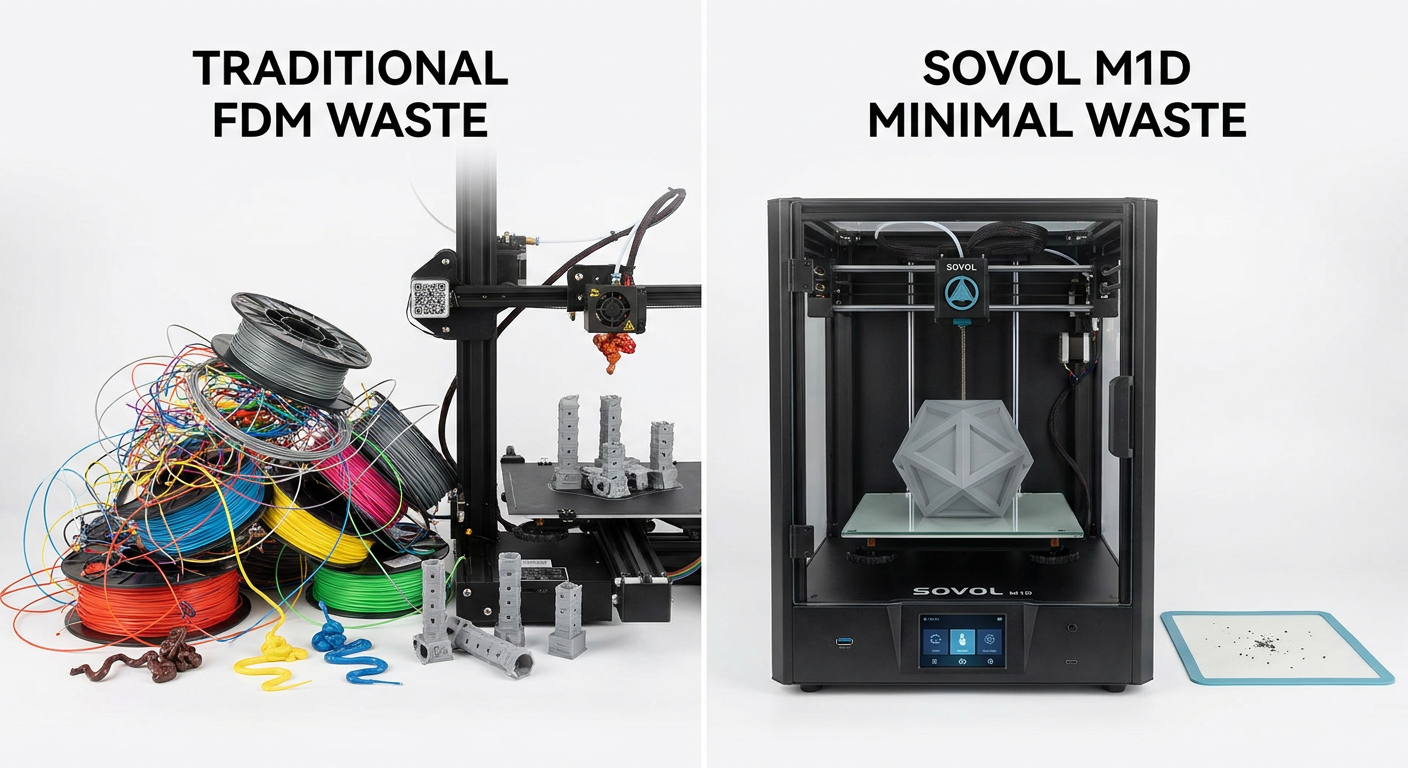
Time is only half of the equation; material consumption is the other. Single-nozzle multi-material systems require flushing 100 mm³ to 300 mm³ of melted filament into a purge tower or waste chute every time a color changes to prevent bleeding (especially when transitioning from dark colors like black to light colors like white).
On a 1,200-swap print:
-
AMS / MMU Waste: 1,200 swaps × 0.2g average purge = 240 grams of wasted plastic (often weighing more than the model itself!).
-
Sovol M1D Waste: Because each color has its own clean, un-contaminated nozzle, no internal color flushing is required. The toolhead requires only a brief micro-wipe on a silicone pad to remove nozzle ooze before entering the print area.
This reduction in purge volume saves hundreds of meters of multi-material filaments per roll, lowering the operational costs for makerspaces and small-batch production workshops.
Multi-Material Capabilities: Combining Rigid, Flexible, and Soluble Filaments
While multi-color printing highlights the speed of the M1D, multi-material functional printing demonstrates its practical versatility. Single-nozzle systems frequently struggle or clog when attempting to combine materials with wildly different printing temperatures or physical properties, such as printing rigid PLA alongside flexible TPU or water-soluble PVA support.
|
Item |
Detail |
|---|---|
|
Tool 0 |
Rigid PLA → Structural body printing on Carriage 1 |
|
Tool 1 |
TPU 95A → Overmolded flexible gaskets via Carriage 2 |
|
Tool 2 |
PVA → Dissolvable interface supports via Carriage 2 |
Because each swappable toolhead retains its own temperature profiles and nozzle sizes:
-
Rigid + Flexible: You can print flexible overmolded grips or living hinges directly onto rigid parts without risking TPU jams in a shared extruder path.
-
Soluble Supports: Dissolvable PVA or BVOH support materials can be printed at lower melt temperatures without heat-creeping into adjacent tools. For optimal support adhesion and clog prevention, storing moisture-sensitive PVA in dedicated filament drying solutions before pre-loading onto the rear rack is recommended.
Operational Best Practices for M1D Toolhead Efficiency
To maintain reliable 5-second tool swaps across long production cycles, workshops should follow a few baseline calibration routines:
-
Auto-Z Alignment across Toolheads: Before initiating a multi-tool job, run the M1D's automated contact alignment routine. This verifies that the vertical Z-offset for all active toolheads matches Carriage 1 within sub-millimeter tolerances.
-
Bed Temperature and First-Layer Stability: Ensure the print bed is thoroughly cleaned with isopropyl alcohol and brought to thermal equilibrium before starting. Reviewing a comprehensive first-layer calibration guide helps eliminate adhesion issues that could cause multi-part shifts during fast tool changes.
-
Slicer Tool Change Scripts: Use Sovol's optimized Klipper tool-change macros in OrcaSlicer or PrusaSlicer. These macros handle toolhead park coordinates, fan speed handoffs, and docking rack retraction automatically.
Conclusion: Higher Throughput for Modern Makerspaces
The Sovol M1D's 5-second toolhead switching system replaces the slow, wasteful mechanics of single-nozzle multi-material printing with a practical hardware solution. By combining independent dual extruders with a 6-slot active tool changer, the M1D turns multi-color and multi-material 3D printing into an efficient, repeatable tool for prototyping and production.
Whether you are managing a UK community makerspace looking to increase printer turnaround or an engineer building multi-material prototypes, reducing tool change overhead from 25 hours down to under 2 hours changes what is possible on the desktop build plate.
Explore Sovol 3D Printers: Interested in expanding your workshop's production capabilities with high-speed CoreXY and multi-material desktop platforms? Explore the complete range of open-source desktop FDM 3D printers at Sovol UK.
Share:
Sovol M1D: 7-Color, 7-Material 3D Printing with Near-Zero Purge Waste
Why the Sovol M1D Is Different: DualX™ Multi-Material 3D Printing