
Key Takeaways
-
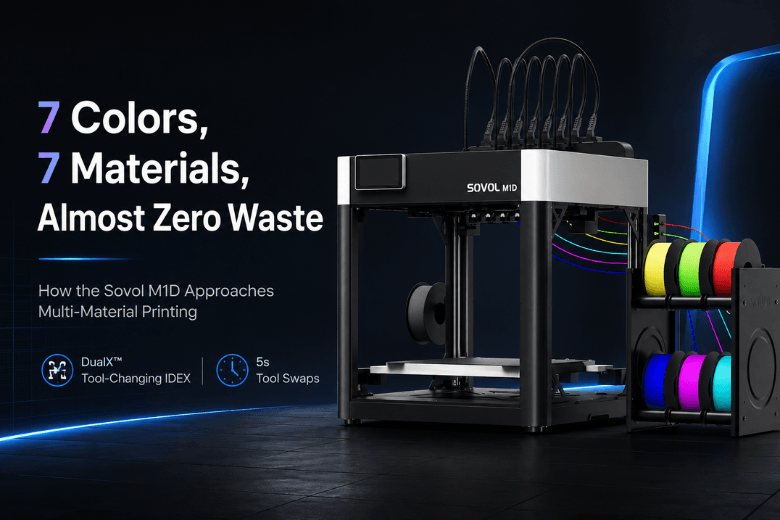
Near-Zero Purge Architecture: The Sovol M1D combines an Independent Dual Extruder (IDEX) gantry with a 6-head automatic tool changer (DualX™ 1+6 system), giving makers access to 7 dedicated toolheads while significantly reducing the need for filament purge towers.
-
7 Colors & 7 Materials: Dedicated hotends and isolated thermal pathways allow simultaneous printing with distinct polymers—such as flexible TPU, rigid PETG, and water-soluble PVA—without thermal cross-contamination or retraction jams.
-
5-Second Swaps & Efficiency: Swapping toolheads mechanically takes approximately 5 seconds, maintaining workflow momentum without waiting for lengthy single-nozzle heating or cooling cycles during material transitions.
-
Workshop Overhead: For UK makerspaces and active workshops, minimizing material flush volume reduces overhead costs while boosting production output via IDEX Duplication and Mirror modes.
Multi-color 3D printing has long promised flexible creative possibilities, yet managing a shared workshop or makerspace often reveals practical tradeoffs. Single-nozzle filament changers can generate substantial piles of flushed plastic and repeated retraction delays to achieve a multi-color surface finish. When complex prints accumulate heavy material waste and extended cycle times, multi-material production becomes less efficient.
The Sovol M1D hybrid IDEX toolchanger addresses these challenges by combining two established mechanical designs into an open-source system: an Independent Dual Extrusion (IDEX) gantry paired with a 6-toolhead automatic changer. Instead of feeding seven different spools through one shared nozzle, the M1D provides dedicated, independently heated toolheads for active material channels. The result is multi-material printing with near-zero purge waste, faster layer transitions, and broad material versatility.
The "Purge Tax": Evaluating Single-Nozzle Filament Changers in Makerspaces
To understand how tool-changing architecture functions, it helps to examine how traditional single-nozzle systems manage multi-color tasks.
Systems such as single-nozzle filament changers use a single hotend fed by a motorized multiplexer. Depending on the model geometry and layer count, every time the sliced file requests a color or material change, the printer executes a multi-step sequence:
-
Retract the active filament back through the PTFE tube.
-
Cut or pull the molten tip out of the melt zone.
-
Feed the new filament forward into the nozzle.
-
Extrude plastic into a purge tower or collector until the previous color is sufficiently cleared.
-
Adjust the hotend temperature if transitioning between different filament types.
|
Item |
Detail |
|---|---|
|
Single-Nozzle Flush Cycle |
Retract → Cut → Feed → Purge Tower Flush → Temp Shift → Resume |
|
M1D DualX™ Tool Swap |
Park Toolhead A → Auto-Grip Dock Toolhead B (5s) → Resume |
As highlighted in Hackaday's analysis of tool-changing design vs single-nozzle purge systems, single-nozzle flushing introduces cumulative overhead during frequent material swaps. On complex models requiring hundreds of layer transitions, a notable portion of total print time and material can be consumed purely by flushing cycles.
Thermal Considerations in Shared Hotends
Beyond material usage, single-nozzle setups face thermal management considerations. Combining materials with contrasting extrusion temperatures—such as flexible TPU, rigid PLA, or dissolvable PVA—requires passing distinct polymers through the same melt chamber.
If a higher-temperature polymer is followed immediately by a lower-temperature one, residual plastic can occasionally lead to incomplete extrusion, heat creep risk, or nozzle clogging if temperatures are not carefully managed.
Inside the DualX™ System: How 1+6 Toolheads Support 7 Colors and Materials
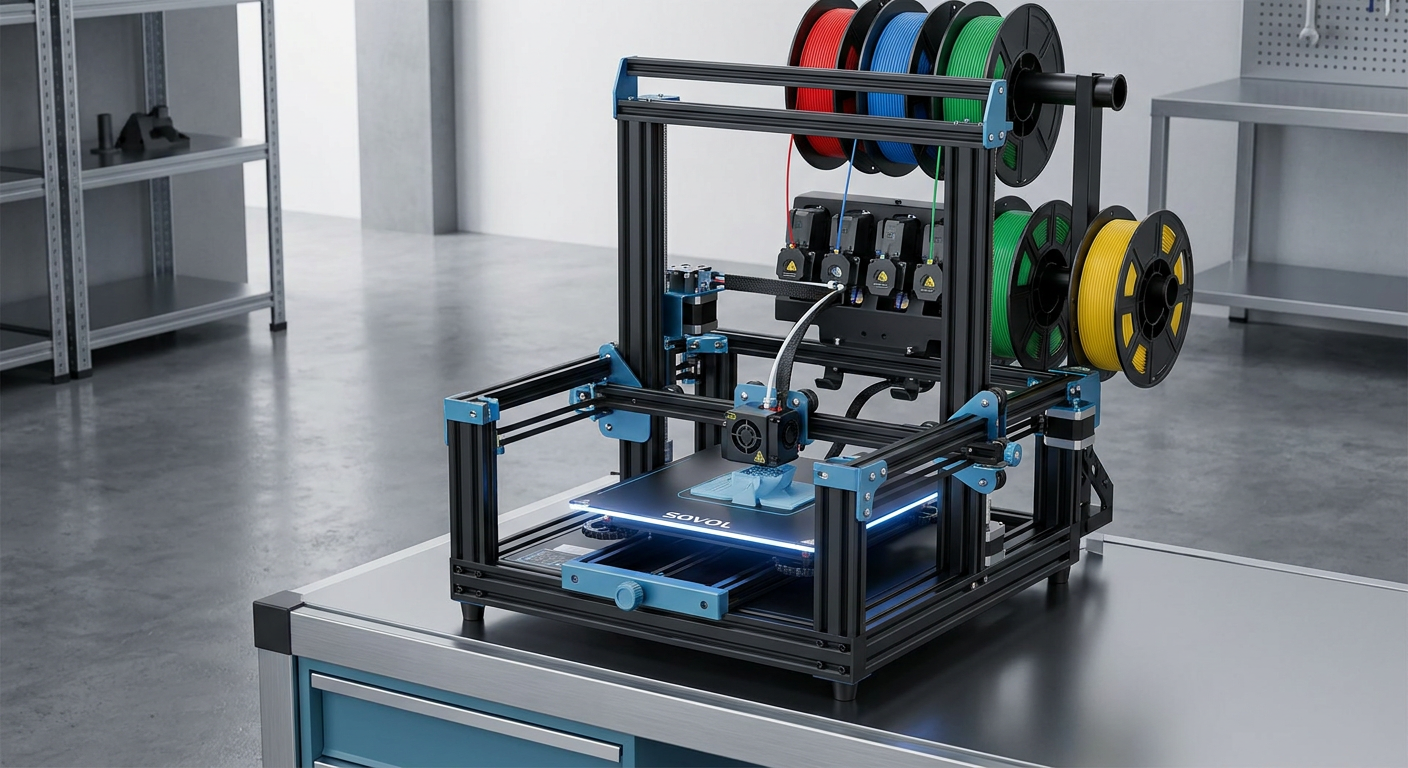
The Sovol M1D handles multi-material workflows through its DualX™ 1+6 toolhead layout, combining elements of an IDEX gantry with an automatic toolchanger.
|
Mechanical Feature |
Traditional Single-Nozzle Systems |
Standard 2-Toolhead IDEX |
Sovol M1D DualX™ Hybrid |
|---|---|---|---|
|
Active Filament Channels |
Typically 4 to 16 spools |
2 spools |
7 active toolheads (1 fixed + 6 swappable) |
|
Purge Waste Per Color Swap |
Variable (depends on flush volume) |
Zero |
Near-Zero (Minimal to no purge towers required) |
|
Tool Swap Cycle Time |
45 to 90 seconds (including flush) |
1 to 2 seconds |
~5 seconds |
|
Thermal Cross-Contamination Risk |
Moderate to high (shared nozzle) |
Minimal (isolated hotends) |
Minimal (7 isolated hotends) |
|
Production Modes |
Single print |
Single, Copy, Mirror |
Multi-color/material, Copy, Mirror, Single |
Mechanical Auto-Grip Docking in 5 Seconds
The M1D gantry utilizes two carriages: one fixed primary carriage and one secondary carriage equipped with an auto-grip mechanical locking mechanism. Docked along the rear frame are 6 swappable toolheads, enabling simultaneous setup for printing up to seven distinct colors or materials.
When a material change is called, the secondary carriage moves to the dock, unlatches the current toolhead, secures the next pre-loaded toolhead in approximately 5 seconds, and resumes printing. Standby toolheads retain independent temperature control, reducing nozzle heating pauses during swaps.
Note for Workshop Managers: With individual toolheads connected through a 6-channel auto-filament system, operators can maintain multiple material pathways ready for immediate job dispatch.
Practical Multi-Material Applications in Prototyping
Beyond multi-color models, dedicated toolhead switching supports functional engineering prototypes.
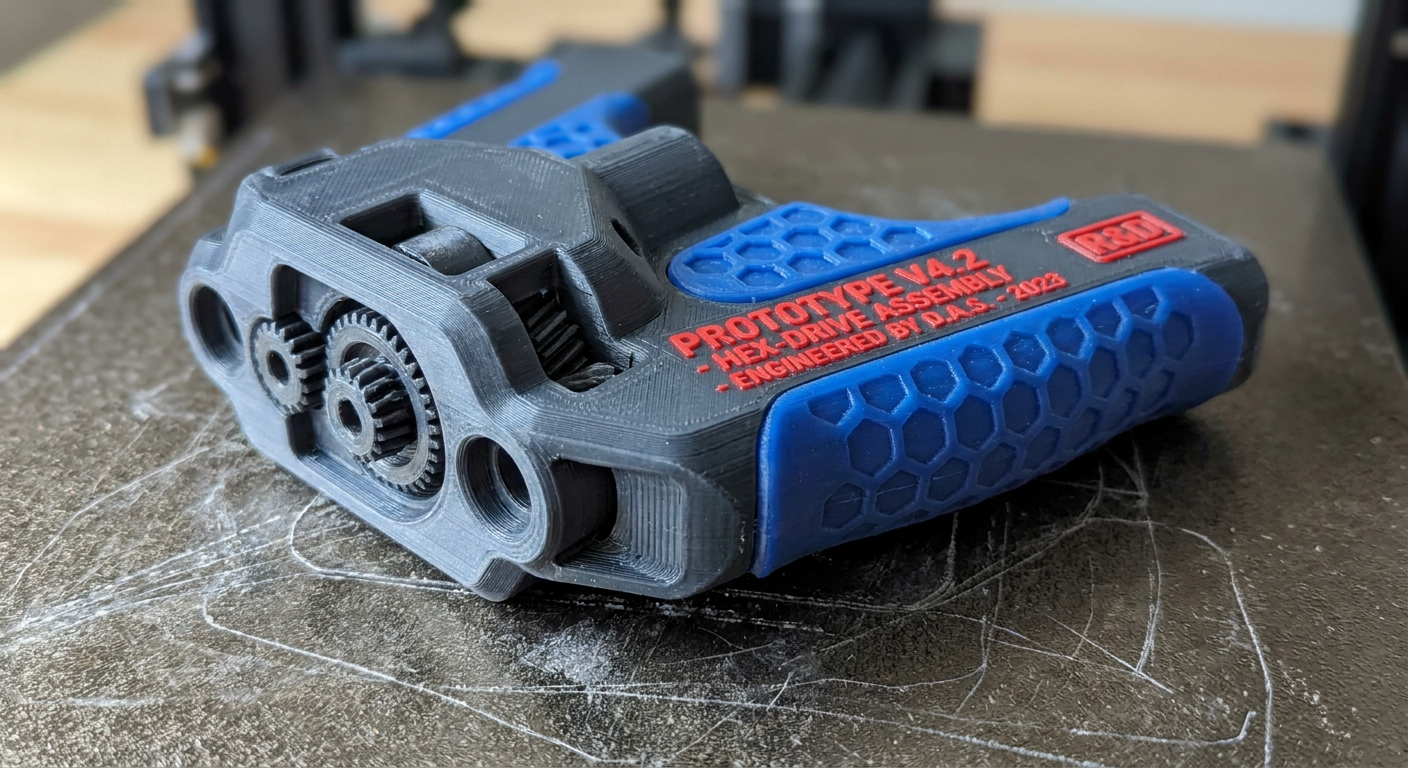
By assigning distinct toolheads to specific material roles, makers and engineering labs can fabricate multi-component assemblies in a single print run:
-
Structural Integrity + Flexibility: Combine rigid PETG structural elements with flexible TPU handles, seals, or dampening pads.
-
Support Material Integration: Pair primary engineering polymers with water-soluble PVA or break-away support filaments. Because support media is extruded through an isolated hotend, interface layers release cleanly without residual material blending.
-
High-Contrast Details: Embed durable text, functional legends, or color-coded indicators directly into industrial parts.
Essential vs. Advanced Hardware Options
As detailed in CNX Software's review of the M1D Essential and Advanced models, Sovol provides two main printer configurations:
-
M1D Essential (Open Frame): Built on an open CoreXY layout with a 300 × 300 × 350 mm build volume. Suitable for general educational and prototyping setups using PLA, PETG, TPU, and standard support materials.
-
M1D Advanced (Enclosed + 60°C Heated Chamber): Features a fully sealed enclosure with active chamber heating up to 60°C, enabling improved dimensional stability when printing materials like ABS, ASA, Nylon (PA), or Polycarbonate (PC).
The printer also retains standard IDEX operational modes. Copy Mode enables simultaneous production of two identical items, while Mirror Mode creates mirrored left- and right-hand components in parallel.
Automated Calibration & Open-Source Control
Multi-toolhead systems rely on accurate alignment to prevent offset errors across tool swaps. The Sovol M1D incorporates automated calibration routines to simplify setup.
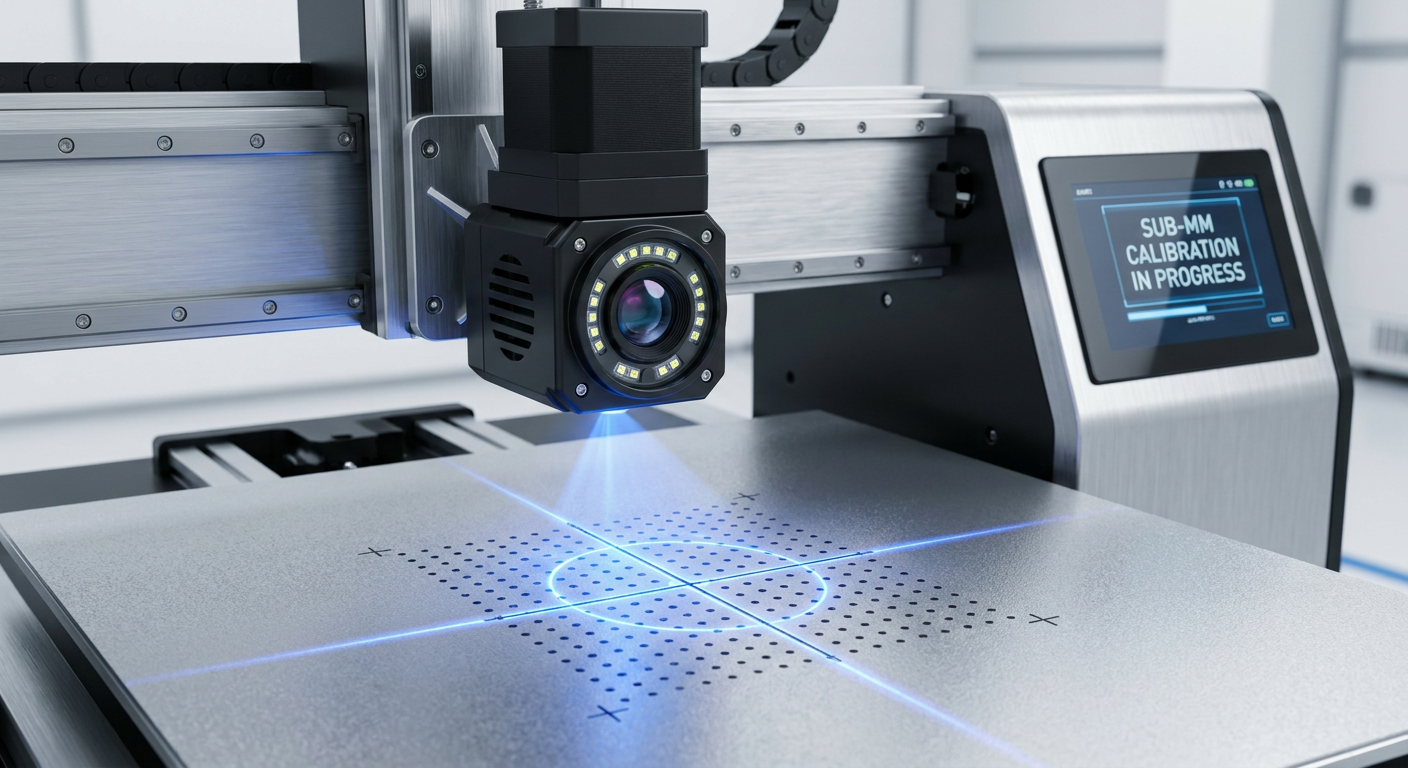
XY Auto Calibration & Auto Z-Lift
To maintain layer precision across all seven toolheads, the M1D separates offset adjustment into dedicated subsystems:
-
XY Auto Calibration: An integrated chamber camera scans an optical calibration target, automatically calculating horizontal X and Y alignment offsets for each swapped toolhead.
-
Auto Z-Lift System: Controls vertical clearance and Z-axis nozzle height independently, ensuring docked or inactive nozzles lift clear of the active print bed.
Bed Leveling & Filament Monitoring
-
Non-Contact Eddy Current Sensor: Scans the 300 × 300 mm build plate to map a detailed bed mesh, supporting consistent first-layer adhesion across the surface.
-
6-Channel Auto-Feeder Safeguard: Tracks filament passage across channels to detect runouts or feeding interruptions during long jobs.
Running on open-source Klipper firmware, the M1D allows operators to customize slicer profiles, control macros, and adjust parameters without relying on proprietary cloud platforms.
Illustrative Total Cost of Ownership (TCO) Scenario
For fabrication labs and commercial workshops evaluating tool-changing equipment, estimating operational costs helps clarify potential long-term value.
Consider a hypothetical workshop scenario running four frequent multi-color or multi-material jobs per week:
-
Material Savings Example: Single-nozzle multi-color prints can discard significant material during flush sequences. In an illustrative scenario where complex jobs average 150g of purged plastic, completing 200 such prints annually could accumulate up to 30 kg of wasted filament. At an estimated £22/kg, reducing flush volume offers tangible long-term savings on material stock.
-
Cycle Time Reduction: Replacing 45-second single-nozzle purge cycles with 5-second mechanical tool swaps across hundreds of layer changes saves multiple hours of gantry idle time per print.
Sourcing equipment through the official Sovol UK M1D product page provides direct access to local warehouse dispatch, regional warranty service, and dedicated technical support.
⚠️ Note: When printing technical filaments like ABS or ASA in shared spaces, operate inside an enclosed system with appropriate ventilation or air filtration.
Frequently Asked Questions (FAQ)
How does the Sovol M1D switch between 7 toolheads using two carriages?
The M1D uses a hybrid IDEX gantry with two carriages. Carriage 1 holds a fixed primary toolhead, while Carriage 2 features an auto-grip mechanical latch. Carriage 2 docks and releases toolheads from a 6-position rear rack in approximately 5 seconds, allowing access to 7 distinct toolheads.
Can the Sovol M1D print flexible TPU and rigid PLA in the same object?
Yes. Because each material channel uses its own dedicated toolhead with independent temperature controls, flexible TPU and rigid polymers can be combined within a single print job without thermal cross-contamination.
Does the Sovol M1D require proprietary filament spools?
No. Sourced via Tom's Hardware coverage of the Sovol M1D hybrid IDEX architecture, the M1D is an open-source platform compatible with standard 1.75 mm filament spools from third-party manufacturers.
What is the build volume of the Sovol M1D?
The printable build volume is 300 × 300 × 350 mm in single-toolhead mode, offering ample space for large functional prototypes and multi-part batch runs.
Streamline Workshop Production with Low-Purge Multi-Material Printing
The Sovol M1D demonstrates how combining IDEX gantry motion with a 6-head automatic toolchanger provides a practical approach to multi-color and multi-material 3D printing. By keeping thermal pathways separate and minimizing flush waste, it offers makerspaces and professional workshops an open-source platform suited for functional production.
To view complete technical specifications, explore configuration details, or learn more about local dispatch, visit the Sovol M1D official product page today.
Share:
3D printer first layer not sticking: a practical fix order that actually works
Sovol M1D 5-Second Toolhead Switching: How It Saves Printing Time