

You now stand at the forefront of a technological revolution in the UK. The 3d printing growth rate has reached an impressive 13.5% annually, with the market set to surpass 21 billion euros. This surge in 3d printing growth has transformed industries and opened new opportunities. You can see its impact in recent headlines: the largest clinical trial on 3D printed medicine for breast cancer now takes place here, focusing on personalised treatments for 200 patients. Researchers at the University of East Anglia have created a new resin for 3D printing intraocular lenses, driving 3d printing growth in healthcare. These examples show you how 3d printing growth shapes innovation and positions the UK as a leader. Understanding this 3d printing growth is vital for you if you want to stay ahead as the market continues its rapid growth.
Key Takeaways
-
The UK 3D printing market is rapidly growing, with an annual growth rate of 13.5% and a market value exceeding 21 billion euros.
-
Key trends driving this growth include advancements in technology, increased demand for customisation, and a focus on sustainability.
-
Government initiatives provide significant funding and support, helping businesses adopt 3D printing technologies and improve their operations.
-
Industries such as healthcare, aerospace, and automotive are leading the way in 3D printing adoption, benefiting from faster production and reduced costs.
-
Embracing 3D printing can position your business for success, offering opportunities for innovation and competitive advantage in the market.
UK 3D Printing Market Overview
Market Size and Value
You can see the 3d printing market in the UK reach new heights each year. The sector now stands as one of the fastest-growing technology markets in the country. In 2023, the UK 3d printing market achieved a value of over 21 billion euros, reflecting a 14.2% increase from the previous year. This impressive growth rate outpaces many other advanced manufacturing sectors. The compound annual growth rate (CAGR) for the UK 3d printing market sits at 13.5%, which positions you at the centre of a dynamic and expanding industry. When you compare this with the global market value, the UK’s contribution continues to rise, making it a key player on the international stage.
Recent Growth Trends
You will notice several trends driving the rapid growth of the 3d printing market in the UK:
-
Advancements in digital warehousing and additive manufacturing now improve inventory management for businesses.
-
You see a growing demand for mass customisation, as consumers increasingly prefer unique, tailor-made products over standardised items.
-
Sustainability has become a central focus, with more companies using recycled materials in 3d printing to reduce environmental impact.
-
The integration of artificial intelligence enhances design and manufacturing processes, allowing you to achieve greater efficiency and customisation.
-
Development of advanced materials opens new possibilities for innovative applications, especially in technology and aerospace.
These trends show you how the 3d printing market adapts to changing consumer needs and technological advancements. You benefit from a sector that values innovation and sustainability.
Key Market Developments
You can track the momentum of the 3d printing market through several notable investments and partnerships:
-
Lancaster University invested £250,000 in a Stratasys J750 PolyJet machine, boosting 3d printing capabilities for research and commercial projects.
-
StormMeister, a business specialising in flood protection, collaborates with Lancaster University to develop innovative flood seal designs using advanced 3d printing technology.
-
Carcinotech raised £4.2 million to expand its operations, focusing on 3d printed micro-tumours for cancer treatment. The company also plans to enter the US market, highlighting the international reach of UK innovation.
-
Carcinotech partnered with CELLINK to develop advanced cancer models using bioprinting technology, strengthening the link between healthcare and 3d printing.
-
Spectroplast secured Series A funding from HZG Group and AM Ventures to enhance its silicone 3d printing capabilities and expand its market presence.
These developments demonstrate how you can benefit from a thriving 3d printing market that attracts investment, fosters collaboration, and drives technological progress.
You now have a clear view of the UK’s 3d printing market. The sector’s growth, recent trends, and key developments position you to take advantage of new opportunities and stay ahead in a competitive landscape.
Drivers of 3D Printing Growth
Technology Advancements
You benefit from rapid progress in 3d printing technology across the UK. The latest advancements have transformed how you approach manufacturing and design. Companies now invest in industrial-scale systems that deliver greater automation and efficiency. For example, AMufacture has introduced HP printers with automatic changeover systems and robotic arms, which streamline large-scale production. This leap in technology attracts interest from the defence sector, where secure supply chains and advanced capabilities are essential.
You see a growing demand for 3D-printed UAV parts. The need for lightweight and complex components in drone manufacturing drives the adoption of additive manufacturing technologies. These innovations allow you to create intricate designs that traditional methods cannot achieve.
Material science also plays a crucial role. The development of hybrid manufacturing and multi-material printing has expanded your options, especially in the automotive sector. You can now produce complex, customised parts using specialised composites and metals. High-performance materials like polycarbonate and nylon offer heat resistance and toughness, making them ideal for engineering. Ultra-high-performance thermoplastics such as PEEK and PEI support aerospace and medical applications, thanks to their exceptional properties. Materials like PETG, with improved chemical resistance and durability, make 3d printing technology more practical for a wider range of uses.
You gain a competitive edge by adopting these advanced technologies and materials, which enable you to meet the demands of modern industry.
Government Initiatives
You operate in a market where government support accelerates innovation. The UK government has launched several initiatives and funding programmes to strengthen advanced manufacturing, including 3d printing technology. These efforts help you access resources, foster collaboration, and drive the sector forward.
|
Initiative |
Funding Amount |
Description |
|---|---|---|
|
£4 billion |
Supports advanced manufacturing capabilities, including 3D printing. |
|
|
National Wealth Fund |
£27.8 billion |
Aims to enhance future priorities in advanced manufacturing. |
|
DecSAM project |
£38 million |
Focuses on scaling up laser powder bed fusion for aerospace. |
|
ISLAA initiative |
£10.5 million |
Advances large-scale additive manufacturing using laser metal deposition. |
|
£1.1 million |
Develops large format additive manufacturing systems to enhance competitiveness. |
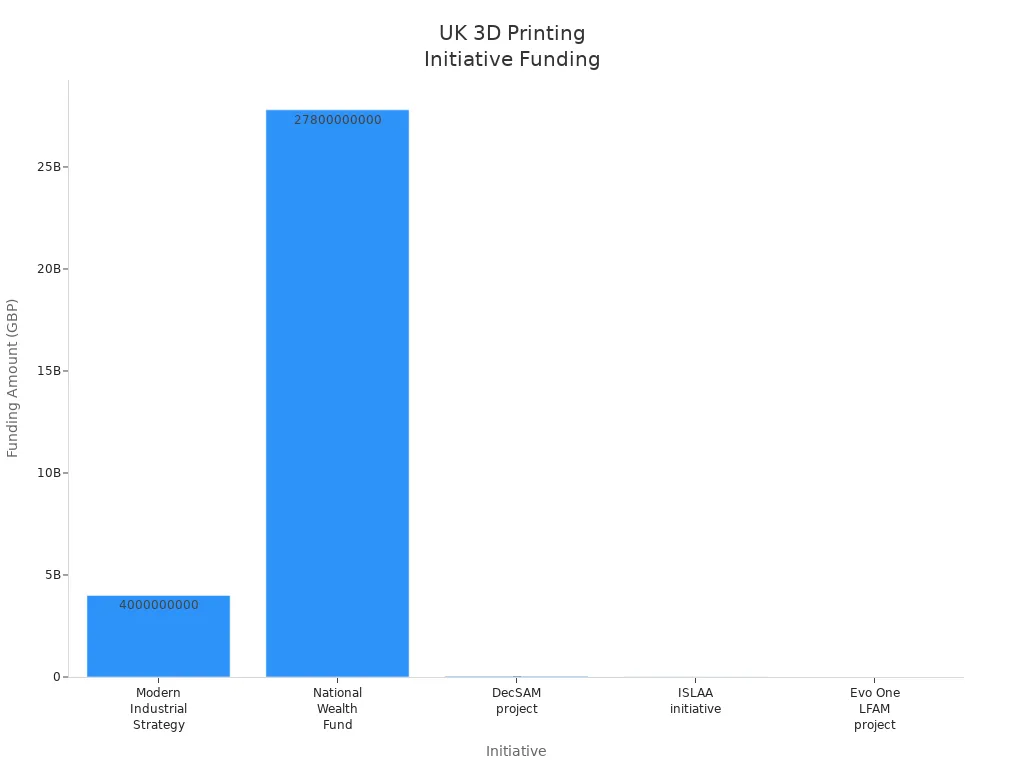
You benefit from policies that aim to double annual business investment in advanced manufacturing. The Advanced Manufacturing Sector Plan and the Make Smarter Initiative both recognise the importance of additive manufacturing technologies. Projects like Evo One LFAM, which involve collaboration between Evo-3D, NMIS, and Rolls-Royce, address the limitations of existing large-format systems. These initiatives ensure you have access to cutting-edge solutions and industry expertise.
Government programmes such as 'Made Smarter' provide financial and technical support. They raise awareness of the advantages of 3d printing technology and encourage you to integrate it into your operations. You see the impact in rapid prototyping, customisation, and productivity gains across multiple sectors.
Industry Demand
You witness strong industry demand for 3d printing solutions in the UK. Sectors such as aerospace, automotive, medical, defence, cycling and sport technology, marine and subsea equipment, and creative industries lead the way. The growing demand for innovative products and efficient processes drives adoption.
-
Aerospace
-
Automotive
-
Medical
-
Defence
-
Cycling and Sport Technology
-
Marine and Subsea Equipment
-
Creative Industries
You choose 3d printing technology for several reasons:
-
Cost efficiency: You reduce production costs by eliminating expensive tooling and minimising material waste.
-
Rapid prototyping: You accelerate product development with quick iterations.
-
Customisation: You produce tailored parts without the need for retooling.
-
Advancements in technology: You benefit from continuous improvements that enhance production and efficiency.
You see that additive manufacturing technologies enable you to respond quickly to market changes. The flexibility and scalability of 3d printing technology support your need for complex, customised, and durable components. As a result, you stay competitive in a fast-evolving landscape.
By embracing these drivers, you position yourself at the forefront of innovation and growth in the UK’s 3d printing market.
Sector Impact Analysis
Healthcare Applications
You experience the transformative power of healthcare 3d printing in the UK. This technology supports surgeries in orthopaedics, cranio-maxillofacial, neurosurgery, and cardiology. You see improved clinical outcomes, with surgery times reduced by up to 2.5 hours for complex procedures. Patients recover faster, often walking within two days after surgery instead of four. You also benefit from tailor-made implants and surgical instruments, which enhance the quality of care. The NHS Golden Jubilee has pioneered 3d bio-printing for bone regeneration, earning international recognition and advancing medical research. These innovations show how healthcare 3d printing improves both patient outcomes and operational efficiency.
-
Surgeries in orthopaedics, cranio-maxillofacial, neurosurgery, and cardiology
-
Reduced surgery times and faster patient recovery
-
Customised implants and surgical tools
-
Internationally recognised research in bone regeneration
Manufacturing and Engineering
You drive innovation in manufacturing by adopting 3d printing. This technology accelerates design cycles through rapid prototyping and reduces costs. You create complex geometries and customise products without extra tooling. The additive process minimises material waste, supporting sustainability goals. On-demand manufacturing reduces inventory and strengthens your supply chain. Projects like Evo One and NMIS help you access advanced 3d printing technologies, boosting productivity and environmental responsibility.
|
Benefit Type |
Description |
|---|---|
|
Cost Reduction |
3D printing allows for bespoke designs without the high costs typically associated with custom work. |
|
Speed |
The technology enables faster production times, particularly for complex components. |
|
Customization |
It facilitates the creation of intricate geometries that traditional methods struggle to achieve. |
Aerospace and Automotive
You gain a competitive edge in aerospace and automotive by using 3d printing for prototyping and production. Aerospace manufacturers use this technology to produce complex parts that traditional methods cannot replicate. You can create prototypes in days, design custom tooling, and print lightweight components that improve performance and fuel efficiency. Collaboration with research centres enhances material development. A UK aerospace firm achieved a 35% weight reduction in titanium components, while Revel Studio cut fabrication time for motorsport parts from four weeks to three days. You also benefit from secure file sharing and local production, which streamline your supply chain.
Education and Research
You see the impact of 3d printing in education and research across the UK. Students in Design and Technology courses design and test mechanical components. Primary pupils create architectural models for STEM clubs, and SEN departments use tactile models to support diverse learners. Hands-on learning increases engagement and deepens understanding. The Windsor Boys School found that 3d printing reduced the time spent on making, allowing students to focus on design and evaluation. Engineering students prototype mechanical parts, gaining practical skills. You use 3d printing to create physical models in mathematics and science, making abstract concepts easier to grasp.
Challenges in 3D Printing Market
Skills and Training Gaps
You face significant challenges in building a skilled workforce for 3D printing. Many companies, especially SMEs, struggle with knowledge and skills gaps. The complexity of 3D printing technology demands expertise in multiple fields, which remains scarce. You may also notice a lack of managerial skills, making it difficult to understand the benefits of 3D printing and train your team effectively.
-
Technical and soft skills shortages limit your ability to adopt new technologies.
-
Insufficient expertise in advanced manufacturing slows your progress.
-
Limited managerial capabilities hinder your ability to drive change.
To address these issues, several initiatives support your growth. For example:
|
Initiative |
Description |
|---|---|
|
M A M Solutions |
Offers training, business assessments, and consultancy for SMEs in additive manufacturing, with a focus on metal technologies. |
You also see projects like CONISSUS, which develop 3D printing solutions for rapid and sustainable construction. These efforts create new job opportunities and make the industry more resilient.
Regulatory Barriers
You encounter regulatory uncertainty, especially in emerging areas like 3D food printing. The UK lacks specific regulations for 3D food printing, which creates confusion for businesses. Concerns about food safety and health impacts persist, as current EU regulations do not fully address the unique aspects of 3D printed foods. The EU Novel Foods Regulation may require labelling for products using unconventional ingredients or methods.
In the medical sector, you follow the older Medical Devices Regulations 2002, while the EU enforces stricter guidelines. This difference means you operate under more lenient rules, but you may face challenges if you export to markets with higher standards.
Cost and Investment Issues
You often find that high production costs present a major barrier to adopting 3D printing. The technology’s maturity and complexity increase your operational expenses. You need skilled workers to integrate new systems, which adds to your costs. As you invest in advanced manufacturing, you may see higher selling prices for your goods and services, which can affect your competitiveness.
|
Challenge Type |
Description |
|---|---|
|
The cost of technology and materials remains significant. |
|
|
Complexity of Technology |
Skilled workers are essential for successful adoption. |
|
Increased Operational Costs |
Strategic integration can lead to higher overall expenses. |
Despite these challenges, you can find positive funding trends. For example, a Sheffield product design firm raised £500,000 to expand its 3D printing services, after previously securing £750,000. This funding allows you to broaden your product range and improve production efficiency, reflecting growing demand in the market.
Overcoming these obstacles will help you unlock greater efficiency, reduce environmental impact, and strengthen your position in the manufacturing sector.
Future of 3D Printing Growth
Market Projections
You can expect the UK 3D printing industry to continue its upward trajectory. Market forecasts show robust expansion over the next five years. The following table outlines projected growth:
|
Year |
Market Value (in billion $) |
CAGR (%) |
|---|---|---|
|
2023 |
0.59 |
- |
|
2028 |
1.03 |
11.7 |
This data highlights a strong compound annual growth rate. You will see the value of production nearly double, reflecting the increasing adoption of advanced technologies across high-growth sectors.
Emerging Trends
You will encounter several trends shaping the future of production in the UK. The healthcare 3D printing market is growing rapidly, driven by demand for customised medical devices and patient-specific treatments. Hybrid manufacturing, which combines additive and subtractive processes, is expanding the range of applications. The focus on personalised treatments is increasing, especially in prosthetics and surgical models.
-
Automation and AI are transforming additive manufacturing, optimising designs and workflows.
-
Bioprinting is advancing, leading to breakthroughs in tissue engineering and healthcare.
-
Sustainable materials are gaining traction, reducing waste in the production process.
-
On-demand manufacturing enables flexibility and efficiency, lowering inventory costs.
-
Hybrid manufacturing enhances production capabilities and quality.
|
Trend |
Description |
|---|---|
|
Automation and AI |
AI and automation optimise designs and streamline workflows. |
|
Bioprinting |
Advances in bioprinting support new healthcare applications. |
|
Sustainable materials |
Focus on eco-friendly materials reduces waste. |
|
On-demand manufacturing |
Flexible production reduces inventory costs. |
|
Hybrid manufacturing |
Combining methods improves quality and application range. |
Opportunities for UK Businesses
You have significant opportunities to lead in the evolving 3D printing landscape. High-growth sectors such as healthcare, aerospace, and automotive offer strong demand for innovative production solutions. By adopting advanced technologies, you can improve efficiency, reduce costs, and deliver customised products. You can also benefit from government support and industry partnerships, which help you access new markets and scale your production. Staying ahead of these trends positions you to capture new business and drive growth in the UK manufacturing sector.
You now see that 3D printing drives rapid growth across UK industries. This technology creates new opportunities for you and your business. Policymakers must support innovation and training. Industry professionals should invest in advanced systems and materials.
-
Explore partnerships with research centres
-
Upskill your workforce
-
Adopt sustainable practices
You can position yourself as a leader by embracing these strategies. The UK’s 3D printing sector promises continued expansion and global influence.
FAQ
What industries benefit most from 3D printing in the UK?
You see the greatest impact in healthcare, aerospace, automotive, and manufacturing. These sectors use 3D printing for rapid prototyping, custom parts, and advanced materials. Education and research also gain from hands-on learning and innovation.
How does 3D printing support sustainability?
You reduce waste by using only the material needed for each part. 3D printing enables you to recycle plastics and metals. This process lowers your carbon footprint and supports your sustainability goals.
Is government funding available for 3D printing projects?
You can access grants and support through initiatives like Made Smarter, the National Wealth Fund, and Innovate UK. These programmes help you invest in advanced manufacturing and scale your operations.
What skills do you need to adopt 3D printing?
You need expertise in design, engineering, and digital manufacturing. Training in CAD software and material science helps you succeed. Upskilling your team ensures you stay competitive.
Share:
3D Printing for Small Business: Real Examples
Best 3D Printers UK Picks for Easy Printing