
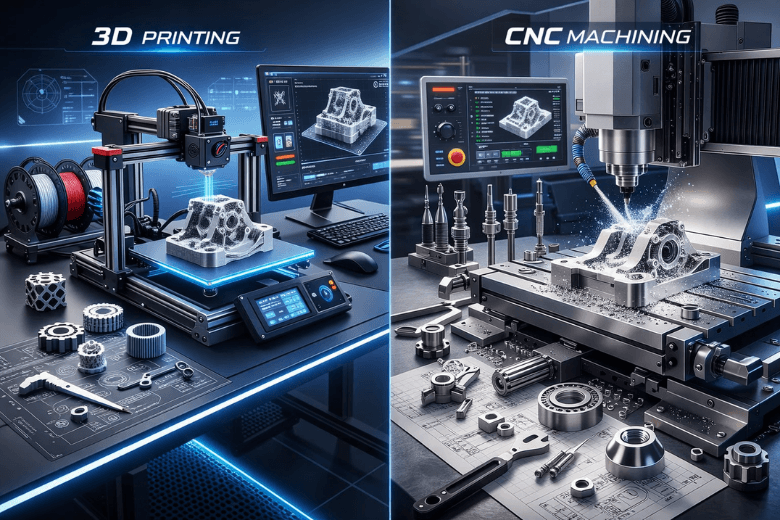
You face a critical choice when selecting between 3d printing and cnc machining for modern production. Each method offers distinct benefits. CNC delivers superior accuracy and supports a wide range of engineering materials, while 3d printing excels in creating complex shapes with minimal setup. Recent industry data shows a 15% increase in entry-level 3d printer shipments and ongoing growth in the 3d printing market, particularly for prototyping and low-volume runs. Your decision should always align with your project’s unique requirements.
Key Takeaways
-
CNC machining excels in accuracy and surface finish, making it ideal for high-precision applications.
-
3D printing offers unmatched design flexibility, allowing for complex geometries and rapid prototyping.
-
Choose CNC for medium to high-volume production to benefit from cost efficiency and consistent quality.
-
3D printing is more cost-effective for low-volume runs, enabling quick iterations and custom designs.
-
Always align your manufacturing choice with project needs, considering factors like accuracy, material, and production volume.
Accuracy: CNC Machining vs 3D Printing
Tolerances and Surface Finish
You will notice a clear distinction in accuracy when comparing cnc machining and 3d printing. Cnc machining consistently achieves tight tolerances, often within microns, which is essential for high-precision applications. You can rely on cnc for smooth surface finishes, as the process removes material with sharp cutting tools. This results in parts that require minimal post-processing and deliver exceptional quality straight from the machine.
In contrast, 3d printing faces several challenges in maintaining dimensional accuracy and surface quality. The layer-by-layer approach can introduce visible lines and slight irregularities. You may find that additional finishing steps, such as sanding or polishing, are necessary to achieve a comparable surface to cnc machining. For projects where surface finish and exact measurements are critical, cnc machining offers superior performance.
Precision Parts
When you need precision parts for manufacturing, cnc machining stands out as the preferred choice. The process supports a wide range of materials and maintains consistent results across multiple runs. You can trust cnc to deliver repeatable accuracy, which is vital for mechanical components and assemblies that must fit together perfectly.
3d printing, while excellent for rapid prototyping and complex design, can struggle with dimensional consistency. You may encounter issues such as:
-
Optical alignment problems, which can cause inconsistencies in part dimensions.
-
Resin shrinkage during curing, leading to changes in size.
-
Mechanical forces during the build, resulting in layer shifts or distortions.
-
Variations in post-processing, such as curing time or UV intensity, affecting final dimensions.
-
Batch-to-batch differences due to environmental factors or printer calibration.
These factors mean you must carefully control the 3d printing process to achieve reliable results. For applications demanding the highest level of accuracy and quality, cnc machining remains the benchmark in modern production.
Materials in 3D Printing Process and CNC Machining
Supported Materials
You will find that the choice of materials plays a crucial role in both 3d printing and cnc machining. Each technology supports a wide range of options, but the selection can impact your final part’s quality and mechanical properties. In cnc machining, you can work with engineering plastics such as ABS, Nylon, Polycarbonate, and PEEK, as well as metals like Aluminium, Stainless Steel, Titanium, and Brass. This versatility makes cnc machining a strong choice for manufacturing parts that demand high precision and durability.
The 3d printing process has evolved rapidly. You can now use not only plastics like PLA, ABS, Nylon, and ULTEM, but also advanced metals including Aluminium, Stainless Steel, Titanium, and Inconel. This expansion allows you to create complex geometries that are difficult to achieve with traditional machining. However, cnc still offers a broader range of engineering-grade materials, especially for applications that require specific mechanical or protective qualities.
Tip: If your project requires exotic alloys or biocompatible materials, 3d printing can provide unique solutions that traditional methods may not support.
|
Material Type |
Common Materials |
Mechanical Properties |
|---|---|---|
|
CNC Machining |
ABS, Nylon, Polycarbonate, PEEK, Aluminium, Stainless Steel, Titanium, Brass |
High precision, good protective qualities, recyclable |
|
3D Printing |
ABS, PLA, Nylon, ULTEM, Aluminium, Stainless Steel, Titanium, Inconel |
Design flexibility, good strength-to-weight ratio, biocompatible (for titanium) |
Material Performance
You must consider how material performance affects your end-use parts. Cnc machining delivers excellent, isotropic mechanical properties, which means your parts will have consistent strength in all directions. This is essential for applications where dimensional accuracy and reliability are critical. In contrast, 3d printing often produces parts with anisotropic properties, so strength may vary depending on the build direction.
When you compare the two, cnc machining stands out for high-precision, high-quality components, especially in medium to large production runs. The 3d printing process excels in prototyping and low-volume manufacturing, where design flexibility and rapid iteration matter most. You can achieve cost-effective results for complex shapes, but you may need to manage issues such as warping or layer lines that affect dimensional stability.
If you prioritise mechanical performance and surface quality, cnc machining remains the industry standard. For innovative designs and rapid prototyping, 3d printing offers unmatched versatility.
Complexity and Flexibility: 3D Printing vs CNC
Geometric Freedom
You gain remarkable design flexibility when you choose 3d printing for your projects. This technology enables you to create complex geometries that cnc machining cannot replicate. With 3d printing, you can:
-
Produce parts with intricate internal channels and lattice structures.
-
Manufacture shapes that would be impossible or extremely costly with traditional methods.
-
Use advanced technologies such as SLS and Multi Jet Fusion to build components without support structures.
You do not need to worry about additional costs or specialised tooling when you want to experiment with new designs. The freedom offered by 3d printing extends across multiple sectors, making it ideal for applications that demand innovation and unique shapes.
Cnc machining, on the other hand, faces limitations with highly intricate designs. You may encounter longer lead times and increased production costs if your part requires complex features. Material properties and advanced machining techniques play a crucial role in managing these challenges. However, cnc machining excels in repeatability, ensuring that each part meets strict quality and mechanical performance standards.
If your project values geometric freedom and rapid iteration, 3d printing provides a clear advantage over cnc machining.
Customisation and Prototyping
You can accelerate your product development cycle with 3d printing. This process removes the need for tools and moulds, giving you greater freedom in CAD and allowing you to move from concept to prototype in days. Companies now create fully functional prototypes in-house, which means you can test, refine, and validate your designs much earlier in the production process. This approach reduces risk and helps you achieve higher quality outcomes.
The flexibility of 3d printing makes it perfect for customised, small-scale manufacturing. You can tailor each part to specific requirements without incurring extra costs. The opportunity for increased product customisation motivates many businesses to adopt 3d printing for both prototyping and end-use parts.
Cnc machining remains a strong choice when you need consistent results across large batches. You benefit from its repeatability and the ability to work with a wide range of materials, but you may find it less suited to rapid prototyping or highly customised designs.
Cost: CNC Machining and 3D Printing
Setup and Production Costs
You must consider both setup and production costs when choosing between cnc machining and 3d printing. Cnc machining usually requires a higher initial investment. You need to account for programming, fixture creation, and machine setup. These steps can make cnc expensive, especially for small batches or one-off components. In contrast, 3d printing offers a lower entry point. For example, you can start with an industrial-grade printer for less than $6,000, which makes it an economical and cost-effective option for many manufacturing operations.
The table below compares setup and production costs for each process:
|
Process |
Setup Cost Comparison |
Production Cost Comparison |
|---|---|---|
|
CNC Machining |
Increases with complexity |
|
|
3D Printing |
Lower (same for each part) |
Constant regardless of complexity |
Cnc machining costs rise with part complexity. You need more toolpaths and smaller cutters, which increases machining time and impacts your budget. 3d printing keeps costs steady, even for intricate designs. You do not pay extra for complexity, which gives you more freedom in prototyping and design.
Tip: If you want to adjust prototypes quickly, cnc machining can offer lower setup costs for modified parts, but 3d printing remains more predictable for complex geometries.
Cost Efficiency by Volume
You should match your choice of technology to your production volume. Cnc machining becomes more cost-effective as you increase batch size. The high setup costs spread across more units, which improves cost efficiency for medium and high-volume runs. 3d printing, however, maintains a similar cost per part, regardless of how many you produce. This makes it ideal for low-volume manufacturing, prototyping, and custom mechanical components.
The following table highlights cost efficiency by volume:
|
Production Volume |
CNC Machining Cost Efficiency |
3D Printing Cost Efficiency |
|---|---|---|
|
Low |
Less cost-effective due to high setup costs |
More affordable due to lower setup costs |
|
Medium |
Cost-effective as setup costs are shared |
Still less advantageous as costs remain similar |
|
High |
Often not cost-effective compared to CNC machining |
You gain the most value from cnc machining when you need high-quality, repeatable parts in larger quantities. For small batches, 3d printing provides a flexible and affordable solution. You should always align your choice with your project’s performance, quality, and budget requirements.
Speed: CNC vs 3D Printing Process
Prototyping Lead Time
You must consider speed when selecting between cnc and 3d printing for your next project. Cnc machining removes material rapidly, which allows you to produce parts with tight tolerances and high dimensional accuracy. You can often receive cnc components in as little as three days, depending on the complexity and materials involved. The process adapts to your schedule, so you can tailor lead times to suit your project’s requirements.
The 3d printing process excels in rapid prototyping. You can move from design to finished part overnight or within a few days. This speed gives you the flexibility to test and refine your ideas quickly. The following table compares typical lead times for both methods:
|
Process |
Lead Times |
|---|---|
|
3D Printing |
Overnight, 3, 7, or 12 days |
|
CNC Machining |
Flexible lead times, typically 3 days or tailored to project needs |
You gain a clear advantage with 3d printing when you need fast iterations. However, cnc machining remains competitive for prototypes that demand mechanical performance and quality.
Batch Production Efficiency
You should evaluate batch production efficiency before committing to a manufacturing method. Cnc machining offers significant benefits for high-volume production. You can distribute setup costs across many parts, which increases efficiency and reduces the cost per unit. This approach makes cnc the preferred choice for large runs of mechanical components that require consistent quality and tight tolerances.
-
Cnc machining becomes more cost-effective as you increase batch size.
-
You can achieve higher throughput and maintain dimensional accuracy across all parts.
-
Cnc allows you to use a wide range of materials, which supports diverse manufacturing needs.
3d printing does not provide the same volume advantages. Each part incurs the same material and machine costs, regardless of batch size. You may find 3d printing more suitable for low-volume runs, custom designs, or when you need to test multiple iterations quickly.
You should match your choice to your project’s speed, quality, and performance requirements. Cnc machining delivers efficiency and repeatability for large-scale manufacturing, while 3d printing offers unmatched flexibility for rapid prototyping and complex geometries.
Volume: Production Scale with CNC and 3D Printing
Low vs High Volume
You must assess your batch size before selecting a manufacturing method. CNC machining stands out when you require medium to high production volumes. You can produce over 1,000 parts in a single run, which demonstrates the scalability of cnc. This process bridges the gap between prototyping and mass manufacturing, as you do not need expensive tooling to transition from one stage to the next. You benefit from consistent quality and precision, which is essential for mechanical components in demanding industries.
3d printing excels in low-volume production and prototyping. You can create complex geometries that cnc machining cannot easily replicate. For batches under 10 units, 3d printing offers a cost-effective solution. You avoid high setup costs and custom tooling, which makes this technology ideal for rapid prototyping and custom designs. You also gain access to specialty materials, such as flexible TPU and advanced metal superalloys, which may not be compatible with traditional machining.
Tip: If you need prototypes or small batches quickly, 3d printing can deliver parts within 24 hours, giving you a significant advantage in speed and flexibility.
Mass Manufacturing Suitability
You should consider cnc when your project demands high-volume production and strict performance standards. This technology is a cornerstone of precision engineering, especially in sectors like automotive, aerospace, and motorsport. You can rely on cnc machining to deliver high-quality parts across a wide range of materials. The process ensures repeatable results, which is vital for mechanical assemblies and critical components.
-
CNC machining supports mass manufacturing with:
-
High throughput for large batches
-
Consistent dimensional accuracy
-
The ability to handle demanding specifications
-
3d printing has transformed the design and manufacturing landscape by enabling real-time object creation from digital files. You can streamline your supply chain and offer on-demand production, which enhances delivery efficiency. While 3d printing does not match cnc for mass manufacturing, it remains invaluable for low-volume production, rapid prototyping, and projects that require complex or customised geometries.
You should match your choice to your production scale, quality requirements, and the complexity of your components. CNC machining provides the reliability and scalability needed for mass manufacturing, while 3d printing empowers you to innovate and iterate without the constraints of traditional methods.
Applications: Real-World Use Cases
Aerospace Components
You see the impact of cnc and 3d printing in aerospace every day. Both technologies help you achieve high performance and strict quality standards for critical components. Cnc machining allows you to produce structural parts with tight tolerances. You can use materials such as titanium and aluminium, which offer strength and light weight. 3d printing gives you the freedom to create complex geometries, including lattice structures and internal channels, that improve mechanical efficiency.
The table below shows how you can apply different materials in aerospace components using cnc machining and 3d printing:
|
Material |
Application in Aerospace Components |
|---|---|
|
Titanium |
Structural components, such as brackets and engine parts. |
|
Aluminium |
Airframe sections, housings, and mounting fixtures. |
|
Carbon Fibre |
Wings, fuselage panels, and lightweight supports. |
|
High-performance Plastics |
Interior panels, ducts, and insulation components. |
You can rely on cnc for repeatable results and high-volume production. 3d printing supports rapid prototyping and the manufacture of parts with unique design features. You gain flexibility in both prototyping and end-use production.
Medical Devices
You play a vital role in healthcare innovation when you use cnc machining and 3d printing for medical devices. Cnc machining helps you produce surgical instruments and implants with high mechanical strength and precision. 3d printing enables you to create patient-specific devices, such as prosthetics and dental implants, that match individual anatomy.
You must follow strict regulatory requirements to ensure safety and quality. These include:
-
CE marking in the European Union
-
FDA approval in the United States
-
Health Canada certification
-
PMDA review in Japan
The table below highlights the main considerations for medical device manufacturing:
|
Evidence Type |
Description |
|---|---|
|
Additive Manufacturing |
Enables custom devices and complex design, but requires careful material selection and validation. |
|
CNC Machining |
Delivers consistent quality for a wide range of medical components. |
|
Regulatory Process |
Demands documentation, clinical trials, and inspections for compliance. |
|
FDA Guidance |
Stresses process control to maintain safety and performance. |
You must select the right technology based on your design, materials, and regulatory needs. Cnc machining ensures reliable quality for standardised devices. 3d printing offers unmatched flexibility for custom solutions and rapid prototyping.
Comparison Table: CNC Machining vs 3D Printing
Key Differences Overview
You often need a quick reference to decide between cnc and 3d printing for your next manufacturing project. The following table gives you a clear overview of the main differences, helping you match each technology to your design, quality, and performance requirements.
|
Factor |
CNC Machining |
3D Printing |
|---|---|---|
|
Process |
Subtractive (removes material) |
Additive (builds layer by layer) |
|
Precision |
Tighter tolerances, high accuracy |
May lack precision for end-use components |
|
Material Options |
Wide range, including metals and plastics |
Limited, but growing selection |
|
Cost |
Higher tooling and setup costs |
Low start-up, no tooling costs |
|
Production Volume |
Best for low-volume or custom runs |
|
|
Application Suitability |
Ideal for high-strength mechanical parts |
Suitable for prototypes and complex shapes |
|
Development Time |
Longer due to setup and tooling |
Rapid, supports fast iteration |
|
Design Complexity |
Limited by tool access and geometry |
Excels at intricate and organic designs |
|
Surface Quality |
Superior finish, minimal post-processing |
Layer lines visible, may need finishing |
|
Performance |
Consistent strength and reliability |
Varies by orientation and material |
Tip: Use cnc when you require high-quality, repeatable mechanical components for demanding applications. Choose 3d printing if you need rapid prototyping, complex geometries, or custom designs.
You can see that cnc provides unmatched accuracy and material versatility for large-scale manufacturing. 3d printing gives you flexibility for innovative design and quick turnaround, especially when you need to test new ideas or produce unique parts. Your choice should always reflect the specific needs of your production, whether you prioritise speed, cost, or the complexity of your components.
Choosing Between CNC and 3D Printing
Decision Factors
You must evaluate several critical factors before selecting the right technology for your project. Each method offers unique strengths, and your choice will impact the final outcome. Consider the following aspects when making your decision:
-
Part complexity
-
Cost
-
Material requirements
-
Accuracy
You will find that cnc suits projects demanding high accuracy, tight tolerances, and specific material requirements. This approach works best for functional testing and low-volume production where mechanical performance and quality cannot be compromised. In contrast, 3d printing excels when you need design flexibility, rapid prototyping, and a cost-effective option for low-volume runs. You can create complex geometries and iterate designs quickly, which supports innovation and reduces time to market.
The table below summarises how each factor influences your choice:
|
Factor |
CNC Machining |
3D Printing |
|---|---|---|
|
Part Complexity |
More restricted in geometries |
Can handle complex designs |
|
Production Volume |
Best for high volume |
Ideal for low to medium volume |
|
Cost |
Higher initial setup costs |
Lower setup costs, variable material costs |
|
Material Requirements |
Limited to specific materials |
Wide range of materials available |
|
Accuracy |
High precision |
Varies by technology and material |
You should match your technology to your priorities. If you require high-precision components with consistent mechanical properties, cnc provides the reliability you need. If your project values speed, design freedom, and cost efficiency, 3d printing offers significant advantages.
Practical Recommendations
You can streamline your manufacturing process by following a few practical steps. Start with a clear request for quotation (RFQ). This reduces misunderstandings and ensures your prototypes align with your goals. When you communicate the purpose of your prototype, you enable your machining partners to suggest the most suitable process.
Focus on design for manufacturability (DFM) principles. Avoid ultra-thin walls and use standard hole sizes to save time and costs. These adjustments improve both the quality and cost efficiency of your parts. You should also consider your budget early in the planning stage. This helps you select the most appropriate technology without sacrificing performance.
For high-volume production of mechanical components, cnc remains the preferred choice. You gain consistent results and superior surface finish. For rapid prototyping, custom designs, or when you need a cost-effective option for small batches, 3d printing delivers unmatched flexibility.
Tip: Always review your project’s requirements for accuracy, material, complexity, cost, speed, and volume. This approach ensures you select the right technology for your manufacturing goals.
You can achieve the best results by aligning your technology choice with your project’s unique needs. Both cnc and 3d printing have transformed modern manufacturing, and your ability to choose wisely will determine the success of your production.
You should weigh your options carefully when choosing between cnc and 3d printing. Consider these main points:
-
Cnc offers better accuracy, surface finish, and material range.
-
3d printing provides design flexibility and rapid prototyping.
-
Cnc is cost-effective for larger runs, while 3d printing suits low volumes.
Assess your priorities for accuracy, material, complexity, cost, speed, and volume. If you remain unsure, consult an expert. The table below can help guide your decision:
|
Method |
When to Choose |
|---|---|
|
CNC Machining |
Medium/high volumes, tight tolerances, metals |
|
3D Printing |
Low volumes, complex shapes, fast turnaround |
FAQ
What is the main difference between additive manufacturing and subtractive manufacturing?
You use additive manufacturing to build objects layer by layer, giving you freedom to create complex geometries. Subtractive manufacturing removes material from a solid block. This method achieves tight tolerances and high precision, making it ideal for functional prototypes and demanding applications.
Can you use 3D printing for low-volume production?
You can choose 3D printing for low-volume production. This manufacturing technology offers freedom in design and cost-effective solutions for custom part manufacturing. You avoid expensive tooling and can quickly adapt to changes, which makes it suitable for rapid prototyping and small batch runs.
How does manufacturing technology affect the creation of complex geometries?
You gain significant freedom with modern manufacturing technology. Additive manufacturing enables you to produce complex geometries that traditional methods cannot achieve. You can design intricate internal features and lightweight structures, which expands your possibilities in product development and innovation.
Why should you consider tight tolerances in your project?
You should prioritise tight tolerances when your parts require precise fits or must perform reliably under stress. Manufacturing technology like CNC machining ensures accuracy and repeatability. This is essential for industries where safety, performance, and quality cannot be compromised.
What are the benefits of using manufacturing technology for custom part manufacturing?
You benefit from manufacturing technology by gaining freedom to create unique designs and functional prototypes. Additive manufacturing supports rapid prototyping and allows you to produce custom parts efficiently. You can respond quickly to market demands and deliver tailored solutions to your clients.
Share:
Best Easter 3D Print Models
Resin vs FDM Which 3D Printer Suits Your Project Needs