
You can transform your daily life with a 3d printer. Print a replacement part for a broken appliance, create custom organisers for your workspace, or design a personalised gift. In healthcare, you might see 3d printing use cases such as custom ear devices or even COVID-19 test swabs. The table below shows how different industries use this technology for both common and unexpected solutions:
|
Industry/Field |
Common Uses |
Surprising Uses |
|---|---|---|
|
Automotive |
Rapid prototyping, custom parts |
Manufacturing replacement parts on demand |
|
Healthcare |
Custom fit ear devices for audiology |
Production of COVID-19 test swabs |
|
Entertainment |
Visual effects and costuming |
Hollywood film production integration |
|
Dentistry |
Dental lab models |
Investment in desktop 3D printers |
Key Takeaways
-
3D printing empowers you to create custom solutions for everyday problems, such as printing replacement parts for household items.
-
Personalised gifts made with a 3D printer stand out, allowing you to design unique items that reflect the recipient's interests.
-
In industries like healthcare and manufacturing, 3D printing accelerates innovation by enabling rapid prototyping and custom tool production.
-
Owning a 3D printer can be cost-effective for regular users, as it reduces reliance on outsourcing and speeds up production times.
-
3D printing enhances education by providing hands-on learning experiences, fostering creativity, and supporting diverse learning needs.
3D Printer at Home
Home Repairs
A 3d printer gives you the power to tackle everyday repairs with ease. You can print replacement parts for household items that often break or go missing. For example, you might create a new battery door for a remote control, a missing knob for your cooker, or a set of sturdy wall hooks for your hallway. These practical solutions save you time and money, as you no longer need to search for rare parts or wait for deliveries. Many users report that 3d printing use cases like these have transformed their approach to home maintenance. You can address problems as soon as they arise, ensuring your home remains functional and organised.
Tip: Start with simple designs such as drawer handles or curtain rail brackets. You will quickly see how 3d printing can solve small but persistent issues around the house.
Custom Organisers
Organisation becomes much simpler when you can design storage solutions tailored to your needs. With a 3d printer, you can create custom organisers for your desk, kitchen drawers, or workshop. You might print a modular storage tray for your stationery, a bespoke spice rack for your kitchen, or a tool holder that fits perfectly in your garage. This level of personalisation ensures that every item has its place, reducing clutter and improving efficiency.
-
You can adjust the size, shape, and compartments to match your exact requirements.
-
Many users find that these customisation opportunities help them maintain order in busy households.
-
3d printing allows you to experiment with different designs until you find the perfect fit.
Personalised Gifts
Personalised gifts made with a 3d printer have gained significant popularity. You can create unique items that reflect the recipient’s personality and interests. Some of the most talked-about examples include:
-
3D Crystal Photos: Photographs laser etched inside a clear block of crystal, ideal for weddings and anniversaries.
-
3D Lenticular Photos: Images that appear to move or change when viewed from different angles.
-
3D Engraved Glass Frames: Two-dimensional images laser-engraved onto glass, adding depth and dimension.
-
3D-Printed Figurines and Sculptures: Custom figurines or models based on personal designs.
-
Custom 3D-Printed Jewellery: Rings, necklaces, and bracelets designed to individual preferences.
-
3D Nameplates and Signs: Decorations or signs featuring names, quotes, or logos.
These gifts stand out because they combine creativity with advanced technology. You can design something truly one-of-a-kind, making every occasion memorable.
Note: 3d printing also enables you to respond quickly to last-minute gift needs, as you can produce items on demand without relying on external suppliers.
Cost Considerations
If you print regularly, owning a 3d printer can be more cost-effective than outsourcing. The table below outlines the recommended approach based on your monthly print volume:
|
Monthly Print Volume |
Recommended Action |
Expected ROI Timeline |
|---|---|---|
|
1-5 prints |
Continue outsourcing |
24+ months (not recommended) |
|
6-15 prints |
Consider entry-level printer |
8-14 months |
|
16-30 prints |
Buy mid-range printer |
4-8 months |
|
31+ prints |
Invest in professional system |
2-5 months |
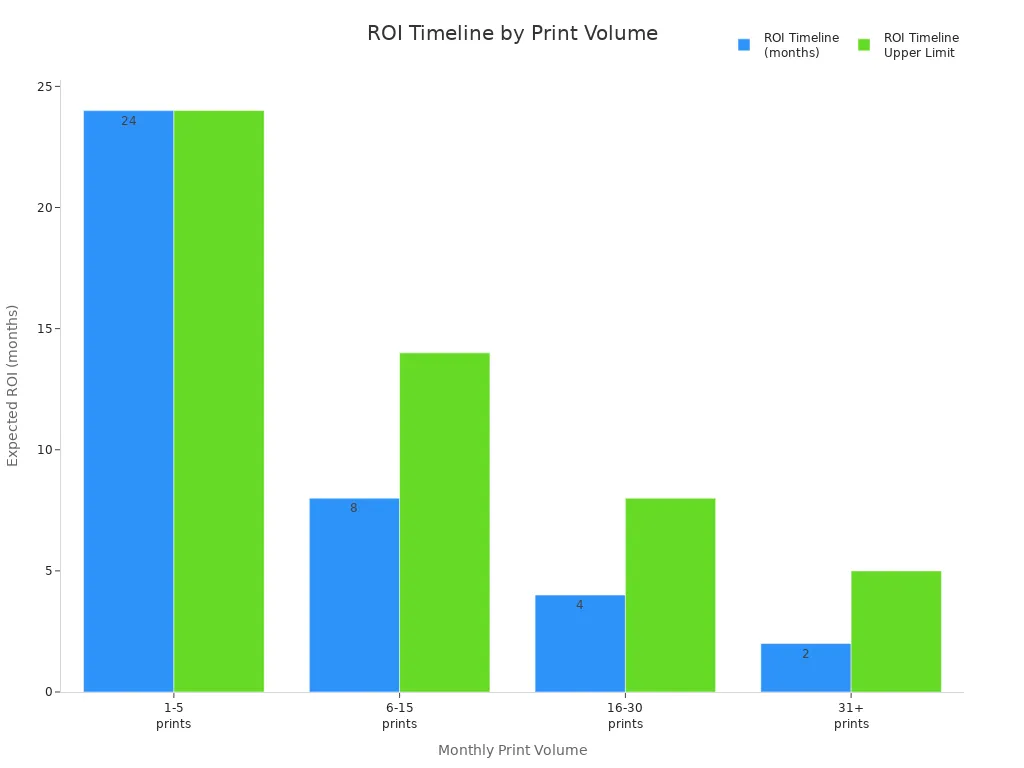
You can see that frequent use leads to a faster return on investment. For occasional users, outsourcing remains the better option. However, if you enjoy experimenting with new designs or need regular replacements and gifts, a 3d printer quickly becomes an essential household tool.
3D Printing Applications in Industry
Rapid Prototyping
You can accelerate product development by using 3D printing technology for rapid prototyping. This approach allows you to test new components quickly and refine designs through multiple iterations. You gain the ability to evaluate performance and make adjustments before committing to full-scale production. Many manufacturers now rely on this process because it streamlines innovation and reduces time-to-market.
-
You can produce specialised components efficiently, which supports niche market demands.
-
The healthcare sector benefits from patient-specific solutions, improving treatment outcomes and reducing lead times.
-
Consumer goods companies use mass customization to create unique products tailored to individual preferences.
-
Additive manufacturing minimises waste compared to traditional methods, supporting sustainability goals.
By adopting rapid prototyping, you reduce costs and material waste. You also gain flexibility, as you can print components on demand and respond quickly to market changes.
Custom Tools and Parts
You can use a 3d printer to create custom parts and tools that meet specific industrial requirements. This capability eliminates the need for expensive moulds and long lead times. Several notable examples highlight the impact of 3d printing applications in this area:
-
Wilson Tool International produces custom press brake tools for forming and air-bending sheet metal, reducing lead times from weeks to hours.
-
GE's LEAP fuel nozzle, a landmark aerospace component, achieves a 25% weight reduction and consolidates 20 parts into one, enhancing both performance and durability.
-
Sulzer Ltd. manufactures closed pump impellers for the energy sector using a hybrid additive and conventional process, cutting production time from weeks to days.
-
Stryker creates biocompatible medical implants with porous structures that mimic bone, using advanced laser powder bed fusion.
-
Wilson Tool Solv3D offers additively manufactured prototypes, jigs, fixtures, and low-volume end-use parts, removing the need for costly tooling.
You gain greater control over your manufacturing process and supply chain. In-house production of custom tools and parts enhances your ability to innovate and adapt to changing demands.
3D Printed House
You can now see the construction industry embracing the 3d printed house as a practical solution to housing challenges. In Wolf Ranch, Texas, builders have completed 100 houses using this method, while Zuri Gardens in Houston features 80 more. These homes cost between $450,000 and $600,000 in Wolf Ranch, which is about $100,000 less than traditional homes. Zuri Gardens offers houses priced from $270,000 to $350,000.
The time savings are significant. Printing the walls of a house takes only 4 to 6 weeks, compared to the 6 to 8 months required by conventional construction. This efficiency makes 3d printing technology an attractive option for large-scale building projects.
Note: While 3d printing offers many advantages, you should consider environmental impacts. Research shows that 3d printing releases volatile organic compounds and particulates, especially in poorly ventilated spaces. Using PLA, a bioplastic derived from plant starch, can reduce your carbon footprint, but proper disposal remains important since it requires industrial composting to break down fully.
By adopting 3d printing applications in industry, you streamline innovation and production. You benefit from faster development cycles, reduced costs, and greater flexibility. These solutions help you meet market demands while supporting sustainability and efficiency.
3D Printing in Healthcare
Prosthetics
You can witness remarkable progress in prosthetics thanks to 3d printing technology. This approach enables mass customization, allowing you to create a custom fit for each patient. In the United States, over two million amputees require personalised solutions. You can use a 3d printer to produce a 3d prosthetic leg or arm tailored to individual anatomy. For example, Alex Pring received a 3d-printed prosthetic arm designed in just eight weeks, featuring an electromyography sensor for enhanced functionality. You can also develop surgical instruments and customized medical devices that improve patient outcomes. The use of additive manufacturing reduces production time and costs, making advanced prosthetics more accessible in a healthcare setting.
Note: 3d printing applications in prosthetics empower you to respond quickly to patient needs, offering flexibility and precision that traditional methods cannot match.
Dental Devices
You can transform dental care with 3d printing technology. This method produces dental prosthetics such as crowns, bridges, and dentures with greater precision than conventional techniques. Digital workflows allow you to preview prosthetics virtually before fabrication, ensuring replacements fit accurately on the first attempt. You can fabricate multiple components simultaneously, speeding up production and reducing chair time. Research shows that 3d printed crowns match or exceed the accuracy of milled crowns. You use less material and generate less waste, lowering costs and improving sustainability. Patient-specific dental implants and surgical guides enhance the fit and comfort, improving human health and reducing the need for manual adjustments.
Bioprinting
You can explore bioprinting as a powerful tool for tissue engineering and personalised medicine. This technology enables you to create living tissue and 3d printed organs using biomaterials. Recent breakthroughs include bioprinted skin, corneal structures, and artificial ovaries that resulted in live offspring when implanted in mice. Clinical use of bioprinted skin is expected to expand into specialist centres by the late 2020s. AI-assisted modelling will allow you to tailor tissue constructs to individual anatomy, improving precision and patient care. You can also develop hybrid coatings for orthopaedic implants, preventing infections and reducing reliance on systemic antibiotics. The integration of 3d bioprinting in medical research promises to revolutionise treatment options and advance human health.
Tip: You can use bioprinting to create realistic anatomical models for pre-operative planning and medical education, enhancing learning and surgical outcomes.
3D Printing in Education and Arts
Classroom Projects
You can transform classroom learning with a 3d printer. Students gain hands-on experience designing and prototyping models, which supports STEM education. A qualitative case study at a bilingual high school in Kuwait found that pupils involved in 3d printing projects developed collaboration, communication, and technology proficiency. You see increased engagement as learners explore mathematical and scientific principles behind their designs. The Department for Education reported that access to 3d printing technology boosts interest and understanding, especially for students who benefit from spatial awareness. You help foster creativity and resilience, as the rapid prototyping process encourages trial and error. Learners with dyslexia can thrive, using spatial skills rather than relying solely on literacy. Effective teacher training remains essential to maximise the educational impact.
Tip: You can use 3d printing applications to support diverse learning needs and encourage innovative thinking in the classroom.
Creative Design
You witness remarkable innovation in the arts sector through additive manufacturing. Artists and designers use 3d printing to realise complex, organic forms and experiment with new materials. The following table highlights notable creative projects:
|
Project Name |
Location |
Description |
|---|---|---|
|
Print the World |
Center Pompidou, France |
Focuses on 'Mutation / Creation', showcasing innovative 3d technologies in art. |
|
iLight Marina Bay |
Singapore |
Features a 3d printed art installation as part of the festival. |
|
Voice Sculpture |
N/A |
Gilles Azzaro created a 3d printed sculpture of Barack Obama’s speech, measuring 1.51 metres. |
|
Björk's Mask |
N/A |
Designed by Neri Oxman, inspired by biological structures, showcasing organic design. |
You also see artists such as Amy Karle, who explores human identity and technology fusion, and Neri Oxman, who bridges biology and design. These projects demonstrate how you can use mass customization to produce unique works that push creative boundaries.
Hobby Components
You can enhance your hobbies with custom parts and accessories. Many enthusiasts use 3d printing to create lightweight bike mounts, cargo cages, and hydration system hangers. Anglers benefit from fishing pole accessories, pellet cutters, and organisational tools designed for their needs. You gain the ability to tailor components for outdoor activities, model building, or electronics. The flexibility of 3d printing applications supports rapid iteration and personalisation, making your hobby experience more enjoyable.
Note: You can use additive manufacturing to produce hobby components that fit your exact requirements, supporting creativity and problem-solving.
Getting Started with 3D Printing
Finding Designs
You can access a vast array of ready-made models before you even attempt your first print. Many platforms cater to different interests and skill levels:
-
Sketchfab: Interactive 3D models, ideal for design and architecture.
-
GrabCAD: Engineering-focused community with technical models.
-
Yeggi: Aggregates 3D models from multiple sources for easy searching.
-
YouMagine: High-quality printable models curated by Ultimaker.
-
3D Warehouse: Thousands of designs, filter for STL files.
-
3DExport: Delicately designed models for various uses.
-
3Dagogo: Marketplace with both free and paid plans.
-
STLFinder: Popular for romantic and creative models.
-
Embodi3D: Extensive library of medical models, mostly free.
These resources make it simple to find inspiration or practical solutions, whether you want to print a spare part or explore creative 3d printing applications.
Setting Up Your 3D Printer
When you set up your 3d printer, you may encounter several common challenges. Dimensional accuracy, material properties, and layer adhesion often require attention. You can address these issues by calibrating your machine regularly, selecting materials carefully, and monitoring prints in real time. Post-processing, such as sanding or cleaning, ensures a professional finish. The cost of 3d printing technology has dropped, with reliable models available for around £500. User-friendly software and mobile apps have reduced the learning curve, making additive manufacturing accessible even for beginners. Many schools and fabrication centres offer training and shared access, so you can gain experience without a large investment.
Tip: Always check your printer’s manual and online tutorials for troubleshooting advice.
Tips for Beginners
You can improve your results by following advice from experienced users:
-
Do not worry if your first print fails—mistakes are part of the learning process.
-
Master bed adhesion, as it is crucial for successful prints.
-
Invest in quality filament to avoid clogging and poor results.
-
Use automatic bed levelling if available to save time and frustration.
-
Remember that printing faster does not always mean finishing sooner; balance speed and quality.
-
Keep your firmware updated for the best performance.
Selecting the right material is also important. The table below summarises popular options:
|
Material |
Advantages |
Disadvantages |
|---|---|---|
|
PLA |
Biodegradable, easy to use, many colours |
Sensitive to water, can discolour |
|
ABS |
Strong, flexible, impact resistant |
Not biodegradable, needs heated bed |
|
Flexible Plastics |
Malleable, varying stiffness |
Can clog extruders |
|
Nylon |
Stable, flexible, impact resistant |
Limited food contact, some only as powder |
|
Polypropylene |
Wear resistant, shock absorbent |
Sensitive to cold, UV expansion |
|
Composites |
Lightweight, strong |
Complex mixing |
|
Soluble Materials |
Dissolvable supports |
Needs specific solvents |
You can rely on online support, educational initiatives, and shared facilities to build your skills and confidence in 3d printing.
You have seen how 3D printing transforms sectors from home repairs to advanced healthcare. The table below highlights its reach:
|
Industry |
|
|---|---|
|
Manufacturing |
Complex products, rapid prototyping, reduced waste |
|
Medical |
Custom prosthetics, surgical models, patient-specific devices |
|
Food |
Chocolate, pasta, plant-based alternatives |
|
Construction |
Houses, hotels, rapid shelter |
Owning a 3d printer offers cost-effectiveness and creative freedom, though you should weigh your needs and interests. Future trends promise even greater innovation and problem-solving opportunities.
FAQ
What materials can you use in a home 3D printer?
You can use materials such as PLA, ABS, PETG, and flexible filaments. Each material offers different strengths and finishes. PLA is popular for beginners due to its ease of use and low odour.
How safe is it to use a 3D printer at home?
You should use your 3D printer in a well-ventilated area. Some materials release fumes or particulates. Always follow the manufacturer’s safety guidelines and keep the printer away from children and pets.
Can you print food or edible items with a 3D printer?
You can print food using specialised food-safe 3D printers. These machines use chocolate, sugar, or dough as printing materials. Standard home 3D printers are not suitable for food production.
How long does a typical 3D print take?
Print times vary based on size, complexity, and layer height. Small objects may take under an hour. Larger or detailed prints can require several hours or even days.
Do you need advanced design skills to start 3D printing?
You do not need advanced skills to begin. You can download ready-made designs from online libraries. As you gain experience, you may wish to learn basic 3D modelling for custom projects.
Share:
Easy 3D Prints for Beginners
Is 3D Printing Growing in 2026 Key Industry Trends to Watch