
With a large 3d printer, you can push creative and practical boundaries. You design and build furniture, intricate geometry for a speaker project, or even a floor-standing speaker design with complex 3d geometry. The adoption of 3d printing has surged globally, with the UK leading at 47% adoption. You can create with a 3d printer in ways that were impossible before, whether you want to experiment with 3d geometry, print a speaker enclosure, or tackle a project that requires large format printers. The ability to shape 3d geometry for a speaker means your next 3d project can combine function and form. 3d printers now allow you to print speaker components, explore new geometry, and reimagine every speaker in your home. Printing with a large 3d printer unlocks 3d geometry for every speaker enthusiast.
Key Takeaways
-
Large 3D printers enable the creation of custom furniture, allowing you to design pieces that reflect your style and needs.
-
You can produce intricate light fixtures and wall art, enhancing your home decor with unique, personalised designs.
-
3D printing in healthcare allows for the production of custom medical devices, improving patient outcomes and reducing costs.
-
You can create educational tools that make learning interactive, helping students grasp complex concepts through hands-on experience.
-
The technology supports rapid prototyping, allowing for quick iterations and testing, which accelerates product development across various industries.
Household Items with a Large 3D Printer
When you use a large 3D printer, you unlock the ability to create household items that combine function and style. You can produce objects that fit your exact needs, whether you want to design a unique speaker project or furnish your home with bespoke pieces. The technology allows you to print household items that were once impossible to manufacture at home. You gain access to a wider range of materials and larger build volumes, which means you can tackle ambitious household projects with ease.
Custom Furniture
You can design and print custom furniture that reflects your personality and requirements. Large 3D printers enable you to produce sofas, chairs, and tables with intricate shapes and innovative reinforcement. You might choose to replicate the flowing forms seen in Richard Little's Binary Collection or opt for robust concrete pieces like Philipp Aduatz's Collection. These projects demonstrate how 3D printing transforms the furniture industry, offering you flexibility and creativity.
|
Example |
Description |
|---|---|
|
Philipp Aduatz's Collection |
Custom-made 3D printed concrete furniture, including sofas and chairs, with advanced reinforcement. |
|
Richard Little's Binary Collection |
Furniture resembling flowing liquid, designed using Spirograph principles and 3D printing. |
|
Paolo Castelli's Hanging Lamp |
3D printed lamp inspired by beehive structures, made with sustainable ceramic materials. |
You benefit from faster production times and reduced storage costs compared to traditional methods. You can modify designs quickly and produce just-in-time, which minimises waste and inventory. The table below highlights the advantages of 3D printing for furniture production:
|
Aspect |
3D Printing Advantages |
Traditional Manufacturing Disadvantages |
|---|---|---|
|
Production Efficiency |
Simultaneous production of multiple components |
Sequential processes lead to longer lead times |
|
Cost-Effective Iteration |
Easy modifications and quick turnaround |
Iterative design is costly and time-consuming |
|
Customisation |
Personalised products without extensive inventory |
Limited customisation without pre-manufactured variations |
Light Fixtures and Wall Art
You can create light fixtures and wall art that serve as centrepieces in your household. Large 3D printers allow you to print decorative items with complex geometry and sustainable materials. You might design a chandelier inspired by stone tracery, like Mamou-Mani's Briar, or craft glass sculptures that mimic natural fungi, as seen in Julia Koerner's Crystal Lamellas.
|
Project Name |
Designer/Artist |
Description |
|---|---|---|
|
Briar |
Mamou-Mani |
Large-scale 3D printed chandelier inspired by stone tracery, located in Virgin Hotels, Edinburgh. |
|
Crystal Lamellas |
Julia Koerner |
Digitally crafted glass sculptures inspired by fungi, produced using Swarovski's 3D printing technology. |
Tip: You can personalise home furnishings to express your unique tastes. With 3D design skills, you modify existing designs or create entirely new household items. Large 3D printers support eco-friendly materials, promoting sustainability in home decor.
Everyday Gadgets and Toys
You can print everyday gadgets and toys that make life easier and more enjoyable. The versatility of a 3D printer lets you produce household items such as coasters, bag clips, and fruit juicers. You might design a toothpaste squeezer to reduce waste or a multi-purpose COVID tool for hygiene. These gadgets demonstrate how 3D printing enhances usability and creativity in household projects.
-
Ear phones case – Protects delicate earphones, offers cable management and secure closure.
-
Bag clips – Versatile clips for sealing food and other items.
-
Multi-purpose COVID tool – Contact-free tool for opening doors and pressing buttons.
-
Toothpaste squeezer – Extracts every bit of toothpaste, improves usability.
-
Fruit juicers – Simple designs for extracting juice from citrus fruits.
You can print both small and large household items, catering to diverse needs. The speed of 3D printing means you receive custom designs quickly, and the flexibility allows you to experiment with new ideas for your household.
Note: You can use a large 3D printer to produce substantial decorative items, such as furniture and larger decor pieces. The technology fosters creativity and innovation, enabling you to design household items that suit your lifestyle.
Medical and Dental 3D Printing
You can transform healthcare with a large 3d printer. This technology enables you to create custom medical solutions that improve patient outcomes and accessibility. You can address unique anatomical needs, reduce costs, and accelerate the delivery of essential devices. The impact of 3d printer technology in medicine extends from orthotics and prosthetics to dental implants and even bioprinting of tissues.
Orthotics and Prosthetics
You can use a 3d printer to produce orthotics and prosthetics tailored to individual patients. This approach ensures a precise fit and enhances comfort. You can design and fabricate custom limb prosthetics and orthotic supports quickly, which is especially valuable in regions with limited resources. The ability to iterate designs rapidly means you can respond to patient feedback and clinical requirements without delay.
|
Application Type |
Description |
|---|---|
|
Tailored to individual anatomy, improving comfort and functionality. |
|
|
Limb Prosthetics |
Custom prosthetic limbs at lower costs enhance accessibility, especially in resource-limited regions. |
|
Custom Prosthetics |
3D printers allow for easy creation of diverse designs without needing additional hardware. |
You can see significant advantages when you compare 3d printer orthotics and prosthetics to traditional alternatives:
|
Feature |
3D Printed Orthotics/Prosthetics |
Traditional Alternatives |
|---|---|---|
|
Reduced |
Higher |
|
|
Fabrication Time |
Rapid |
Slower |
|
Customisation Capabilities |
Enhanced |
Limited |
|
Cost Efficiency |
More cost-effective |
Generally higher |
You reduce material waste and lower costs by using 3d printer technology. You also benefit from rapid fabrication, which means patients receive their devices faster. Enhanced customisation leads to better comfort and improved outcomes. You can create diverse parts for each project without the need for additional hardware or complex tooling.
Note: You can improve accessibility to custom healthcare solutions by using a large 3d printer. Rapid prototyping and reduced production costs make advanced medical devices available to more patients.
Dental Implants and Devices
You can revolutionise dental care with a 3d printer. The technology allows you to produce dental implants, crowns, surgical guides, and orthodontic devices with high accuracy. You can tailor each device to the patient’s anatomy, which improves fit and function. The use of biocompatible materials ensures safety for intraoral applications.
|
Advancement Type |
Description |
|---|---|
|
Dental 3D printers allow for the creation of patient-specific devices tailored to individual needs. |
|
|
Improved Accuracy |
Recent advancements have enhanced the precision of 3D printers, ensuring high-quality dental devices. |
|
Reduced Production Times |
3D printing technology significantly shortens the time required to produce dental implants and devices. |
|
Biocompatible Materials |
The availability of FDA-compliant resins enables the production of safe and effective intraoral devices. |
You can achieve results that match or exceed traditional methods:
-
3d printed dental devices, such as crowns and surgical guides, demonstrate accuracy and fit that is comparable or superior to conventional techniques.
-
Research shows that 3d printed crowns have exterior correctness that matches or exceeds that of milled crowns.
-
3d-printed retainers offer greater precision and reliability than traditional vacuum-formed options.
-
Selective laser melting in 3d printing yields removable partial denture frameworks with enhanced mechanical properties.
You can produce parts for dental applications quickly and efficiently. This capability allows you to respond to patient needs with minimal delay and ensures high standards of care.
Bioprinting Applications
You can explore the frontier of medicine with bioprinting. This advanced use of a 3d printer enables you to create living tissues and, in the future, even organs. You can use a patient’s own stem cells to produce custom implants, which reduces the risk of rejection. The potential to eliminate long wait times for organ transplants represents a major breakthrough.
-
Custom solutions: You can create organs using the patient’s own cells, which improves compatibility and reduces rejection risks.
-
Reduced wait times: You can address the urgent need for transplants by producing tissues and organs on demand.
You can also support tissue engineering projects, such as bioprinted skin grafts, cartilage, and blood vessels. These advances show promise for regenerative medicine and personalised treatment. Bioprinting impacts organ transplantation, surgical planning, and personalised medicine by enabling the creation of custom tissues and organs. You can address critical challenges, such as donor shortages and the need for tailored therapies.
Tip: You can use a large 3d printer to produce complex parts for bioprinting, dental, and orthopaedic applications. This technology supports rapid prototyping and customisation, making advanced healthcare solutions more accessible and effective.
You can see how a 3d printer changes the landscape of medical and dental care. You gain the ability to produce custom parts for each patient, reduce costs, and improve outcomes. The integration of large-scale 3d printer technology in healthcare continues to expand, offering new possibilities for innovation and patient care.
Art, Fashion, and Lifestyle
A large 3d printer opens new horizons in art, fashion, and lifestyle. You can create pieces that were once impossible, from monumental sculptures to wearable technology and intricate props. This technology empowers you to push creative boundaries, whether you are an artist, designer, or enthusiast.
Sculptures and Installations
You can use a 3d printer to produce large-scale sculptures and installations that captivate audiences. Artists now design intricate forms and kinetic structures that traditional methods cannot achieve. For example, Theo Jansen’s Strandbeests move like living creatures, while Neri Oxman blends science and art in organic 3d printed art. The following table highlights some of the most notable projects:
|
Sculpture/Installation |
Artist/Creator |
Height/Size |
Material |
Description |
|---|---|---|---|---|
|
Meteor |
Design Studio |
N/A |
Polyurethane |
A reinterpretation of Christian Dior’s Medallion Chair, depicting motion. |
|
Angela Merkel Statue |
Wilhelm Koch |
2.70 metres |
Recycled concrete |
A life-size statue commemorating Merkel’s service as chancellor. |
|
Hold Your Nose |
Alan Phelan |
5.5 metres |
Eco-plastic and paper |
A public sculpture reflecting on Irish emancipation themes. |
|
Equinox |
Mat Collishaw |
5 metres |
3D printed materials |
A kinetic sculpture resembling a lotus flower, part of an ecological display. |
|
Michelangelo’s David |
University of Florence & Swedish Group |
Over 5 metres |
Acrylic resin |
A 3D printed replica of the biblical hero, created for the World Expo 2020. |
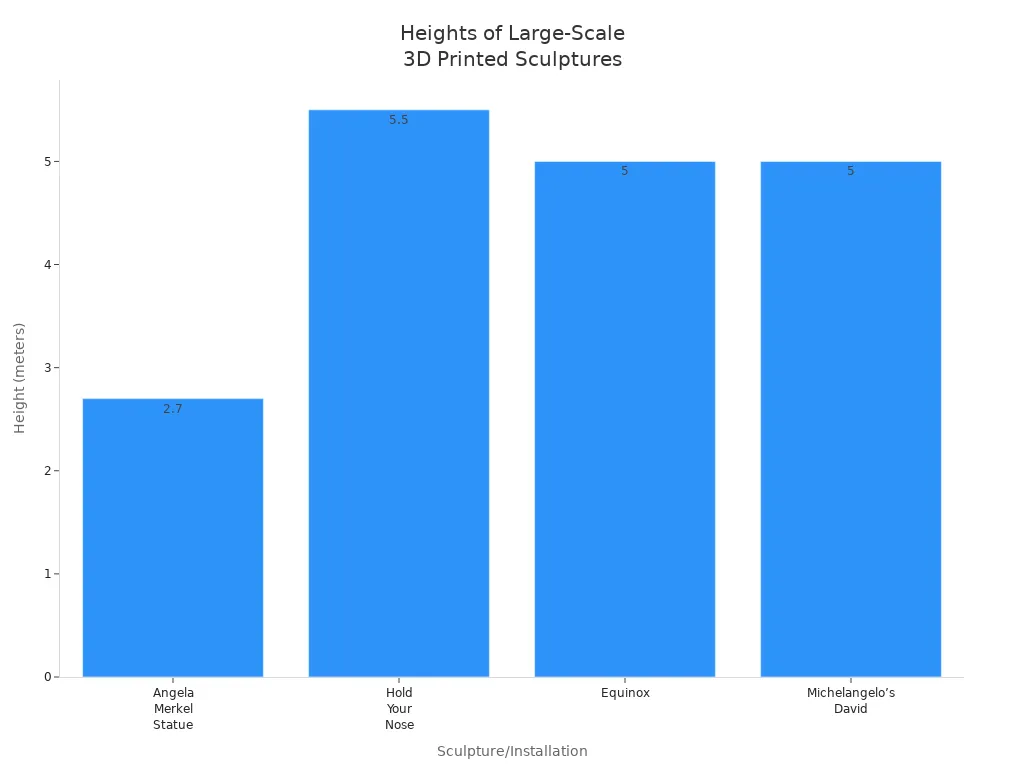
You can see how a large 3d printer enables you to create installations that command attention in public spaces and galleries.
-
Artists use 3d printers to achieve intricate designs.
-
You can combine art, science, and technology for unique results.
Custom Sports Shoes and Wearables
You can revolutionise your wardrobe with 3d printer technology. Leading brands such as Puma, Decathlon, and ASICS now offer sports shoes with 3d printed midsoles and lattice structures. These designs provide comfort, durability, and breathability. For example:
-
3D MTRX Sneakers from Puma and Porsche Design feature a honeycomb midsole for enhanced performance.
-
Decathlon’s sports shoe uses HP’s Jet Fusion 5200 for customisation and recyclability.
-
ASICS ACTIBREEZE™ HYBRID Sandals offer a breathable lattice structure.
-
The 16kw Shoe from Koobz uses recyclable polyurethane for flexibility.
You can personalise fashion with digital customisation. The Organic Skirt from the After Forever Collection offers over 1,000 variants, showing how 3d printing supports unique designs. Eyewear brands now use 3d printers to create frames on demand, reducing waste and enabling rapid changes. Wearable technology, such as smart clothing, further enhances personalisation and interaction with your garments.
Props and Cosplay
You can bring your favourite characters to life with custom props and costumes. A 3d printer allows you to create detailed items for cosplay and entertainment. Notable examples include:
-
Hela’s helmet from 'Thor: Ragnarok', printed in several parts.
-
Mjölnir, Thor’s hammer, produced using binder jetting.
-
Star-Lord’s mask and Korath’s armour from 'Guardians of the Galaxy'.
-
Queen Ramonda’s costume in 'Black Panther', designed by Julia Koerner.
-
The Demogorgon from 'Stranger Things', crafted with Formlabs printers.
-
Costumes for 'Avatar 2', made possible by 3d printing.
You benefit from faster production and high detail. The Form 3L printer captures intricate features, reducing trial and error. Lightweight materials make props easier to wear, while rapid production helps you meet tight deadlines for any project. You can focus on creativity, knowing that your 3d printer delivers both quality and speed.
Tip: Use a large 3d printer to create custom props, wearable art, and installations that reflect your vision. This technology gives you the freedom to experiment and innovate in every project.
Prototyping and Models with 3D Printing
When you use a large 3d printer, you transform the speed and quality of prototyping and models across many industries. You gain the ability to produce physical models rapidly, allowing for real-time feedback and quick design validation. This technology reduces traditional design cycle times and minimises delays caused by late-stage errors. You can create high-quality prototypes that withstand mechanical stress and test them for form, fit, and function before mass production.
Architectural Models
You can produce architectural models with exceptional detail and accuracy. A 3d printer enables you to print models in hours rather than days, which allows for quick modifications and multiple iterations within budget. You improve communication with clients and investors by presenting high-quality models that showcase complex designs. You benefit from reduced costs, increased precision, and enhanced design flexibility.
-
Speed: Print models quickly for faster project turnaround.
-
Communication: Present models that clarify ideas for clients.
-
Cost: Reduce expenses by up to 75%, enabling more iterations.
-
Quality: Achieve high detail and resolution in every model.
-
Precision: Minimise manual errors and improve design quality.
-
Design Flexibility: Create complex structures that traditional methods cannot match.
Tip: Use a large 3d printer to create models that demonstrate your vision and expertise in architecture.
Engineering Prototypes
You accelerate the development of engineering prototypes with 3d printing. As products grow in complexity, you need advanced production methods. Large Format Additive Manufacturing supports the creation of large, durable parts without the constraints of traditional moulds. You achieve exceptional precision and customisation, which is essential for unique shapes and intricate details.
-
Produce prototypes with complex geometries and internal passageways.
-
Develop lightweight structures efficiently.
-
Rapid prototyping allows for quicker iterations and testing.
-
Create prototypes that mirror final product complexity, reducing lead times and costs.
-
Aerospace engineering benefits from lightweight components that meet strict standards.
You can produce complete working prototypes in days, significantly reducing the overall product development cycle. Early testing and validation lower the risk of costly design errors before full-scale production.
Educational Tools
You enhance learning experiences with 3d printing in education. You can create models of complex concepts, such as the Wankel engine, which help students understand mechanics through physical interaction. Multiplication and division fidget spinners make maths engaging for younger learners. Customisable anatomical models provide detailed representations of human anatomy, allowing students to practise surgical procedures and improve practical skills.
-
Visualise concepts beyond traditional graphics.
-
Allow students to interact physically with models, improving retention.
-
Provide real-world applications in various disciplines.
-
Improve understanding of complex anatomical systems.
-
Reduce the risk of complications during actual surgeries by allowing practice on realistic models.
Note: You can use a 3d printer to produce educational tools that make learning interactive and memorable.
You see how prototyping and models benefit from the capabilities of a large 3d printer. You accelerate innovation, improve accuracy, and support creative projects in architecture, engineering, and education.
Limitations and Considerations
When you invest in a large 3d printer, you must understand the practical limitations and considerations that affect your projects. These factors influence the quality, cost, and feasibility of your printed items.
Material Choices
The material you select plays a critical role in the outcome of your print. Each material offers unique properties that determine strength, flexibility, and suitability for specific applications. The table below outlines the most widely used materials and their impact:
|
Material |
Properties |
Impact on Final Product |
|---|---|---|
|
PLA |
Biodegradable, easy to print |
Good for prototypes, less durable |
|
PETG |
Strong, flexible, heat resistant |
Suitable for functional parts |
|
PEEK |
High strength, heat resistant |
Ideal for industrial applications |
|
PA6/66 |
Strong, flexible |
Good for mechanical parts |
|
PLX |
High-performance |
Suitable for demanding applications |
Material limitations directly affect the types of objects you can produce. The appearance, strength, and resistance to environmental factors depend on your material choice. You may find that the lack of consistent standards and the range of available materials restrict broader applications. You must tailor your material selection to match the requirements of each project.
Size and Complexity
Printing larger or more complex objects introduces new challenges. You face a trade-off between size, printing time, and quality. Mistakes during the process can cause significant delays, sometimes costing days of work. You must validate parameters such as thread tension and nozzle distance before starting. Supports are essential for stability, especially with intricate designs.
-
Large prints require careful planning.
-
Errors can result in wasted material and time.
-
Complex shapes may need additional supports.
Cost and Practicality
Operating a large 3d printer involves several financial and practical considerations. The total cost of ownership includes not only the purchase price but also maintenance, upgrades, and support. Production times for large items can be lengthy, and the unit cost may exceed that of traditional mass production. However, you benefit from reduced material waste and the ability to produce small batches or customised items efficiently.
|
Description |
|
|---|---|
|
Total Cost of Ownership |
Calculate all costs including interest, maintenance, and fees to understand the full financial impact. |
|
Upgrade Potential |
Consider leasing or short-term financing if frequent upgrades are anticipated due to rapid technology advancements. |
|
Usage Needs |
Assess how often the printer will be used to justify the investment, especially for businesses versus hobbyists. |
|
Warranty and Support |
Ensure a solid warranty and customer support are included, as these can add long-term value to the investment. |
Note: You should evaluate your needs, budget, and technical expertise before committing to a large-scale 3d printing solution.
You now see how a large 3d printer empowers you to create everything from bespoke furniture to advanced medical devices and striking art installations. This technology is reshaping manufacturing, healthcare, and creative industries by enabling customisation and efficiency. The market for 3D printing continues to expand, with innovations in materials and processes driving growth. You can expect future printers to support sustainability and strengthen supply chains. The possibilities will only grow, offering you new ways to innovate and solve real-world challenges.
FAQ
What is the largest object you can print with a 3d printer?
The maximum size depends on the printer’s build volume. Some industrial machines can print objects over two metres long. You should always check your model’s specifications before starting a large project.
How long does it take to print large items?
Printing time varies based on object size, complexity, and layer height. Large items may require several hours or even days. You can reduce time by adjusting print settings or using faster materials.
Can you use recycled materials for large-scale printing?
Yes, many large-format printers support recycled plastics or composites. You help reduce waste and promote sustainability by choosing eco-friendly materials for your projects.
Is it expensive to operate a large 3D printer?
Operating costs include electricity, materials, and maintenance. While initial investment can be high, you save money on customisation and small-batch production compared to traditional methods.
What software do you need for designing large prints?
You use CAD (Computer-Aided Design) software to create models. Popular options include Fusion 360, SolidWorks, and Blender. Always ensure your software supports the file formats required by your printer.
Share:
Sovol SV08 Max 3D Printer vs Creality K1 Max 3D Printer
Top 10 Useful Things to 3D Print at Home