
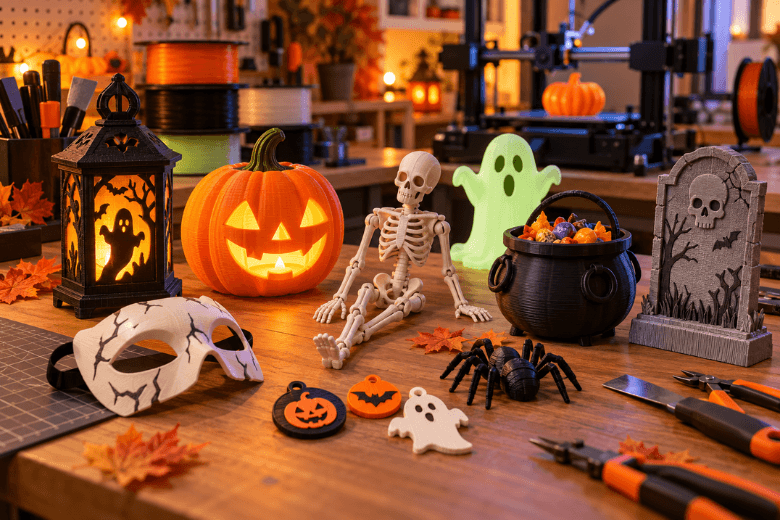
October is the month when a makerspace's print queue stops being about projects and starts being about a deadline. Fifteen models, a handful of printers, a fixed date, and a room full of people who all want their piece finished before the 31st. What actually gets printed is decided by three things long before anyone opens a slicer: whether the part fits the bed, whether the material survives where the part will sit, and whether the finished object passes a safety check before it goes near a child or a naked flame.
This shortlist is organised around those constraints. Ideas are grouped by how they print and where they go — indoor display, outdoor and porch, wearables and costume props, and workshop batch projects — and within each group they run roughly from the easiest fit on a standard-build-volume FDM printer to the ones that need more planning. A 220 × 220 × 250 mm bed is the working assumption, since that class covers most budget and mid-range machines and handles the large majority of downloadable models; anything that exceeds it is flagged as a splitting job rather than quietly assumed to fit.
A note on what this is. It is a research-and-practical-reasoning roundup, drawing on manufacturer material datasheets, UK fire-safety and toy-safety guidance, and platform licensing terms. It is not a lab test, and no model here has been benchmarked on a rack of printers. Print-time figures are estimates derived from stated assumptions about size, layer height and wall count — treat them as planning numbers for a queue, not measured results. Where a manufacturer's guidance has a limit, the limit is stated rather than smoothed over, because a makerspace leader handing a job sheet to a volunteer needs to know where the failure modes are.
The aim is a list you can take into a workshop meeting: material, splitting and safety decisions already worked out, so the conversation can be about who prints what and when.
Indoor Display Pieces
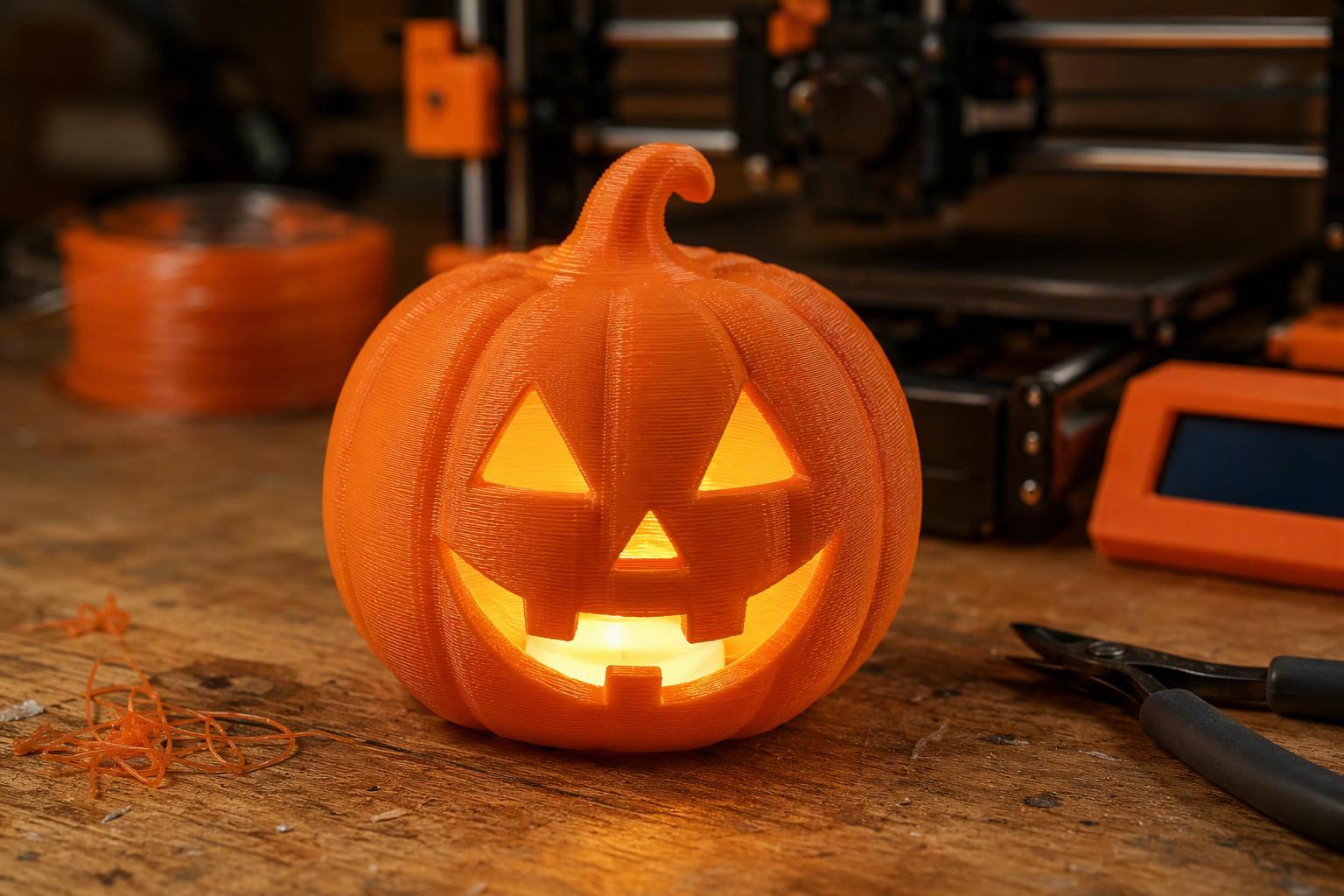
Indoor pieces are the safest category and should carry most of a makerspace's October volume.
Indoor pieces are the safest category and should carry most of a makerspace's October volume. They stay dry, they sit away from heat sources, and they can be printed in PLA — the material most community printers are already dialled in for. PLA prints fast, needs no heated bed, and is not prone to significant warping, which is why it suits shared machines with a rotating cast of operators. Its limits are equally clear: Prusa's material guidance states that PLA gets soft and deforms at temperatures over 60 °C, degrades under UV light, and breaks along layers or into shards on impact. Indoors, out of direct sun, none of that is a problem. On a sunny windowsill or a porch, all of it is.
1. Pumpkin Tea-Light Holder (LED Only) — Best Overall First Print
This is the project to give a first-time user on a shared machine: a single-piece print, modest filament use, no supports if the model is designed with a flat base, and a result that looks like Halloween rather than a test cube. It also teaches the one safety rule that applies to every lit print in this article.
The heat problem is real and worth stating plainly. PLA softens above roughly 60 °C, and a real tea light is a small open flame sitting inside a plastic shell. UK fire-safety guidance is explicit that night lights and tea lights can melt plastic surfaces, and that candles should always be placed on a heat-resistant surface. Prusa's own Halloween guidance goes further for printed models: do not use real candles, use battery-powered alternatives, and notes that LED tea lights or fairy lights are completely safe. Specify battery LED tea lights in the job sheet and check the model has a vent or a removable base so the LED can be switched on without dismantling the print.
As a planning estimate, a 90 mm-diameter holder at 0.2 mm layers with two perimeters and 10–15% infill sits in roughly the 2.5–4 hour band on a modern FDM machine. That is an estimate from those assumptions, not a measured figure — a 0.6 mm nozzle or a 0.28 mm layer height will move it substantially.
2. Articulated Skeleton
The crowd-pleaser, and the one that demonstrates why print-in-place design is such a good fit for community machines. The joints are printed as captive ball-and-socket or pin connections with a designed clearance, so the model comes off the plate already articulated — no supports, no assembly, no fasteners to lose. On a 220 × 220 mm bed a full skeleton usually needs to be laid out diagonally or split into a torso and limbs; the print-in-place principle is what makes either option workable.
Scaling is the variable to watch. Joint clearance scales with the model, so a skeleton shrunk to 70% has 70% of the gap — which may be tight enough to fuse. Print time, meanwhile, scales roughly with volume, so a 70% scale is closer to a third of the material and time. Test one joint at the intended scale before committing a plate.
Worth knowing for teams without multi-material hardware: Prusa's 2026 Halloween collection was printed on a multi-tool machine, but the company notes that most of the models can be printed from separate parts and assembled, so a single-extruder printer is not a barrier.
3. Glow-in-the-Dark Skull or Ghost
Luminous filament is the material story of the season, and it comes with a maintenance cost that should be in the job sheet before the spool goes on the machine. eSUN's PLA-Luminous parameters are a 190–230 °C extruder, a 45–60 °C bed, 100% fan, and speeds under 200 mm/s, with a recommendation to use a wear-resistant nozzle such as hardened steel. Prusa makes the same point about its glow filament: the particles that make it luminous also make it abrasive, and a 0.6 mm hardened nozzle is recommended for the best results.
Be honest with users about how it behaves. The material glows in low light after exposure to ultraviolet light — it charges from light and fades, it does not glow indefinitely. A skull that sits in a dark hallway all day will be dim; one that charges on a windowsill or under a UV torch will perform.
Budget for nozzle wear. A hardened steel nozzle is the consumable that protects the rest of the hotend, and a makerspace running glow filament through a brass nozzle is quietly converting nozzle diameter into glitter.
4. Spooky Lantern with LED Fairy Lights
A hollow, thin-walled print that turns layer lines into texture — the striations catch the light from inside and read as deliberate rather than as an artefact. The design decision is wall thickness against light bleed: two perimeters at a 0.4 mm nozzle gives roughly 0.8 mm of wall, which transmits a soft glow; thicker walls block more light but hold shape better on tall unsupported sections.
A 0.6 mm nozzle is the practical upgrade here. It cuts print time on a large thin-walled shell substantially and gives a chunkier wall in two passes, which suits the aesthetic. The LED-only rule applies exactly as it does to the tea-light holder: battery fairy lights inside, never a candle.
Batch note: scaled down to 80–100 mm tall, three or four lanterns fit a single 220 × 220 mm plate, which makes this a good overnight job for a shared printer.
5. Cauldron Bowl or Sweet Dish
A prop that doubles as a serving vessel — and the point where food-contact caveats have to be stated rather than assumed. Prusa's food-safe FDM guidance is the relevant reference: layer lines can harbour bacteria and absorb chemicals such as soap and detergent, and the standard brass nozzle is not considered food-safe because it wears and the worn material goes into the print. A stainless-steel or titanium nozzle would be needed even to consider printing a food-contact surface.
The practical answer for a makerspace is a two-part design: print the cauldron as an outer bowl, and serve sweets from a separate food-safe liner — a glass or ceramic dish, or a food-grade plastic insert — that sits inside it. The print provides the look; the liner provides the hygiene. That also solves the cleaning problem, since the liner can go in a dishwasher and the print cannot.
Dry sweets in wrappers are a lower-risk use than loose unwrapped food, but the liner approach removes the question entirely and is easier to explain to a volunteer.
Outdoor and Porch Displays
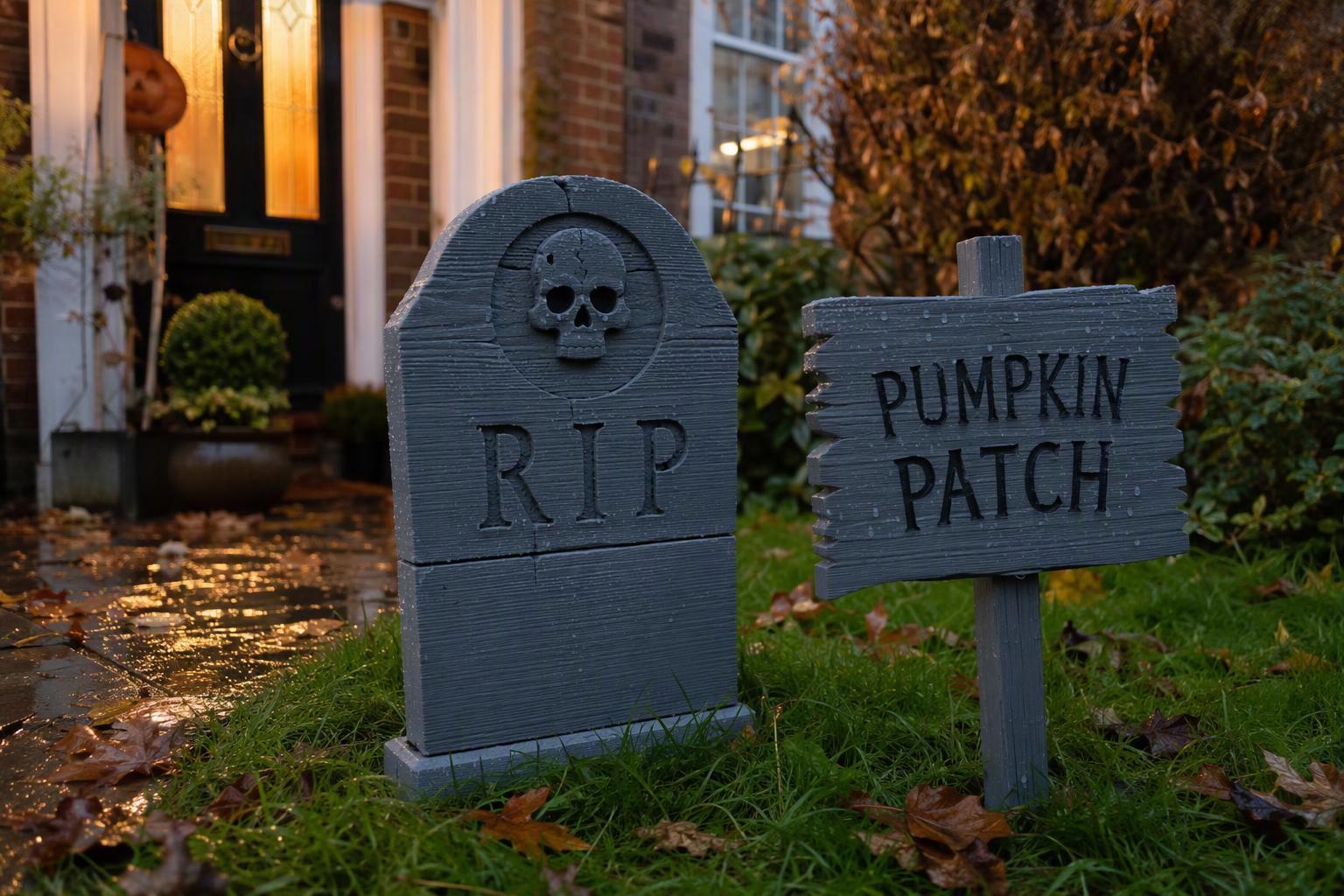
Outdoor displays are where material choice stops being a preference and becomes a specification.
Outdoor displays are where material choice stops being a preference and becomes a specification. The UK October context, using the Met Office's 1991–2020 long-term averages for a representative English location, is a mean daily maximum of about 13.9 °C, a mean daily minimum of about 8.2 °C, roughly 112 mm of rainfall across about 14.6 days with at least 1 mm of rain, and around 102 hours of sunshine for the month. Cool, wet, and low-UV compared with summer — but over a display season that runs from early October to the 31st, moisture and daylight accumulate, and a piece left out for three weeks is not the same test as a piece left out for one night.
That distinction drives the material decision. A display packed away after Halloween night can be PLA. A display that stays up all season should not be.
6. Weatherproof Pumpkin Patch Signage
The clearest case for ASA over PLA in the whole list. Prusa's material guidance states that PLA is not suitable for outdoor use — it degrades under UV light and softens above 60 °C. ASA is described as a technical material suitable for outdoor use due to high UV and temperature resistance, with a heat deflection temperature of 93 °C at 0.45 MPa in the Prusament datasheet.
The trade-off is in the printing, not the material. Prusa lists significant warping as ASA's main disadvantage, notes that an enclosure is necessary for printing large parts, and warns that it releases potentially dangerous fumes (styrene) during printing, so the printer needs to be in a well-ventilated area. A makerspace putting ASA on a shared machine should treat ventilation and enclosure as prerequisites, not optional extras, and should brief whoever is running the job.
For signage specifically, the practical rule is: ASA for anything staying out all season, PLA for a display packed away after Halloween night. Do not split the difference with an unenclosed ASA print on a large flat sign — that is the geometry most likely to warp off the plate.
7. Tombstone Lawn Markers
A full-size tombstone exceeds most beds, so this is a splitting decision before it is a printing decision. Design it as interlocking or dowelled segments — two or three vertical sections that key together — rather than trying to scale a single slab down to fit.
The joint is the weak point outdoors. Prusa's datasheet shows vertical-printed test specimens with higher tensile yield than horizontal ones in their test setup (45 ± 2 MPa versus 42 ± 1 MPa for ASA), but interlayer adhesion is the limiting factor in real parts, and a joint that collects water and flexes in wind will find that limit. Orient segments so the layer lines run along the load path rather than across it, and key the joints mechanically rather than relying on glue alone.
ASA or PETG are the sensible materials. Weight the base — a printed hollow base filled with sand or a removable weight — rather than driving stakes through printed parts, which concentrates stress exactly where the layers are weakest.
8. Window Silhouette Cutouts
Flat, fast, batch-friendly prints that sit behind glass and stay dry — the lowest-risk outdoor-adjacent category, because the glass does the weatherproofing. Glow filament or translucent PETG both work well; a translucent cutout catches interior light and reads as a silhouette from outside.
Flat parts print quickly and stack many per plate, which makes this one of the strongest makerspace batch items on the list. A set of a dozen cutouts for a community centre's windows is a realistic single-evening job across two printers.
9. Hanging Bat or Spider Garland
Many small identical parts, which is exactly where batch workflow pays off. The design choice is print-in-place chains versus separate links: a print-in-place chain comes off the plate as a connected string, which is faster to hang but harder to repair if one link fails; separate links are more robust and let a group share the printing.
If children are nearby, the string matters as much as the print. UK toy safety regulations require toys intended to be strung across a cradle, cot or perambulator by strings, cords, elastics or straps to carry a specific entanglement warning on the packaging and permanently on the toy. A makerspace garland is not that product, but the underlying hazard — cord near young children — is the same, so keep hanging cords short, secure them out of reach, and do not hand a garland to a toddler group as a plaything.
Wearables and Costume Props
Before any item in this section, the safety frame. UK toy safety regulations set out warning requirements that apply to toys, including that imitations of protective masks and helmets must bear the warning "This toy does not provide protection," and that toys which might be dangerous for children under 36 months must carry a warning such as "Not suitable for children under 36 months" or the equivalent graphic. A printed mask is a costume piece. It is not eye protection, not head protection, and not impact protection. Visibility, ventilation and weight are the checks before a child wears one, and a makerspace that sells or donates these should label them to the same standard the regulations describe.
10. Printed Mask Shell (Costume Only)
Segmentation is the first design decision: a mask that fits a face needs to be split into sections that follow the bed and assemble into a curved shell, and the seams become part of the look. Ventilation openings are not optional — a rigid shell with no airflow fogs up, overheats and gets pulled off within minutes. Sightlines need to be genuinely clear, not a grid of small holes the wearer has to squint through.
A rigid printed mask also needs a soft liner where it contacts the face, both for comfort and to stop the hard edges pressing. That liner is a separate material decision and should be treated as part of the build, not an afterthought.
If the makerspace sells or donates masks, the "This toy does not provide protection" warning is the labelling standard to follow. It is a short line that prevents a serious misunderstanding.
11. Articulated Finger Claws or Gauntlet
Small, fast, high-impact — the kind of print that takes under an hour and gets worn all evening. Print-in-place articulation works well at this scale, with the joints printed captive so the claws flex without assembly.
Sizing to the wearer is the practical constraint: a gauntlet printed for an adult hand will not stay on a child's, and a claw sized for a child is a small detached part. Around young children, treat any small separated piece as a choking hazard and keep the assembled item for older wearers. The under-36-months warning exists for exactly this reason.
12. Wand, Staff or Prop Weapon
Address the prop-weapon question directly rather than hoping it does not come up. The design rules are blunt, lightweight, no sharp points, and clearly a toy — a silhouette that reads as a magic wand rather than a blade, and a finish that does not invite a swing at another person.
The structural issue is layer direction at thin shafts. A wand printed horizontally has layer lines running across its length, so a bend snaps it; printed vertically, the layers run along the shaft and the part survives handling far better. Where a design needs a long horizontal section, print it in segments around a core — a dowel or rod through the centre — so the printed shell is decorative rather than load-bearing.
Workshop and Makerspace Batch Projects
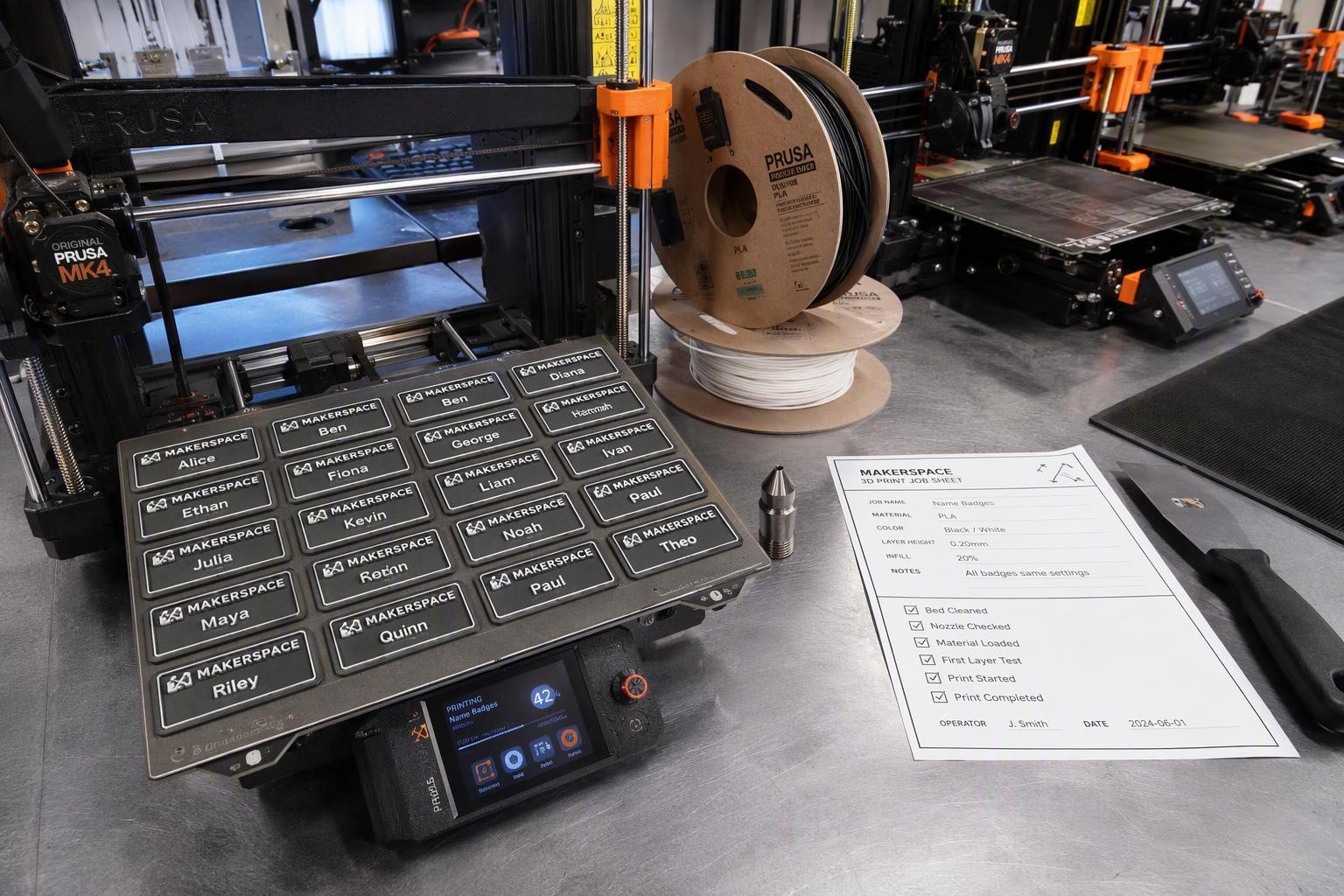
This section is for the community leader rather than the individual maker: shared printers, many users, tight October deadlines.
This section is for the community leader rather than the individual maker: shared printers, many users, tight October deadlines. The questions here are throughput and licensing, not which model looks best.
13. Name-Tag or Badge Set for a Halloween Event
The ideal batch job — small, fast, personalisable, low material. A plate of twenty badges is a realistic single print, and the personalisation can be done with a colour change at a set layer height rather than multi-material hardware: pause the print, swap the spool, resume. That is a manual step, so it suits a supervised session rather than an overnight job.
Plate layout matters more than it looks. Sequential printing — one object at a time — is limited by gantry height and clearance, so check the slicer's sequential-printing settings before promising a plate of tall badges. For flat badges, printing them all at once is simpler and faster.
14. Table Centrepiece Kit for a Workshop
A multi-part kit that a group can each print one component of, then assemble — good teaching structure, because it makes bed fit the assignment. One person prints the base, another the column, another the topper, and the parts have to match when they meet.
That means standardising filament and settings across the group: same material, same brand where possible, same layer height, and a shared tolerance for the joints. A kit printed across five machines with five different spools will not fit together as reliably as one printed on a single machine, and the assembly session becomes a filing session.
15. Spooky Model Remix Station (Ghost-ify an Existing Model)
The community-engagement item, and the lowest-risk way to get beginners designing. Prusa's 2026 Halloween offer includes a free web tool that transforms an existing model into a ghost — a gentle introduction to the idea that a model is a starting point rather than a fixed object.
Pair it with the licensing check below. A remix of someone else's model inherits obligations from that model's licence, and a ghost-ified version shared back to a platform needs to respect the terms the original was published under. Teaching that alongside the tool is part of the point.
Material and Print-Time Quick Reference
The table below maps each idea to a recommended material, whether it needs splitting on a standard 220 × 220 × 250 mm bed, where it can live, and an estimated print-time band. The time bands assume 0.2 mm layers, two to three perimeters, and a part size typical for the item — they are estimates from those assumptions, not measured figures, and a 0.6 mm nozzle or a coarser layer height will move them significantly. ASA requires an enclosure for large parts and good ventilation in all cases.
|
# |
Idea |
Material |
Split on standard bed? |
Indoor / outdoor |
Estimated print time |
|---|---|---|---|---|---|
|
1 |
Pumpkin tea-light holder (LED) |
PLA |
No |
Indoor |
2.5–4 h |
|
2 |
Articulated skeleton |
PLA |
Sometimes (layout-dependent) |
Indoor |
4–8 h |
|
3 |
Glow skull or ghost |
PLA-Luminous (hardened nozzle) |
No |
Indoor |
3–6 h |
|
4 |
Spooky lantern |
PLA |
No (batch 3–4 per plate) |
Indoor |
3–5 h each |
|
5 |
Cauldron bowl |
PLA |
No |
Indoor (with liner) |
4–7 h |
|
6 |
Pumpkin patch signage |
ASA (or PLA for one night) |
Yes, for large signs |
Outdoor |
5–10 h |
|
7 |
Tombstone markers |
ASA or PETG |
Yes, by design |
Outdoor |
6–12 h per set |
|
8 |
Window silhouettes |
PLA glow or translucent PETG |
No (batch many per plate) |
Sheltered outdoor |
0.5–1.5 h each |
|
9 |
Bat or spider garland |
PLA |
No (batch) |
Sheltered outdoor |
1–3 h per set |
|
10 |
Mask shell |
PLA |
Yes, for fit |
Wearable (costume) |
6–12 h |
|
11 |
Finger claws or gauntlet |
PLA |
No |
Wearable |
0.5–1.5 h |
|
12 |
Wand or staff |
PLA or PETG |
Yes, for length |
Wearable / prop |
1–3 h |
|
13 |
Name-tag set |
PLA |
No (batch 15–20 per plate) |
Event use |
1.5–3 h per plate |
|
14 |
Centrepiece kit |
PLA (standardised) |
Per component |
Indoor |
6–12 h across a group |
|
15 |
Ghost-ified remix |
PLA |
Model-dependent |
Indoor |
Model-dependent |
Heat deflection temperature (ISO 75) for three Prusament filaments, shown at both test loads because the values differ by load. These are one manufacturer's typical values on printed specimens and rank materials for placement decisions; they do not predict the behaviour of a specific print. ASA also requires an enclosure for large parts and good ventilation because of styrene fumes.
Licensing and Safety Checklist for Makerspaces
The non-printing decisions are the ones that cause trouble after the event, so consolidate them before the workshop starts.
Licensing. Printables' terms state that when a user uploads a model, they offer it to other users under the licence they select, and that the platform operator does not grant any licence to users for the printing documents. In practice: the licence comes from the designer, not the platform, so check each model's licence before a paid workshop, a sold kit, or a display used to promote a business. Creative Commons NonCommercial licences restrict use to noncommercial purposes, and CC's own interpretation guidance notes that an NC-licensed work may not be included in a commercially distributed collection even as a small portion of it. A makerspace charging for a workshop that prints NC-licensed models is exactly the kind of case to check rather than assume.
Fire. LED tea lights and fairy lights only inside printed models — never real candles. UK fire-safety guidance warns that night lights and tea lights can melt plastic surfaces, and that candles should sit on a heat-resistant surface and never be left unattended. Prusa's Halloween guidance is equally direct: do not use real candles in printed models.
Toy safety. Imitations of protective masks and helmets must carry the warning "This toy does not provide protection." Toys that might be dangerous for children under 36 months must carry an under-36-months warning. Toys intended to be strung across a cradle, cot or perambulator by cords must carry the entanglement warning on the packaging and permanently on the toy — relevant to garlands and anything with a hanging loop.
Food contact. Printed bowls and cauldrons should hold a separate food-safe liner, not loose food. Layer lines harbour bacteria and absorb cleaning chemicals, and a brass nozzle is a consumable that wears into the print.
Material handling. ASA needs an enclosure for large parts and good ventilation because of styrene fumes. Glow filament needs a hardened nozzle. Both belong on the job sheet, not in a verbal handover.
Conclusion
The decision rule is short enough to put on a wall. PLA and LED lights for indoor pieces that are packed away after the night. ASA — with an enclosure and ventilation — for anything facing a UK October outdoors for the season, and PLA only for outdoor pieces that come in after Halloween night. Segmented designs for anything bigger than the bed, with the joints designed rather than improvised. And a licence and safety check before anything leaves the makerspace, whether it is sold, donated or displayed under the organisation's name.
Everything else is a scheduling problem: which printer, which spool, which volunteer, which evening. The fifteen ideas above are ordered so that the easy, low-risk prints come first and the ones needing material changes or splitting come later, which gives a workshop a natural ramp from the first week of October to the last.
If your makerspace is also standardising its printer setup this season, Sovol's learning path for UK makerspaces walks through the progression from first print to full projects. And if your community has a Halloween list of its own — a model that always prints well, a material that failed, a batch trick worth copying — that is worth sharing back; the next workshop will use it.
Key Takeaways
-
Match material to location: PLA for indoor pieces, ASA for outdoor displays that stay up, per manufacturer guidance on UV and heat limits.
-
Use LED tea lights and fairy lights only — never real candles — inside printed models.
-
Anything larger than the bed should be designed as segments; joints are the weak point outdoors.
-
Treat printed masks as costumes, not protection, and follow UK toy-warning requirements.
-
Check each model's licence before paid workshop or display use; the platform grants no licence itself.
-
Print-time figures here are estimates from stated assumptions, not measured benchmarks.
Share:
How to Avoid Ringing and Ghosting in Fast 3D Prints
7 Colors, 7 Materials, Less Waste: How the Sovol M1D Changes Multi-Material Printing