
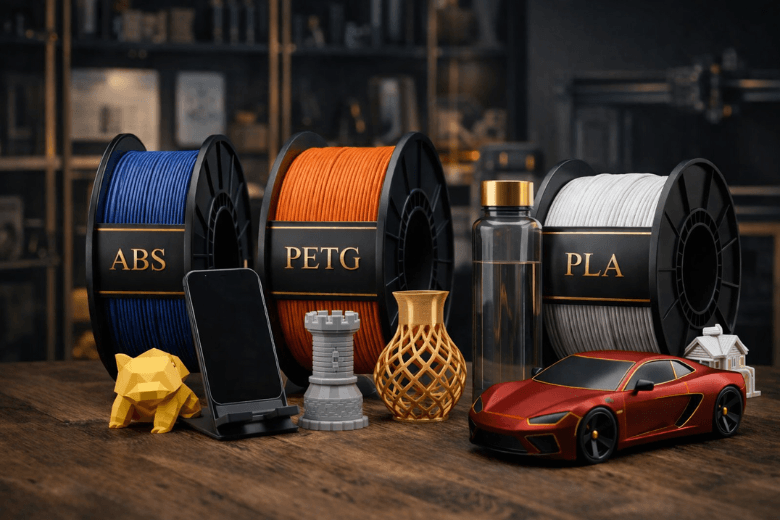
I always recommend PLA as the top choice for everyday 3D printing. PLA works best for most users who want quick, attractive results without hassle. Many people value ease of use, so I see PLA as ideal for beginners and hobby projects. PLA does not need special equipment, and prints stick well to most beds. When I need a filament that handles more stress, I consider PETG, which offers better durability and stretchiness. PLA, however, remains my favourite for its simplicity and reliability. If you want to know how PLA PETG ABS compare, I will help you decide which one suits your needs. PLA stands out for low melting point and easy handling, making it the best starting point for anyone new to 3D printing. PLA also excels in rapid prototyping and aesthetic prints, so I use it for most of my projects.
Key Takeaways
-
PLA is the best choice for beginners due to its ease of use and low printing temperature.
-
PETG offers excellent durability and flexibility, making it ideal for functional parts and outdoor projects.
-
ABS is suitable for high-temperature applications, providing strong impact resistance but requires careful handling.
-
PLA is eco-friendly and biodegradable, appealing to those concerned about environmental impact.
-
Choosing the right filament depends on your project needs; consider printability, strength, and heat resistance.
PLA PETG ABS: Quick Answer
Best Filament for Everyday Use
When I consider everyday 3D printing, I always reach for pla. I find that pla petg abs each have their place, but pla stands out as the most reliable and user-friendly option for most projects. Experts consistently recommend pla for general use because it prints easily, costs less, and produces attractive results. I see pla as the best starting point for anyone new to 3D printing or for those who want hassle-free results.
Tip: If you want a filament that works straight out of the box and delivers smooth, consistent prints, pla is the safest bet.
Here’s a quick comparison of the main advantages and disadvantages of pla petg abs for everyday use:
|
Material |
Advantages |
Disadvantages |
|---|---|---|
|
PLA |
High tensile strength, easy to print |
Brittle, lower heat resistance |
|
PETG |
Good impact resistance, chemical resistance, strong layer adhesion |
More challenging to print than PLA |
|
ABS |
High heat resistance, good impact resistance |
Prone to warping, requires higher printing temperatures |
Why This Filament Wins
I choose pla for most of my daily prints because it offers a unique mix of benefits that suit both beginners and experienced users. Pla petg abs all have strengths, but pla wins for everyday use for several reasons:
-
Pla prints at lower temperatures, so I do not need a heated bed or enclosed printer.
-
I rarely experience warping or adhesion problems with pla, which saves me time and frustration.
-
Pla produces smooth finishes and sharp details, making it ideal for decorative objects, prototypes, and indoor brackets.
-
The eco-friendly nature of pla appeals to me, as it is biodegradable and made from renewable resources.
-
Pla remains the most popular 3D printer filament due to its affordability and ease of use.
When I compare user satisfaction, pla consistently receives high marks for reliability and print quality. Here’s how pla petg abs stack up in typical applications:
|
Filament |
Characteristics |
Typical Applications |
|---|---|---|
|
PLA |
Easy to print, no warping, biodegradable |
Decorative objects, prototypes, indoor brackets |
|
PETG |
Tough, UV and water-resistant, easy to print |
Functional parts, outdoor projects, workshop tools |
|
ABS |
Impact-resistant, heat-stable, requires technical know-how |
Mechanical parts, vehicle components, tools |
I have noticed that pla does have some limitations. It can soften or deform in hot environments, so I avoid using it for parts exposed to high temperatures. However, for most household items, models, and prototypes, pla delivers the best balance of quality, ease, and value. When I need more durability or heat resistance, I consider petg or abs, but for everyday prints, pla remains my top choice.
Note: If you want to avoid common issues like warping and cracking, especially with abs, stick with pla for stress-free printing.
By weighing the strengths and weaknesses of pla petg abs, I always return to pla as the most dependable filament for daily 3D printing needs.
PLA vs ABS vs PETG: Filament Basics
PLA Overview
When I compare pla vs abs vs petg, I always start with pla. This filament comes from renewable resources, which makes it biodegradable and environmentally friendly. I find that pla melts at a lower temperature, usually between 180-200°C. The strength of pla stands out, with tensile strength typically ranging from 50-60 MPa. However, pla begins to deform at temperatures above 90°C, so I avoid using it for parts exposed to heat. The material is robust but not flexible, and it absorbs water easily. I notice that pla offers a smooth finish and sharp details, which suits decorative prints. In the context of pla vs abs, pla is much easier to print and does not require a heated bed.
-
Made from biological materials like cornstarch or sugarcane
-
Melting temperature: 180-200°C
-
Tensile strength: 50-60 MPa
-
Low impact resistance and flexibility
-
Not water-resistant
-
Biodegradable and non-combustible
PETG Overview
When I consider petg vs pla, I see petg as a tough and versatile filament. Petg combines the ease of printing of pla with improved strength and flexibility. I use petg when I need better chemical resistance and UV stability. The melting temperature for petg ranges from 220-260°C, and it has a glass transition temperature around 80°C. The strength of petg is impressive, with tensile strength between 40-50 MPa and elongation at break of 20-25%. I find petg suitable for outdoor applications and parts that require durability. Petg is also considered food-safe, which adds to its versatility. Compared to pla vs abs vs petg, petg offers a balance of printability and strength.
-
Excellent layer adhesion and chemical resistance
-
Melting temperature: 220-260°C
-
Tensile strength: 40-50 MPa
-
Medium impact resistance
-
UV and water-resistant
-
Suitable for functional and outdoor parts
ABS Overview
In the pla vs abs vs petg debate, abs stands out for its strength and durability. I rely on abs when I need high impact resistance and dimensional stability. The melting temperature for abs is higher, usually between 220-250°C, and it requires a heated bed set at 80-110°C. The strength of abs is solid, with tensile strength around 34-36 MPa. I notice that abs can warp due to thermal shrinkage, so I always use good ventilation because abs emits unpleasant fumes during printing. In the context of pla vs abs, abs is less user-friendly but offers superior durability for mechanical parts.
-
Strong material with high impact resistance
-
Melting temperature: 220-250°C
-
Tensile strength: 34-36 MPa
-
High glass transition temperature (~105°C)
-
Prone to warping and requires a heated bed
-
Emits fumes during printing
Tip: When I choose between pla vs abs vs petg, I always match the filament to the project’s strength, durability, and printability needs.
|
Property |
PLA |
PETG |
ABS |
|---|---|---|---|
|
Tensile Strength (MPa) |
50-60 |
40-50 |
34-36 |
|
Impact Resistance |
Low |
Medium |
High |
|
Melting Temperature (°C) |
180-200 |
220-260 |
220-250 |
|
Glass Transition Temp (°C) |
~60 |
~80 |
~105 |
|
Water Resistance |
Low |
High |
Moderate |
|
Printability |
Easy |
Moderate |
Challenging |
I always review these basics before I decide which filament to use. The differences in strength, print settings, and material properties help me select the right option for each project.
Filament Comparison: Everyday Factors
Printability and Ease of Use
When I assess 3d printing materials, printability always comes first. PLA stands out as the easiest 3d printer filament for everyday printing. I find that PLA requires lower temperatures and does not need a heated bed, which simplifies the process. PETG offers moderate printability, but it demands a heated bed and careful temperature control. ABS, in my experience, presents the most challenges. Warping and fumes make ABS less suitable for beginners. Here is a quick comparison:
|
Material |
Printability |
Ease of Printing |
Beginner-Friendly |
|---|---|---|---|
|
PLA |
Easiest |
Excellent |
Yes |
|
PETG |
Moderate |
Good |
Somewhat |
|
ABS |
Complex |
Challenging |
No |
I always recommend PLA for those new to 3d printing materials due to its consistent results and minimal fuss.
Durability and Strength
Durability and tensile strength matter for functional parts. PLA provides good tensile strength but can be brittle. PETG impresses me with its excellent durability and flexibility, making it ideal for items that need to withstand daily use. ABS delivers solid tensile strength and moderate flexibility, which suits general household projects. Here is how I compare their performance:
|
Filament |
Durability |
Tensile Strength |
Suitable Uses |
|---|---|---|---|
|
PLA |
Moderate |
High |
Decorative, Prototypes |
|
PETG |
Excellent |
High |
Outdoor, Food-grade |
|
ABS |
Good |
High |
General, Mechanical |
I consider PETG one of the strongest 3d printing materials for everyday items.
Flexibility and Impact Resistance
Flexibility and impact resistance affect how a 3d print handles stress. PLA has low flexibility and can snap under pressure. PETG offers more flexibility and absorbs impact better. ABS provides moderate flexibility and good impact resistance, which helps for mechanical parts. I always match the filament to the project’s needs.
-
PLA: Low flexibility, low impact resistance
-
PETG: High flexibility, good impact resistance
-
ABS: Moderate flexibility, good impact resistance
Heat Resistance
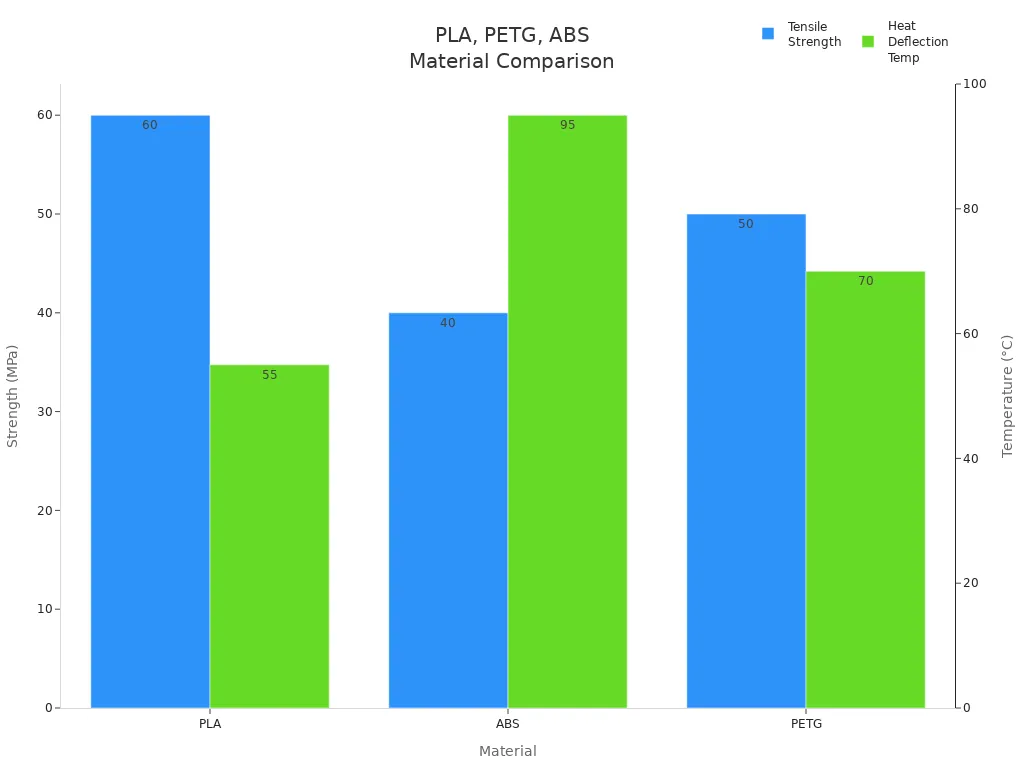
Heat resistance is crucial for 3d printing strength in high-temperature environments. PLA softens at 55°C, so I avoid it for hot settings. PETG withstands up to 70°C, which covers most household uses. ABS excels with a maximum operating temperature of 98°C, making it the best choice for parts exposed to heat.
|
Material |
Maximum Operating Temperature |
|---|---|
|
PLA |
55°C |
|
PETG |
70°C |
|
ABS |
98°C |
For printing recommendations where heat is a concern, I choose ABS.
Environmental Impact
I always consider the environmental impact of 3d printer filaments. PLA is biodegradable and made from renewable resources like cornstarch. PETG is non-toxic and recyclable, which reduces its footprint. ABS, however, emits fumes during printing and is not biodegradable. PLA remains my top choice for eco-friendly 3d printing materials.
-
PLA: Biodegradable, renewable, low emissions
-
PETG: Recyclable, non-toxic, slow to decompose
-
ABS: Not biodegradable, emits fumes
This comparison helps me select the right filament for each project, balancing printability, tensile strength, and environmental responsibility.
Choosing the Right Filament
For Beginners
When I guide a beginner, I always recommend starting with pla. This filament prints at low temperatures and does not require a heated bed. I find that pla sticks well to most build plates and rarely warps. Most users achieve beautiful results with minimal effort. User reviews consistently rate pla as the most beginner-friendly option. I have seen many new users succeed with their first prints using pla.
|
Material |
Ease of Printing |
Temperature Requirements |
Notes |
|---|---|---|---|
|
PLA |
Most beginner-friendly |
190-220℃ |
No heated bed needed, easy to print |
|
PETG |
Easy, but requires careful settings |
220-260℃ |
Needs a heated bed, good thermal stability |
|
ABS |
Challenging |
Requires heated bed |
Prone to warping and emits fumes |
Tip: If you are a beginner, choose pla for a smooth introduction to 3D printing.
For Functional Parts
I often select petg or abs for functional parts that need to withstand stress or wear. Petg offers excellent durability and flexibility, making it suitable for gears, hinges, and wear parts. Abs provides high impact resistance and heat stability, which I use for enclosures and automotive components. Both petg and abs are common choices for functional items in consumer 3D printing. I have printed tool handles and brackets with petg, and I rely on abs for parts that must endure mechanical loads.
|
Material |
Tensile Strength |
Heat Deflection Temp |
Print Difficulty |
Applications |
|---|---|---|---|---|
|
PLA |
~60 MPa |
55°C |
Very Easy |
Visual prototypes, models |
|
ABS |
~40 MPa |
95°C |
Moderate |
Enclosures, automotive, functional parts |
|
PETG |
~50 MPa |
70°C |
Easy |
Gears, hinges, wear parts |
For High-Temperature Uses
When I need a part to resist heat, I turn to abs. This filament withstands temperatures up to 95°C, which suits car accessories and kitchen fixtures. Petg also performs well in moderate heat, handling up to 70°C. For extreme heat, I consider advanced materials like polycarbonate, but for most household needs, abs remains my preferred choice. I have used abs for parts near electronics and appliances without issues.
For Prototypes and Models
For prototypes and models, I always reach for pla. This filament produces sharp details and smooth finishes, which are essential for visual presentation. I use pla for architectural models, figurines, and design mock-ups. The low cost and ease of use make pla ideal for rapid prototyping. In professional and hobbyist settings, pla remains the standard for model-making.
Note: If you want reliable results for prototypes or display pieces, pla delivers consistent quality.
I see clear strengths in each filament:
-
PLA: Easy to print, eco-friendly, ideal for beginners.
-
PETG: Durable, flexible, suitable for functional parts.
-
ABS: Heat-resistant, strong, best for technical applications.
I recommend PLA for most daily prints. Your needs may differ, so experiment with all three as your skills grow.
Every print teaches me something new. Choose confidently and enjoy the process.
FAQ
What filament do I use for outdoor prints?
I choose PETG for outdoor prints. This material resists UV light and moisture. PLA degrades in sunlight. ABS can work, but it may crack over time. PETG gives me the best balance of strength and weather resistance.
Can I print ABS without a heated bed?
I do not recommend printing ABS without a heated bed. Warping becomes a major issue. I always use a heated bed set to at least 90°C. This step ensures better adhesion and reduces failed prints.
Is PLA safe for food contact items?
I avoid using standard PLA for food contact. Most filaments contain additives. Even if labelled food-safe, I cannot guarantee safety due to possible contamination from the printer nozzle or bed. I use certified food-safe filament and dedicated hardware for such projects.
How do I reduce stringing with PETG?
I lower the print temperature and increase retraction settings. PETG tends to string more than PLA. I also keep the nozzle clean. These adjustments help me achieve cleaner prints with fewer wispy strands.
Which filament produces the smoothest finish?
I find PLA produces the smoothest and most detailed finish. The low printing temperature and minimal warping allow for crisp edges. For display models or prototypes, I always reach for PLA first.
Share:
Top Picks for Large Format 3D Printers in 2026 Featuring Sovol SV08 Max
How to Print Large Models Without Warping