
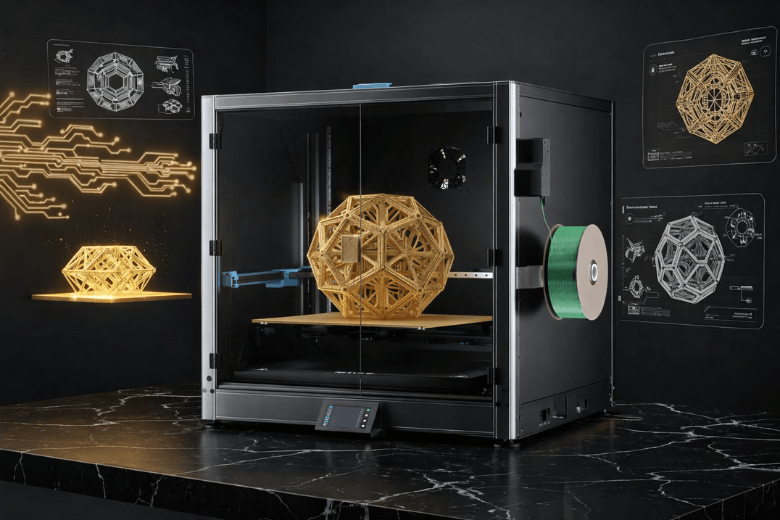
I believe the Sovol SV08 Max 3D Printer stands out as a leading choice for large format 3D printing in 2026. I see impressive options across the market, including the Comgrow T500, Ultimaker S5, Anycubic Kobra 3 Max, Bambu Lab P2S, Elegoo Centauri Carbon, and Prusa CORE. I aim to help you identify the best printer for your needs by focusing on clear comparisons, essential specifications, and practical advice.
Key Takeaways
-
The Sovol SV08 Max 3D Printer excels in speed, build volume, and material compatibility, making it ideal for demanding projects.
-
Consider build volume and print speed when selecting a printer to ensure it meets your project requirements efficiently.
-
Material compatibility is crucial; choose printers that support a wide range of filaments for diverse applications.
-
Reliability features like automatic bed levelling and robust construction reduce failed prints and save material.
-
Evaluate the price-to-performance ratio to ensure you invest in a printer that delivers professional results for your needs.
Large Format 3D Printer Comparison 2026
Key Specs Table
I have compared the leading large format 3D printers for 2026 in the table below. This summary focuses on the features that matter most for demanding projects and professional results.
|
Model |
Build Volume |
Max Speed |
Material Compatibility |
Reliability |
Value |
|---|---|---|---|---|---|
|
Large |
PLA, TPU, PETG, ABS, advanced filaments |
High (CoreXY, auto-levelling) |
Excellent |
||
|
Comgrow T500 |
Extra Large |
600 mm/s |
PLA, PETG, ABS |
High |
Very Good |
|
Ultimaker S5 |
Large |
300 mm/s |
PLA, ABS, Nylon, CPE, PC |
Very High |
Premium |
|
Anycubic Kobra 3 Max |
Large |
600 mm/s |
PLA, PETG, TPU |
High |
Excellent |
|
Bambu Lab P2S |
Large |
500 mm/s |
PLA, PETG, ABS, PC |
High |
Good |
|
Elegoo Centauri Carbon |
Large |
400 mm/s |
PLA, PETG |
High |
Good |
|
Prusa CORE |
Large |
400 mm/s |
PLA, PETG, ABS, ASA |
Very High |
Very Good |
I recommend using this table as a quick reference when you need to compare build volume, speed, and material options at a glance.
Main Differences
I notice several key differences that set these printers apart:
-
The Sovol SV08 Max 3D Printer stands out for its combination of high speed, large build volume, and broad material compatibility. I find its CoreXY design and automatic bed levelling system deliver consistent reliability, even for complex prints.
-
The Comgrow T500 offers an even larger build area, which suits oversized prototypes, but it does not support as many advanced materials as the Sovol SV08 Max 3D Printer.
-
Ultimaker S5 excels in dual extrusion and print quality, though its speed is lower and the price is higher.
-
Anycubic Kobra 3 Max balances speed and value, making it a strong choice for users who want reliable performance without a premium price.
-
Bambu Lab P2S and Elegoo Centauri Carbon both provide robust reliability, but their material compatibility is more limited.
-
Prusa CORE remains a market leader for reliability and ease of use, though it does not match the Sovol SV08 Max 3D Printer in speed.
I always advise matching your choice to your project’s size, speed, and material requirements. This approach ensures you get the best results for your investment.
Buyer’s Guide for Large Format Printers
When I select a large format 3D printer, I focus on five essential factors. These include build volume, print speed, material compatibility, reliability, and value. I always match these features to the specific requirements of my projects.
Build Volume
I consider build volume as the foundation for any large format printer decision. A larger build volume lets me print bigger parts in one go. This feature also allows me to produce several smaller components at the same time. I find this approach increases efficiency and reduces assembly steps, which is vital for rapid prototyping and mass production.
-
Large build volumes enable single-print large parts.
-
I can print multiple small items simultaneously.
-
Fewer assembly steps mean faster project completion.
Print Speed
Print speed directly impacts my productivity. In 2026, I see average print speeds reaching 700 mm/s for top models. This speed allows me to complete prototypes and large models quickly. Faster print speeds reduce waiting times and help me keep up with tight deadlines.
-
High print speeds boost rapid prototyping.
-
Reduced waiting times improve workflow efficiency.
Material Compatibility
I always check which materials a printer supports before making a purchase. The best large format printers, such as the Sovol SV08 Max, handle a wide range of filaments. I can use PLA, ABS, PETG, polycarbonate, nylon, and high-performance polymers. This flexibility lets me tackle diverse projects, from functional prototypes to end-use parts.
-
Wide material compatibility supports more applications.
-
Advanced filaments expand project possibilities.
Reliability
Reliability remains a top priority for me. I look for features like automatic bed levelling and robust frame construction. Consistent performance means fewer failed prints and less wasted material. I also read user reviews to gauge real-world reliability.
Tip: I always check recent user feedback to confirm reliability claims.
Value
I weigh the price-to-performance ratio carefully. The Sovol SV08 Max offers a large build volume, fast printing, and broad material support at a price higher than entry-level models, but I find the investment worthwhile for professional results.
|
Feature |
Sovol SV08 Max |
Other Leading Printers |
|---|---|---|
|
Build Volume |
Large |
Varies |
|
Printing Speed |
Fast |
Varies |
|
Material Compatibility |
Wide |
Varies |
|
Price |
Higher than entry-level |
Varies |
I always match the printer’s strengths to my project needs to ensure the best value.
Top Model Reviews
Sovol SV08 Max 3D Printer – Features & Use Cases
I have found the Sovol SV08 Max 3D Printer to be a standout performer in the large format category. The combination of a spacious build volume and rapid print speeds up to 700 mm/s allows me to tackle both large prototypes and batch production efficiently. The CoreXY architecture ensures precise movement, which translates to consistently accurate prints. I appreciate the automatic bed levelling system, which reduces setup time and minimises failed prints. The wide material compatibility, including PLA, TPU, PETG, ABS, and advanced filaments, means I can switch between functional prototypes and aesthetic models without changing machines. For professional workshops and advanced hobbyists, this printer offers a compelling balance of speed, reliability, and versatility.
Tip: I always recommend the Sovol SV08 Max 3D Printer for users who need a robust, all-round solution for demanding projects.
Comgrow T500 – Large Build Volume
When I require an extra-large build area, I often consider the Comgrow T500. This model provides one of the largest print volumes in its class, making it ideal for oversized prototypes and architectural models. The print speed reaches up to 600 mm/s, which keeps my workflow efficient. However, I have noticed that material compatibility is more limited compared to the Sovol SV08 Max 3D Printer. The T500 handles standard filaments like PLA, PETG, and ABS well, but does not support as many advanced materials. For users focused on sheer size and straightforward materials, the T500 delivers excellent value.
Ultimaker S5 – Dual Extruder & Quality
I have always respected the Ultimaker S5 for its exceptional print quality and dual extrusion capabilities. This printer targets professionals who demand precision and flexibility. The advanced software integration streamlines print management, and the open filament system allows me to experiment with a wide range of materials. I find the S5 particularly reliable, with minimal maintenance required over long-term use. The following table highlights how the S5 compares to its sibling, the S3, in key areas:
|
Feature |
Ultimaker S5 |
Ultimaker S3 |
|---|---|---|
|
Build Platform Size |
Larger than S3 |
Smaller than S5 |
|
Filament System |
Open filament system |
Closed filament system |
|
Software Integration |
Advanced software for management |
Basic software |
|
Target Users |
Professionals |
Hobbyists |
|
Print Quality |
Exceptional |
Good |
The S5’s larger build platform and advanced management tools make it my preferred choice for professional environments where reliability and print quality are paramount.
Anycubic Kobra 3 Max – Speed & Reliability
The Anycubic Kobra 3 Max impresses me with its remarkable print speeds and consistent results. I have achieved speeds up to 600 mm/s, thanks to advanced vibration compensation algorithms and a robust motion control system. The printer also supports fast print speeds up to 180 mm/s for standard jobs, which keeps my projects on schedule. I value the built-in Accelerometer G-Sensor, which detects vibration frequencies and adjusts motion control to prevent ringing issues. This feature ensures smooth extrusion and high-quality prints, even at higher speeds.
|
Feedback Type |
Description |
|---|---|
|
Print Quality |
The printer delivered high-quality prints quickly, thanks to its impressive 600 mm/s speed. |
|
Motion Control |
The built-in Accelerometer G-Sensor detects vibration frequencies and adjusts motion control to prevent ringing issues, ensuring smooth extrusion on each layer. |
|
User Experience |
Despite minor hiccups with setup instructions, the overall user experience was positive and fulfilling. |
I recommend the Kobra 3 Max for users who prioritise speed and reliability, especially when time-sensitive projects are involved.
Bambu Lab P2S – Advanced Features
I have found the Bambu Lab P2S to be a feature-rich option for advanced users. The printer includes a comprehensive monitoring system with built-in sensors that detect filament run out, tangling, and feed rate issues, automatically pausing the print if necessary. The 5-inch touch screen offers an intuitive interface, which enhances my workflow. The Adaptive Airflow system optimises cooling for different filament types, and the AMS 2 Pro actively dries filament to maintain low humidity.
|
Feature |
Description |
|---|---|
|
Monitoring System |
Built-in sensors monitor run out, tangling, and feed rate, automatically pausing if issues arise. |
|
Material Compatibility |
Supports a wide range of materials including PLA, PETG, ABS, and more, with high-temperature capabilities. |
|
User Interface |
Features a 5-inch touch screen with an intuitive interface, enhancing user experience. |
|
Cooling Technology |
The Adaptive Airflow system optimises cooling by drawing in cool air for low-temperature filaments. |
|
Filament Management |
The AMS 2 Pro actively dries filament, maintaining low humidity for optimal printing conditions. |
I also appreciate the automation and connectivity options, such as the built-in camera with AI error detection and remote viewing via the Bambu Handy app. These features make the P2S a strong contender for users who value automation, multi-material printing, and seamless integration with third-party slicers.
Elegoo Centauri Carbon – Project Suitability
I often recommend the Elegoo Centauri Carbon for its versatility across a wide range of applications. The printer excels in rapid prototyping, automotive solutions, DIY home improvements, and marine projects. I have used it for SFX and prop making, as well as fine arts and sculpture, due to its ability to handle diverse mediums. The Centauri Carbon also supports medical modelling and simulation, providing hyper-realistic models for training and emergency services.
|
Project Type |
Description |
|---|---|
|
Rapid Prototyping |
Manufacture parts to test for component fit and function, helping to get products to market faster. |
|
Automotive |
Solutions for bonding, damping, sealing, and reinforcing to enhance vehicle safety and performance. |
|
DIY Home Improvements |
Professional results for home projects like countertops and flooring at DIY prices. |
|
Marine |
High-performance resins and adhesives for long-term protection against weathering. |
|
SFX & Prop Making |
Realistic props and special effects for film and television, including prosthetic appliances. |
|
Composites & Tooling |
Materials for model and tool making, optimised for various applications. |
|
Fine Arts & Sculpture |
Diverse mediums for creating visual and three-dimensional artworks. |
|
Medical Modelling & Simulation |
Hyper-realistic models for medical training and emergency services. |
|
Theming & Attractions |
Materials for creating themed environments and displays in parks and retail outlets. |
I find the Centauri Carbon to be a reliable choice for users who need a printer that adapts to multiple project types.
Prusa CORE – Market Leader
The Prusa CORE has earned its reputation as a market leader through robust design and user-friendly features. The exoskeleton frame provides maximum firmness, which results in excellent print quality. I benefit from the large print volume of 300×300×330 mm, which accommodates functional parts and models with ease. The advanced AC convection heatbed and active air circulation ensure uniform heat distribution, which is essential for consistent results. I can start printing within minutes of unpacking, thanks to the straightforward setup process. The detachable 1080p camera allows me to monitor prints remotely, and the fully automatic chamber temperature management maintains optimal conditions for every job.
-
The Prusa Core One is praised for its build quality and reliability.
-
It has strong community support, making it easier for users to find help.
-
However, it lacks advanced features that competitors offer, which may impact its value perception.
-
The higher price point compared to models like the Bambu Lab A1 may deter beginners.
|
Feature |
Prusa Core One |
Bambu Lab A1 |
Qidi Plus 4 |
Anycubic Photon Mono M7 Max |
|---|---|---|---|---|
|
Build Quality |
Excellent |
Good |
Good |
Excellent |
|
Reliability |
High |
Moderate |
High |
High |
|
Advanced Features |
Lacks |
Yes |
Yes |
Yes |
|
Community Support |
Strong |
Moderate |
Moderate |
Moderate |
|
Price |
$1,199 |
$899 |
$699 |
$599 |
|
Best For |
Enthusiasts |
Beginners |
Hobbyists |
Professionals |
I recommend the Prusa CORE for enthusiasts and professionals who value reliability, community support, and a proven track record in large format 3D printing.
Choosing the Right Printer
Professional Use
When I select a large format 3D printer for industrial or professional use, I follow a clear set of criteria:
-
I define the type of object I want to print, such as machine parts or architectural models.
-
I measure the largest part to confirm the printer’s build volume will accommodate it.
-
I choose the right technology—FDM suits large jobs, while SLA works best for detailed components.
-
I check material compatibility, focusing on strong options like ABS or PETG.
-
I look for features such as heated beds and enclosures to prevent warping and support tough materials.
-
I assess the extrusion system for smooth, clog-free operation.
-
I consider the physical space and airflow requirements for the printer.
By following these steps, I ensure my investment meets the demands of industrial applications.
Hobbyist Options
I often recommend hobbyists look for printers that balance ease of use, reliability, and affordability. The table below highlights models I find suitable for home workshops:
|
Printer Model |
Features |
|---|---|
|
Bambu Lab P2S |
High build volume, suitable for large projects |
|
Elegoo Centauri Carbon |
Advanced features for detailed prints |
|
Prusa CORE One |
Versatile, good for various materials |
|
Creality SPARKX i7 |
Easy for beginners, automatic calibration |
|
Anycubic Kobra 3 Max |
Auto-levelling, large build volume |
I suggest the Creality SPARKX i7 for beginners due to its automatic calibration and AI monitoring. The Anycubic Kobra 3 Max also stands out for its simple setup and filament compatibility.
Large-Scale Production
For large-scale production, I focus on several essential features:
-
Large build volume, starting at 500 x 500 x 500 mm, to handle big projects.
-
High print speed, with advanced models reaching up to 700 mm/s, for efficient output.
-
Broad material compatibility, including PLA, ABS, PETG, nylon, carbon fibre, and TPU.
-
Reliability features such as power recovery and filament sensors.
-
Strong customer support and active user communities for troubleshooting.
These factors help me maintain consistent quality and minimise downtime in production environments.
Versatile Printing
When I need a printer for diverse project types, I look for models that offer flexibility. I have found the Bambu Lab P2S, Elegoo Centauri Carbon, Prusa CORE One, and Snapmaker U1 to be especially versatile. The Snapmaker U1, for example, combines 3D printing, laser engraving, and CNC carving in one machine. This multifunctionality allows me to tackle a wide range of creative and technical tasks without switching equipment.
I always match the printer’s strengths to my project goals, ensuring I get the best results for every application.
I recommend the Sovol SV08 Max 3D Printer for users who need speed, versatility, and reliability. I choose the Comgrow T500 for oversized prints, and the Ultimaker S5 for dual extrusion and premium quality. When I select a printer, I focus on:
-
Matching build volume to project size for efficiency.
-
Ensuring material compatibility for advanced applications.
-
Prioritising reliability and regular maintenance for consistent results.
I advise using the comparison table and buyer’s guide to match each printer to your specific requirements.
FAQ
What is the main advantage of the Sovol SV08 Max 3D Printer?
I value the Sovol SV08 Max for its speed, large build volume, and wide material compatibility. This combination lets me complete demanding projects quickly and reliably.
How do I choose the right material for my project?
I always match the material to the project’s requirements. For strength, I use ABS or PETG. For flexibility, I select TPU. For general use, I rely on PLA.
Tip: I check the printer’s supported materials before starting any job.
Can I use these printers for commercial production?
Yes, I use large format printers for commercial production. I focus on models with high reliability, fast speeds, and strong support. These features help me maintain quality and meet deadlines.
What maintenance do large format 3D printers require?
I perform regular nozzle cleaning, bed levelling, and firmware updates. I also inspect belts and lubricate moving parts. This routine keeps my printers running smoothly and reduces downtime.
|
Task |
Frequency |
|---|---|
|
Nozzle Cleaning |
Weekly |
|
Bed Levelling |
Before prints |
|
Firmware Updates |
Monthly |
|
Lubrication |
Monthly |
Share:
What to Know Before Buying a Large Format 3D Printer
How PLA PETG and ABS Filaments Compare for Everyday Use